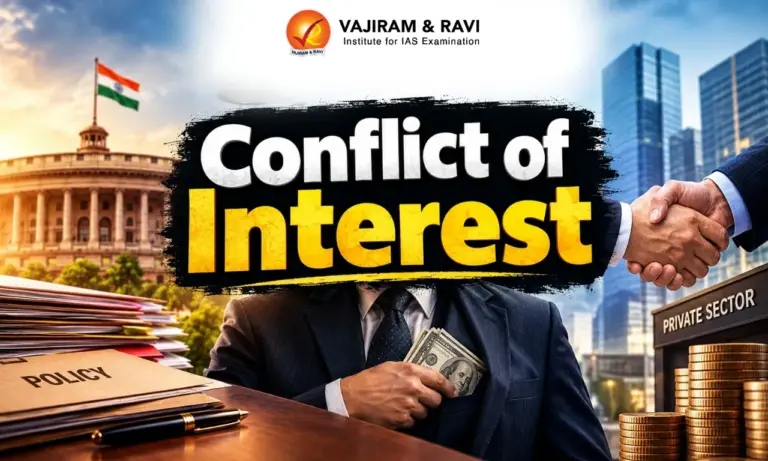
What is Conflict of Interest?
A conflict of interest occurs when a person’s personal interests, financial benefits or relationships interfere with their professional duties and responsibilities. It can affect fair and impartial decision-making in government, business and other organisations. For example, a government officer favouring a relative’s company while awarding a contract creates a conflict of interest.
Types of Conflict of Interest
Conflict of interest can occur in government offices, private companies, research institutions and other professional settings. Its major types include:
- Actual Conflict of Interest: This occurs when a person’s personal interests directly interfere with their current professional responsibilities. For example, an officer participates in selecting a contractor even though the officer has a financial interest in that company.
- Potential Conflict of Interest: This arises when a situation could create a conflict in the future. For example, a government official may be assigned to regulate a company in which the official holds shares.
- Perceived Conflict of Interest: This occurs when a situation appears to involve a conflict, even if there is no evidence that the person’s judgment has actually been influenced. For example, a public official awards a contract to a close friend, creating doubts about the fairness of the decision.
- Financial Conflict of Interest: This arises when financial interests, such as investments, shareholdings or business ownership, may influence professional decisions.
- Personal or Relationship-Based Conflict of Interest: This occurs when family ties, friendships or personal relationships influence official decisions. Giving a relative an unfair advantage in recruitment is one example.
- Professional Conflict of Interest: This occurs when a person’s professional commitments or competing responsibilities affect their ability to act impartially. For example, a consultant advising two competing companies may face conflicting obligations.


Causes of Conflict of Interest
Several factors can lead to a conflict of interest. Common causes include:
- Personal financial benefits: A person may make decisions to gain money, property or other financial advantages.
- Family and personal relationships: Personal connections may influence decisions related to recruitment, contracts or promotions.
- Lack of transparency: Decisions made without proper disclosure or public scrutiny can create opportunities for favouritism.
- Abuse of official position: A person may use their authority to benefit themselves or their associates.
- Political pressure: Officials may face pressure to favour particular individuals, groups or organisations.
- Weak rules and accountability: Inadequate safeguards and poor monitoring can make conflicts difficult to identify and manage.
- Gifts and hospitality: Expensive gifts, favours or benefits may influence a person’s professional judgment or create doubts about their impartiality.
Examples of Conflict of Interest
Conflict of interest can be understood through examples from different fields.
- In Public Administration: A government officer selects a relative’s company for a public project without a fair tendering process.
- In Politics: A public representative supports a policy that provides an undisclosed financial benefit to a business they own.
- In Business: A purchasing manager chooses a supplier because the supplier offers personal benefits rather than because it provides the best value.
- In Healthcare: A doctor recommends a particular product because of undisclosed financial incentives from its manufacturer rather than solely on the basis of the patient’s needs.
- In Research: A researcher fails to disclose financial support from a company whose product is being evaluated.
- In Education: A teacher gives preferential treatment to a student because of a personal relationship with the student’s family.
Conflict of Interest in Public Administration
Conflict of interest is particularly important in public administration because government officials exercise authority and make decisions that affect citizens.
Public servants are expected to act in the public interest, maintain impartiality and use public resources responsibly. When personal interests influence their decisions, public trust in government institutions can decline.
The main concerns associated with conflict of interest in public administration are:
- Nepotism: Giving unfair advantages to relatives or close associates.
- Favouritism: Supporting particular individuals or groups for personal reasons.
- Corruption: Using public office for private gain.
- Misuse of public resources: Directing public money, property or opportunities towards private interests.
- Loss of public trust: Creating doubts about the fairness and integrity of government decisions.
- Weakening of accountability: Making it difficult to determine whether decisions were based on public interest or personal benefit.
Conflict of Interest in India
In India, conflict of interest is an important issue in public administration, corporate governance, politics, healthcare and research. Several laws, service rules and institutional mechanisms help prevent or manage such situations.
1. Central Civil Services (Conduct) Rules, 1964
The Central Civil Services (Conduct) Rules, 1964, prescribe standards of conduct for covered central government employees. They address integrity, devotion to duty, conduct unbecoming of a government servant and restrictions relating to matters such as gifts, private trade and employment.
These rules help ensure that official duties are performed honestly and without improper personal influence.
2. Prevention of Corruption Act, 1988
The Prevention of Corruption Act, 1988, as amended, addresses specified corruption-related offences involving public servants and others. It provides a legal framework for dealing with certain forms of bribery and abuse of public office.
A conflict of interest is not automatically an offence under this Act. Whether criminal liability arises depends on the conduct and the applicable legal provisions.
3. Companies Act, 2013
The Companies Act, 2013, contains provisions relating to directors’ duties, disclosure of interests and related-party transactions.
For example, Section 166 sets out duties of directors, including acting in good faith and avoiding situations in which they may have a direct or indirect interest that conflicts, or possibly conflicts, with the interests of the company. Other provisions address disclosures and specified transactions.
These requirements promote accountability and protect the interests of companies and their stakeholders.
4. Right to Information Act, 2005
The Right to Information Act, 2005, enables citizens to access information held by public authorities, subject to the Act’s exemptions and other provisions.
Greater transparency can help citizens and oversight bodies examine public decisions, identify irregularities and question the use of public resources.
However, access to information alone cannot eliminate every conflict of interest. Effective disclosure, ethical conduct and accountability are also necessary.
5. Lokpal and Lokayuktas
The Lokpal and Lokayuktas Act, 2013, provides for the establishment of the Lokpal at the Union level and a framework for Lokayuktas in states.
These institutions form part of India’s broader anti-corruption framework. Their jurisdiction and powers are governed by the applicable law.
How Can Conflict of Interest Be Prevented?
Conflict of interest cannot always be avoided, but it can be identified and managed through effective safeguards.
- Disclosure of interests: Officials and professionals should declare relevant financial, personal or professional interests according to applicable rules.
- Recusal from decisions: A person with a significant conflict may need to withdraw from the relevant decision-making process.
- Clear ethical guidelines: Organisations should establish rules explaining what constitutes a conflict and how it should be handled.
- Transparent procedures: Recruitment, procurement and other important decisions should follow clear, documented and objective criteria.
- Independent oversight: Audits, ethics committees and supervisory bodies can help identify and address conflicts.
- Restrictions on gifts: Organisations should regulate gifts, hospitality and other benefits that may influence professional judgment.
- Training and awareness: Employees should receive guidance on recognising and reporting conflicts of interest.
- Effective accountability: Violations should be investigated fairly and addressed under the applicable rules.
- Regular review: Financial interests, outside employment and professional relationships should be reviewed when circumstances change.
Significance of Managing Conflict of Interest
Managing conflicts of interest is essential for maintaining ethical standards and ensuring fair decision-making.
Its major benefits include:
- Promotes public trust: Citizens are more likely to trust institutions when decisions are fair and transparent.
- Improves decision-making: Decisions are based on facts, merit and public needs rather than personal benefits.
- Prevents favouritism: Clear safeguards reduce unfair advantages for relatives, friends or business associates.
- Strengthens accountability: Disclosure and documentation make it easier to examine decisions.
- Protects public resources: Fair procedures help prevent the misuse of public funds and opportunities.
- Supports good governance: Ethical decision-making strengthens transparency, impartiality and institutional integrity.
- Protects professional credibility: Organisations and individuals can maintain confidence in their work by managing conflicts responsibly.

 Last updated on Oct, 2026
→ UPSC 2027 Notification will be released on 13 January 2027 at upsconline.nic.in.
→ Check Nobel Prize 2026 Winners List here.
→ Download PIB PRiSM Monthly Magazine 2026 here.
→ Check UPSC Monthly Current Affairs Magazine The Recitals here.
→ Check out the latest UPSC Syllabus here.
→ Download UPSC Model Answers for Mains 2026
→ UPSC Mains Question Paper 2026 is out now for Essay & GS Paper 1, 2, 3 & 4.
→ UPSC Calendar 2027 has been released.
→ Enroll in Vajiram & Ravi’s UPSC Mains Test Series 2027 for structured answer writing practice, expert evaluation, and exam-oriented feedback.
→ Join Vajiram & Ravi’s UPSC Mentorship Program 2027 for personalized guidance, strategy planning, and one-to-one support from experienced mentors.
→ Go through the UPSC Mains Previous Year Papers to enhance your preparation.
→ UPSC has released UPSC Toppers List 2025 with the Civil Services final result on its official website.
→ Also check Best UPSC Coaching in India
Conflict of Interest FAQs
Q1. What is a conflict of interest in simple words?+
Q2. What are the three main types of conflict of interest?+
Q3. Is conflict of interest the same as corruption?+
Q4. What is an example of conflict of interest in public administration?+
Q5. How can conflict of interest be prevented?+
Q6. Why is conflict of interest important in ethics?+
Tags: conflict of interest