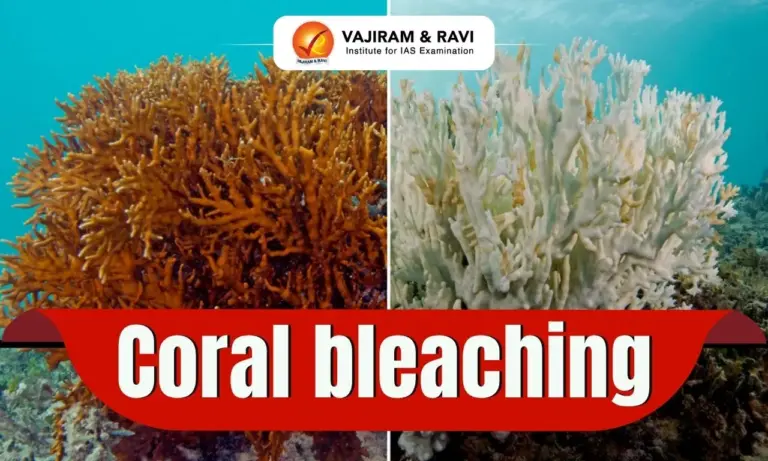
Coral Bleaching Latest News
Recently, the seventh Status of Coral Reefs of the World report by the Global Coral Reef Monitoring Network (GCRMN) said that Coral bleaching events are becoming more frequent and recovery periods have shortened dramatically.
About Coral Bleaching
- It occurs when corals experience stress in their environment due to changes in temperature, pollution or high levels of ocean acidity.
- Process of Coral Bleaching
- Under stressed conditions, the zooxanthellae or food-producing algae living inside coral polyps start producing reactive oxygen species, which are not beneficial to the corals.
- So, the corals expel the colour-giving zooxanthellae from their polyps, which expose their pale white exoskeleton, giving the corals a bleached appearance.
- This also ends the symbiotic relationship that helps the corals to survive and grow.


What Causes Coral Bleaching?
- Change in Ocean Temperature: Increased Ocean temperature caused by climate change is the leading cause of coral bleaching.
- Runoff and Pollution: Storm generated precipitation can rapidly dilute ocean water and runoff can carry pollutants, which can bleach near shore corals.
- Overexposure to sunlight: When temperatures are high, high solar irradiance contributes to bleaching in shallow water corals.
- Extremely low tides: Exposure to the air during extremely low tides can cause bleaching in shallow corals.
What are Corals?
- Corals are marine invertebrates or animals not possessing a spine.
- Each coral is called a polyp and thousands of such polyps live together to form a colony, which grows when polyps multiply to make copies of themselves.
- Corals share a symbiotic relationship with single-celled algae called zooxanthellae.
- The algae provide the coral with food and nutrients, which they make through photosynthesis, using the sun’s light.
- In turn, the corals give the algae a home and key nutrients. The zooxanthellae also give corals their bright colour.
Source: DTE

 Last updated on Oct, 2026
→ UPSC 2027 Notification will be released on 13 January 2027 at upsconline.nic.in.
→ Check Nobel Prize 2026 Winners List here.
→ Download PIB PRiSM Monthly Magazine 2026 here.
→ Check UPSC Monthly Current Affairs Magazine The Recitals here.
→ Check out the latest UPSC Syllabus here.
→ Download UPSC Model Answers for Mains 2026
→ UPSC Mains Question Paper 2026 is out now for Essay & GS Paper 1, 2, 3 & 4.
→ UPSC Calendar 2027 has been released.
→ Enroll in Vajiram & Ravi’s UPSC Mains Test Series 2027 for structured answer writing practice, expert evaluation, and exam-oriented feedback.
→ Join Vajiram & Ravi’s UPSC Mentorship Program 2027 for personalized guidance, strategy planning, and one-to-one support from experienced mentors.
→ Go through the UPSC Mains Previous Year Papers to enhance your preparation.
→ UPSC has released UPSC Toppers List 2025 with the Civil Services final result on its official website.
→ Also check Best UPSC Coaching in India
Coral Bleaching FAQs
Q1. What is Coral Bleaching?+
Q2. What are the major Indian Coral reef regions?+
Tags: coral bleaching prelims pointers upsc current affairs upsc prelims current affairs