Coral Reefs Latest News
Scientists at the University of California San Diego developed SNAP-X, a bio-ink enhancing coral larvae settlement by 20x, offering a breakthrough for reef restoration amid climate threats.
About Coral Reefs
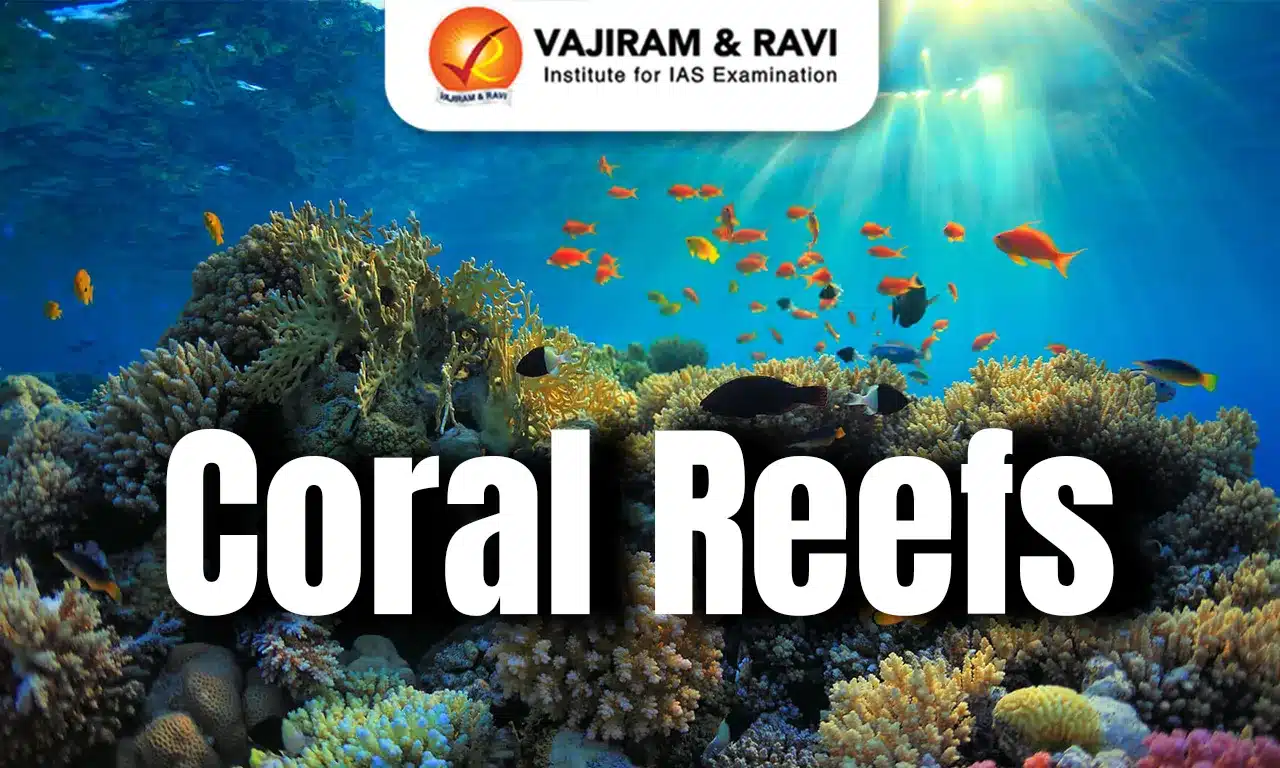
- Coral reefs are marine ecosystems built by groups of coral polyps bound together by calcium carbonate. These vibrant habitats flourish in warm, clear, and shallow waters of tropical regions.
- Notable examples include the Great Barrier Reef and India’s Gulf of Mannar and Lakshadweep.
- Coral reefs offer crucial benefits, such as providing food, shielding coastlines, and supporting local economies through tourism and fishing.
- Types of Coral Reefs:
- Fringing Reefs: Found close to shorelines, separated from land by shallow lagoons. Most common type.
- Barrier Reefs: Located farther offshore, separated from land by deeper, wider lagoons. The Great Barrier Reef in Australia is the largest example.
- Atolls: Ring-shaped reefs that encircle a lagoon, often formed on sinking volcanic islands. Common in the Indian and Pacific Oceans.


Conditions Required for Coral Reef Formation
- Stable, Warm Water: Temperatures typically around 20°C, found in tropical regions between 30°N and 30°S.
- Shallow Depths: Usually up to 55 meters deep, allowing sufficient sunlight for photosynthesis.
- Clear, Low-Nutrient Saltwater: Essential for light penetration and coral health.
- Minimal Pollution: Corals are highly sensitive to chemical and sediment pollution.
- Abundant Plankton: Provides food for coral polyps.
Coral Reefs FAQs
Q1. What are called coral reefs?
Ans. Coral reefs are underwater structures made by colonies of tiny animals called coral polyps held together by calcium carbonate.
Q2. What is coral reef and its importance?
Ans. Coral reefs are diverse underwater ecosystems that protect coastlines, support fisheries, and are vital for marine biodiversity and local economies.
Q3. What are the three types of coral reefs?
Ans. The three main types are fringing reefs, barrier reefs, and atolls.
Source: Eurasia Review

 Last updated on Oct, 2026
→ UPSC 2027 Notification will be released on 13 January 2027 at upsconline.nic.in.
→ Check Nobel Prize 2026 Winners List here.
→ Download PIB PRiSM Monthly Magazine 2026 here.
→ Check UPSC Monthly Current Affairs Magazine The Recitals here.
→ Check out the latest UPSC Syllabus here.
→ Download UPSC Model Answers for Mains 2026
→ UPSC Mains Question Paper 2026 is out now for Essay & GS Paper 1, 2, 3 & 4.
→ UPSC Calendar 2027 has been released.
→ Enroll in Vajiram & Ravi’s UPSC Mains Test Series 2027 for structured answer writing practice, expert evaluation, and exam-oriented feedback.
→ Join Vajiram & Ravi’s UPSC Mentorship Program 2027 for personalized guidance, strategy planning, and one-to-one support from experienced mentors.
→ Go through the UPSC Mains Previous Year Papers to enhance your preparation.
→ UPSC has released UPSC Toppers List 2025 with the Civil Services final result on its official website.
→ Also check Best UPSC Coaching in India
Tags: coral reefs prelims pointers upsc prelims current affairs