Cornea Latest News
The Union Ministry of Health and Family Welfare recently amended the Transplantation of Human Organs and Tissues (Amendment) Rules, 2025, to boost cornea donation and transplant services across the country.
About Cornea
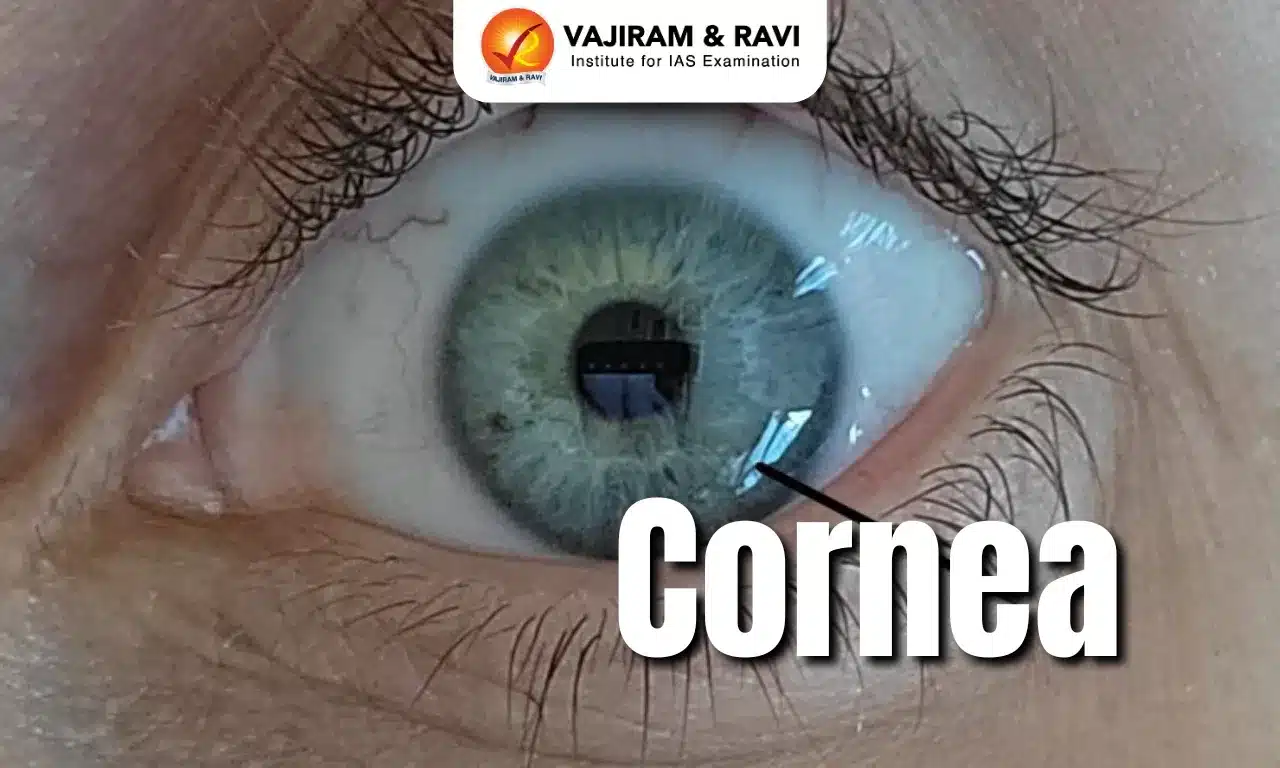
- The cornea is the clear outer layer at the front of the eye.
- It covers the pupil (the opening at the center of the eye), iris (the colored part of the eye), and anterior chamber (the fluid-filled inside of the eye).
- Viewed from the front of the eye, the cornea appears slightly wider than it is tall. This is because the sclera (the “white” of the eye) slightly overlaps the top and bottom of the anterior cornea.
- The cornea’s main function is to refract, or bend light. The cornea is responsible for focusing most of the light that enters the eye.
- As light passes through the cornea, it is partially refracted before reaching the lens.
- The curvature of the cornea, which is spherical in infancy but changes with age, gives it its focusing power.
- The cornea provides approximately 65 to 75 percent of the focusing power of the eye.
- The remainder of the focusing power of the eye is provided by the crystalline lens, located directly behind the pupil.
- Cornea’s specific shape plays a key role in how your eyesight works and filters some ultraviolet (UV) rays.
- Except at its margins, the cornea contains no blood vessels, but it does contain many nerves and is very sensitive to pain or touch.
- Since there are no nutrient-supplying blood vessels in the cornea, tears and the aqueous humor (a watery fluid) in the anterior chamber provide the cornea with nutrients.
- Most refractive errors — nearsightedness, farsightedness, and astigmatism — are due to a less-than-optimal curvature or symmetry of the cornea.
- The cornea is incredibly sensitive, helping you instinctively and immediately react to stop anything from harming your eyes further.
- Because corneas are the first line of defense for the surface of your eye, they’re also prone to injuries and damage.
- The cornea tends to repair itself quickly from minor abrasions.
- However, deeper abrasions may cause scars to form on the cornea, which causes the cornea to lose its transparency, leading to visual impairment.
Source: TH


 Last updated on Oct, 2026
→ UPSC 2027 Notification will be released on 13 January 2027 at upsconline.nic.in.
→ Asian Games 2026 are being held in Aichi-Nagoya, Japan, from 19 September to 4 October.
→ Check Nobel Prize 2026 Winners List here.
→ Download PIB PRiSM Monthly Magazine 2026 here.
→ Check UPSC Monthly Current Affairs Magazine The Recitals here.
→ Check out the latest UPSC Syllabus here.
→ Download UPSC Model Answers for Mains 2026
→ UPSC Mains Question Paper 2026 is out now for Essay & GS Paper 1, 2, 3 & 4.
→ UPSC Calendar 2027 has been released.
→ Enroll in Vajiram & Ravi’s UPSC Mains Test Series 2027 for structured answer writing practice, expert evaluation, and exam-oriented feedback.
→ Join Vajiram & Ravi’s UPSC Mentorship Program 2027 for personalized guidance, strategy planning, and one-to-one support from experienced mentors.
→ Go through the UPSC Mains Previous Year Papers to enhance your preparation.
→ UPSC has released UPSC Toppers List 2025 with the Civil Services final result on its official website.
→ Also check Best UPSC Coaching in India
Cornea FAQs
Q1. What is the cornea?+
Q2. What is the main function of the cornea?+
Q3. How much of the eye’s focusing power does the cornea provide?+
Q4. How does the curvature of the cornea affect vision?+
Tags: cornea prelims current affairs prelims pointers upsc prelims current affairs