Corpse Flower Latest News
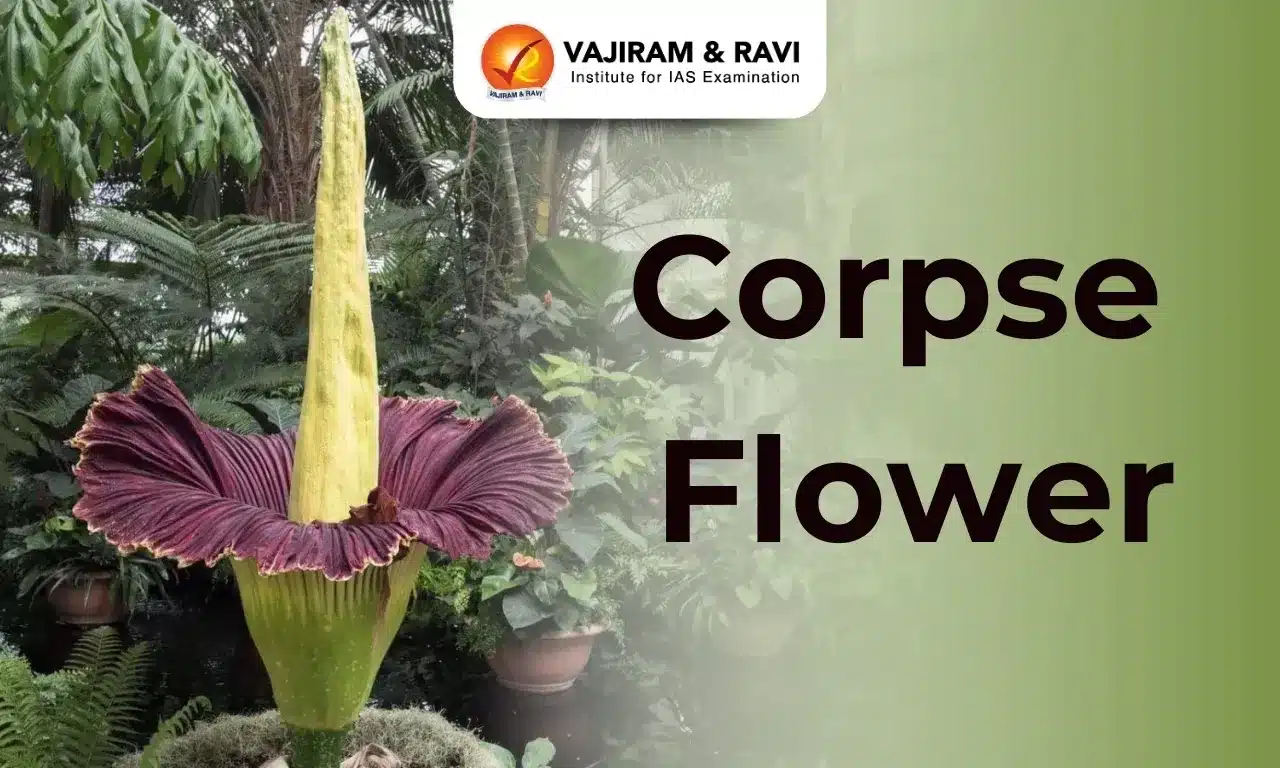
Recently, a “corpse flower” at the Royal Botanic Gardens of Sydney has drawn more than 20,000 curious viewers to a special display for its much-anticipated opening.
About Corpse Flower
- It is native to the Indonesian island of Sumatra, gets its name from the literal translation of the Indonesian phrase Bunga bangkai.
- Its species name is Amorphophallus titanium.


Features of Corpse Flower
- Some corpse flowers have been known to grow 3 meters (about 10 feet) tall before revealing a phallic spadix (or spike).
- Its odor released by the spadix to attract insects is often likened to decaying meat.
- Its blooms are often inconsistent. Many will bloom once a decade, though sometimes even more frequently.
Life Cycle of Corpse Flower
- The life cycle depends on the time it takes for the “corm” of the flower to gather enough energy to bloom.
- When enough energy has been stored through leaf cycles, the flowering stage begins.
- The bloom lasts for a day, with the spathe (the purple, petal-like structure surrounding the spadix) taking hours to fully unfurl.
- Insects attracted to the odor are ones that lay their eggs in decaying meat, but they have the benefit of moving pollen between male and female flowers to trigger the flower’s reproductive cycle.
- These flowers have both male and female flowers. Female flowers open first to prevent a plant from pollinating itself. Nearby flowers are required to bloom at similar times in order for cross-pollination to be possible.
- Chemicals emitted during female flowering are: Dimethyl disulfide, Dimethyl trisulfide, 3-Methylbutanal, Dimethyl sulfide and Methanethiol, Methyl thioacetate and Isovaleric acid.
- It is categorized as Endangered by the IUCN.
Corpse Flower FAQs
Q1: Why is it called a corpse flower?
Ans: It is commonly called the corpse flower because its scent is reminiscent of rotting flesh,
Q2: Where is the corpse flower originally found?
Ans: It is native to the rainforests of western Sumatra, Indonesia
Q3: Is the corpse flower found in India?
Ans: No.
Source: WE

 Last updated on Oct, 2026
→ UPSC 2027 Notification will be released on 13 January 2027 at upsconline.nic.in.
→ Check Nobel Prize 2026 Winners List here.
→ Download PIB PRiSM Monthly Magazine 2026 here.
→ Check UPSC Monthly Current Affairs Magazine The Recitals here.
→ Check out the latest UPSC Syllabus here.
→ Download UPSC Model Answers for Mains 2026
→ UPSC Mains Question Paper 2026 is out now for Essay & GS Paper 1, 2, 3 & 4.
→ UPSC Calendar 2027 has been released.
→ Enroll in Vajiram & Ravi’s UPSC Mains Test Series 2027 for structured answer writing practice, expert evaluation, and exam-oriented feedback.
→ Join Vajiram & Ravi’s UPSC Mentorship Program 2027 for personalized guidance, strategy planning, and one-to-one support from experienced mentors.
→ Go through the UPSC Mains Previous Year Papers to enhance your preparation.
→ UPSC has released UPSC Toppers List 2025 with the Civil Services final result on its official website.
→ Also check Best UPSC Coaching in India