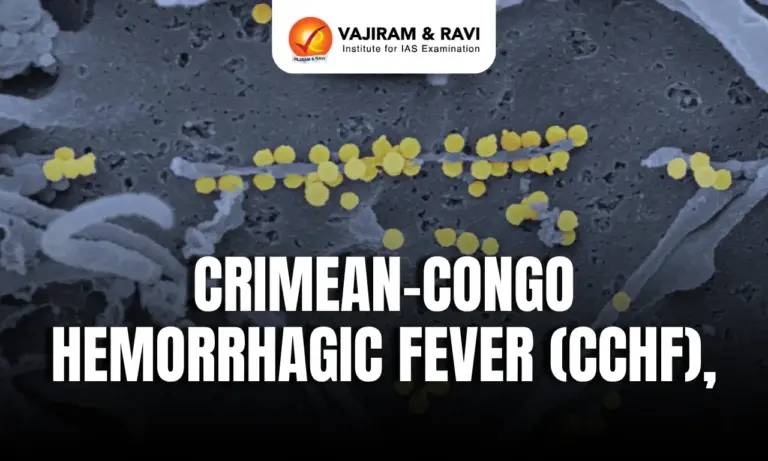
Crimean-Congo Hemorrhagic Fever Latest News
Scientists recently identified multiple targets for antibodies—proteins that protect us when an unwanted substance enters our body—that could one day help treat Crimean-Congo hemorrhagic fever (CCHF).
About Crimean-Congo Hemorrhagic Fever
- It is an important zoonotic disease caused by a tick-borne virus (Nairovirus) belonging to the family Bunyaviridae.
- The CCHF virus causes severe viral haemorrhagic fever outbreaks, with a case fatality rate of 10–40%.


Crimean-Congo Hemorrhagic Fever Distribution
- The disease was first characterized in 1944 in the Crimea.
- In 1969, the same pathogen was identified as the cause of a similar disease in the Democratic Republic of the Congo, leading to the combined name used today.
- CCHF commonly spreads in (is endemic to) Africa, Asia, the Middle East, and parts of Europe.
- Its distribution closely mirrors that of Hyalomma ticks, the primary vectors responsible for transmitting the virus.
Crimean-Congo Hemorrhagic Fever Transmission
- It is transmitted by bites from infected ticks or by direct contact with blood or tissues of infected ticks, people, and livestock.
- The ticks can also be hosted by migratory birds.
- People working in livestock industries, slaughterhouses, and veterinary services are considered among the highest-risk groups for infection.
Crimean-Congo Hemorrhagic Fever Symptoms
- Symptoms start one to 13 days after infection. Common symptoms include:
- High fever
- Muscle, back, or belly pain
- Headache, often severe
- Nausea and vomiting
- Diarrhea
- Pink eye (conjunctivitis)
- Low blood pressure (hypotension)
- Flushing
- Yellow skin or eyes (jaundice)
- Nosebleeds or bleeding gums
- Mood changes
- Confusion
- Sensitivity to light (photophobia)
- Three to five days after the initial symptoms start, you might also have heavier or more widespread bleeding and large bruises.
- Some people are infected but don’t have any symptoms.
Crimean-Congo Hemorrhagic Fever Treatment
- There is no specific treatment or cure for CCHF.
- Supportive care includes fluid balance, giving oxygen, managing blood pressure, and treating other infections.
- An antiviral called Ribavirin has shown some benefits in treating CCHF patients.
News: MEDX

 Last updated on Oct, 2026
→ UPSC 2027 Notification will be released on 13 January 2027 at upsconline.nic.in.
→ Asian Games 2026 are being held in Aichi-Nagoya, Japan, from 19 September to 4 October.
→ Check Nobel Prize 2026 Winners List here.
→ Download PIB PRiSM Monthly Magazine 2026 here.
→ Check UPSC Monthly Current Affairs Magazine The Recitals here.
→ Check out the latest UPSC Syllabus here.
→ Download UPSC Model Answers for Mains 2026
→ UPSC Mains Question Paper 2026 is out now for Essay & GS Paper 1, 2, 3 & 4.
→ UPSC Calendar 2027 has been released.
→ Enroll in Vajiram & Ravi’s UPSC Mains Test Series 2027 for structured answer writing practice, expert evaluation, and exam-oriented feedback.
→ Join Vajiram & Ravi’s UPSC Mentorship Program 2027 for personalized guidance, strategy planning, and one-to-one support from experienced mentors.
→ Go through the UPSC Mains Previous Year Papers to enhance your preparation.
→ UPSC has released UPSC Toppers List 2025 with the Civil Services final result on its official website.
→ Also check Best UPSC Coaching in India
Crimean-Congo Hemorrhagic Fever FAQ's
Q1. What is Crimean-Congo Hemorrhagic Fever (CCHF)?+
Q2. What is the case fatality rate of Crimean-Congo Hemorrhagic Fever (CCHF)?+
Q3. How is Crimean-Congo Hemorrhagic Fever (CCHF) primarily transmitted to humans?+
Q4. Is there a specific cure for Crimean-Congo Hemorrhagic Fever (CCHF)?+
Tags: Crimean-Congo Hemorrhagic Fever