Critical Mineral Stockpiling Latest News
- The Ministry of Mines is planning to finalise a new policy on critical mineral stockpiling within a month to reduce import dependence and protect India against global supply chain disruptions.
About Critical Minerals
- Critical minerals are raw materials that are essential for economic development, technological advancement and national security, but whose supply may be vulnerable to geopolitical tensions, concentration of production or supply chain disruptions.
- Important critical minerals include:
- Lithium and cobalt: Used in rechargeable batteries and electric vehicles.
- Nickel: Important for battery manufacturing and industrial applications.
- Copper: Essential for electricity networks, power infrastructure and renewable energy systems.
- Rare earth elements: Used in wind turbines, advanced electronics and other strategic technologies.
- These minerals are increasingly important for the clean energy transition, electric mobility and the expansion of modern industrial infrastructure.


Need For Critical Mineral Stockpile
- A strategic stockpile is a reserve of essential materials maintained to ensure their availability during emergencies or periods of supply disruption.
- India faces several vulnerabilities in securing critical minerals:
- High import dependence
- India has limited processing capacity and is entirely dependent on imports for most critical minerals, according to the report. This exposes domestic industries to international price fluctuations and supply disruptions.
- Concentration of processing capacity
- China controls approximately 90% of global critical mineral processing capacity. Such concentration creates strategic risks because disruptions or restrictions affecting a dominant supplier can have consequences for industries worldwide.
- Geopolitical and trade risks
- Critical minerals can become instruments of economic leverage during trade tensions. Export restrictions or other supply interruptions could affect battery manufacturing, electric vehicles and renewable energy infrastructure.
- Challenges in overseas acquisitions
- India has attempted to secure mineral assets abroad through Khanij Bidesh India Ltd (KABIL). However, proposed investments in mineral extraction projects in countries such as Australia, Vietnam, Mali and Chile have faced delays or setbacks.
- Progress has been reported in Argentina, where KABIL has acquired five lithium brine blocks in Catamarca province.
- A domestic stockpile could provide a buffer against these vulnerabilities while longer-term efforts to diversify mineral supplies and develop domestic processing capacity continue.
About National Critical Minerals Mission (NCMM)
- The NCMM is a government initiative aimed at strengthening India’s critical mineral supply chains and improving the availability of minerals required for domestic industries.
- The mission proposes the development of a National Critical Mineral Stockpile Programme.
- Key features include:
- Financial allocation: ₹500 crore has been earmarked for the stockpiling initiative over the mission period of seven years, from 2024-25 to 2030-31.
- Minimum mineral coverage: The proposed national stockpile will include at least five critical minerals.
- Institutional participation: A joint initiative involving Central Public Sector Undertakings (CPSUs) and private companies is proposed to establish and operate the stockpiling programme.
- Primary objective: To mitigate global supply chain risks and ensure the availability of essential minerals for domestic use during emergencies.
- The proposed policy is expected to establish a more structured approach to building and maintaining these strategic reserves.
Boosting Domestic Critical Mineral Processing
- Stockpiling can provide short-term protection, but long-term supply security also requires domestic processing capabilities and technological self-reliance.
- The government has identified four states for promoting critical mineral processing plants.
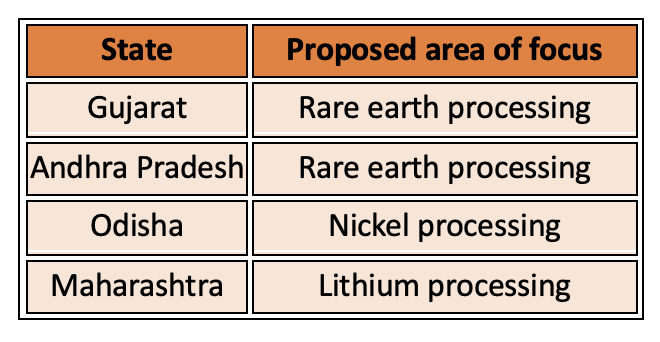
- The government intends to develop each processing park as a complete ecosystem for a particular mineral.
- Such an approach could support the development of specialised industrial infrastructure, supply chains and related manufacturing activities.
- Indigenous technology development
- Access to processing technology remains a major challenge because countries with established capabilities may be reluctant to share their technological expertise.
- The Ministry of Mines has therefore emphasised developing indigenous processing technologies or acquiring them wherever available. Nine Centres of Excellence have been identified for this purpose, with some reportedly making substantial progress.
- The government has also been considering a separate scheme to promote lithium and nickel processing, both of which are important for the battery manufacturing ecosystem.
Challenges and the Way Forward
- India’s critical mineral strategy must address several interconnected challenges.
- Limited processing capacity: Establishing processing facilities requires specialised technology, infrastructure and skilled personnel.
- Overseas project delays: Diversifying mineral supplies through foreign acquisitions requires sustained investment and effective project execution.
- Implementation of stockpiles: The government must determine appropriate reserve levels, storage arrangements, replenishment mechanisms and procedures for releasing minerals during emergencies.
- Private-sector participation: Clear institutional responsibilities and commercially viable arrangements will be necessary to sustain collaboration between public and private entities.
- Supply diversification: India should pursue multiple international supply sources while developing domestic exploration, extraction and processing capabilities.
- A balanced strategy combining strategic reserves, international partnerships, technological development and domestic industrial capacity can reduce vulnerability to external shocks.
Source: IE

 Last updated on Oct, 2026
→ UPSC 2027 Notification will be released on 13 January 2027 at upsconline.nic.in.
→ Check Nobel Prize 2026 Winners List here.
→ Download PIB PRiSM Monthly Magazine 2026 here.
→ Check UPSC Monthly Current Affairs Magazine The Recitals here.
→ Check out the latest UPSC Syllabus here.
→ Download UPSC Model Answers for Mains 2026
→ UPSC Mains Question Paper 2026 is out now for Essay & GS Paper 1, 2, 3 & 4.
→ UPSC Calendar 2027 has been released.
→ Enroll in Vajiram & Ravi’s UPSC Mains Test Series 2027 for structured answer writing practice, expert evaluation, and exam-oriented feedback.
→ Join Vajiram & Ravi’s UPSC Mentorship Program 2027 for personalized guidance, strategy planning, and one-to-one support from experienced mentors.
→ Go through the UPSC Mains Previous Year Papers to enhance your preparation.
→ UPSC has released UPSC Toppers List 2025 with the Civil Services final result on its official website.
→ Also check Best UPSC Coaching in India
Critical Mineral Stockpiling FAQs
Q1. What is a critical mineral stockpile?+
Q2. Why is India vulnerable to critical mineral supply disruptions?+
Q3. What is the National Critical Minerals Mission?+
Q4. Which four states have been identified for critical mineral processing plants?+
Q5. Why is indigenous critical mineral processing technology important?+
Tags: critical mineral stockpiling mains articles upsc current affairs upsc mains current affairs