About Critical Minerals Summit:
- It is organised by the Ministry of Mines, Government of India, in collaboration with the Shakti Sustainable Energy Foundation (Shakti), the Council on Energy, Environment and Water (CEEW), and the Indian Institute of Sustainable Development (IISD).
- It is designed to foster collaboration, share knowledge, and drive innovation in the field of critical mineral beneficiation and processing.
- The summit will bring together a diverse array of Indian and international stakeholders, including industry leaders, startups, government officials, scientists, academics, and policy experts.
- It will address the increasing demand for Critical Raw Materials (CRMs) required for renewable energy systems and electric vehicles as part of India’s strategic development goals.
- The Ministry of Mines has identified eight key mineralsfor focus at the summit, including Glauconite (Potash), Lithium – Rare Earth Elements (Laterite), Chromium, Platinum Group, Graphite, Tungsten associated with Graphite, Rare Earths(RE), and Vanadium associated with Graphite.
- Participants will engage in active dialogue and interactive workshops focused on critical issues such as mineral auction progress, policy incentives for CRMs ecosystem development, and the advancement of commercially viable and environmentally sustainable solutions.
Key Facts about Critical Minerals:
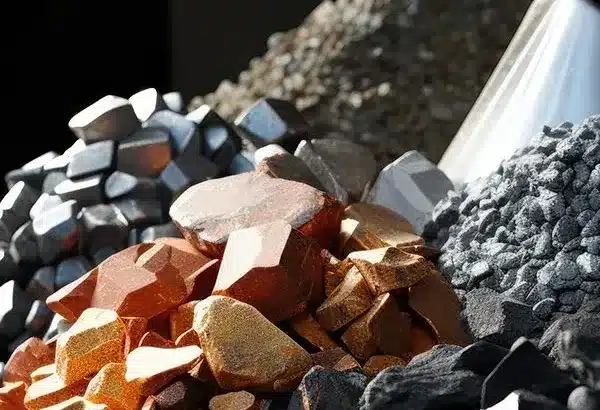
- It is a metallic or non-metallic element that has two characteristics.
- It is essential for the functioning of our modern technologies, economies or national security and
- There is a risk that its supply chains could be disrupted.
- The ‘criticality’ of minerals changes with time as supply and society’s needs shift.
- Applications:
- They are used to manufacture advanced technologies, including mobile phones, computers, fibre-optic cables, semiconductors, banknotes, and defence, aerospace and medical applications.
- Many are used in low-emission technologies, such as electric vehicles, wind turbines, solar panels, and rechargeable batteries.
- Some are also crucial for common products, such as stainless steel and electronics.
- Examples: antimony, beryllium, bismuth, cobalt, copper, gallium, germanium, lithium, vanadium, etc.
- Top Producers: Chile, Indonesia, Congo, China, Australia, and South Africa.
- Critical Minerals in India:
- Government has released a list of 30 critical minerals for India.
- These minerals are Antimony, Beryllium, Bismuth, Cobalt, Copper, Gallium, Germanium, Graphite, Hafnium, Indium, Lithium, Molybdenum, Niobium, Nickel, PGE, Phosphorous, Potash, REE, Rhenium, Silicon, Strontium, Tantalum, Tellurium, Tin, Titanium, Tungsten, Vanadium, Zirconium, Selenium, and Cadmium.
Q1: What are Rare Earth Elements (REE)?
REE are a set of seventeen elements in the periodic table. These include the fifteen lanthanides on the periodic table plus scandium and yttrium. REE are all metals, and the group is often referred to as the “rare earth metals. Although called “rare”, they are actually found relatively abundantly in the Earth’s crust. These metals are very difficult to mine because it is unusual to find them in concentrations high enough for economical extraction.These metals have many similar properties, and that often causes them to be found together in geologic deposits.They are also referred to as “rare earth oxides” because many of them are typically sold as oxide compounds.
Source: Mines Ministry to Hold Two-day Critical Minerals Summit from Tomorrow


 Last updated on Oct, 2026
→ UPSC 2027 Notification will be released on 13 January 2027 at upsconline.nic.in.
→ Asian Games 2026 are being held in Aichi-Nagoya, Japan, from 19 September to 4 October.
→ Check Nobel Prize 2026 Winners List here.
→ Download PIB PRiSM Monthly Magazine 2026 here.
→ Check UPSC Monthly Current Affairs Magazine The Recitals here.
→ Check out the latest UPSC Syllabus here.
→ Download UPSC Model Answers for Mains 2026
→ UPSC Mains Question Paper 2026 is out now for Essay & GS Paper 1, 2, 3 & 4.
→ UPSC Calendar 2027 has been released.
→ Enroll in Vajiram & Ravi’s UPSC Mains Test Series 2027 for structured answer writing practice, expert evaluation, and exam-oriented feedback.
→ Join Vajiram & Ravi’s UPSC Mentorship Program 2027 for personalized guidance, strategy planning, and one-to-one support from experienced mentors.
→ Go through the UPSC Mains Previous Year Papers to enhance your preparation.
→ UPSC has released UPSC Toppers List 2025 with the Civil Services final result on its official website.
→ Also check Best UPSC Coaching in India