About Criticality in a Nuclear Reactor:
- Nuclear reactors use uranium fuel rods—long, slender, zirconium metal tubes containing pellets of fissionable material to create energy through fission.
- Fission is the process of splitting the nuclei of uranium atoms to release neutrons that in turn split more atoms, releasing more neutrons.
- Fission produces a great deal of energy in the form of very high heat and radiation.
- That’s why reactors are housed in structures sealed under thick metal-reinforced concrete domes.
- Power plants harness this energy and heat to produce steam to drive generators that produce electricity.
- Criticalitymeans that a reactor is controlling a sustained fission chain reaction, where each fission event releases a sufficient number of neutrons to maintain an ongoing series of reactions.
- This is the normal state of nuclear power generation.
- Fuel rods inside a nuclear reactor are producing and losing a constant number ofneutrons, and the nuclear energy system is stable.
- Nuclear power technicians have procedures in place, some of them automated, in case a situation arises in which more or fewer neutrons are produced and lost.
- Controlling Criticality:
- When a reactor is starting up, the number of neutrons is increased slowly in a controlled manner.
- Neutron-absorbing control rods in the reactor core are used to calibrate neutron production.
- The control rods are made from neutron-absorbing elements such as cadmium, boron, or hafnium.
- The deeper the rods are lowered into the reactor core, the more neutrons the rods absorb and the less fission occurs.
- Technicians pull up or lower down the control rods into the reactor core depending on whether more or less fission, neutron production, and power are desired.
- Should a malfunction occur, technicians can remotely plunge control rods into the reactor core to quickly soak up neutrons and shut down the nuclear reaction.
What Is Supercriticality?
- At start-up, the nuclear reactor is briefly put into a state that produces more neutrons than are lost.
- This condition is called the supercritical state, which allows the neutron population to increase and more power to be produced.
- When the desired power production is reached, adjustments are made to place the reactor into the critical state that sustains neutron balance and power production
Q1: What are neutrons?
Neutrons, along with protons, are subatomic particles found inside the nucleus of every atom. The only exception is hydrogen, where the nucleus contains only a single proton. Neutrons have a neutral electric charge (neither negative nor positive) and have slightly more mass than positively charged protons.
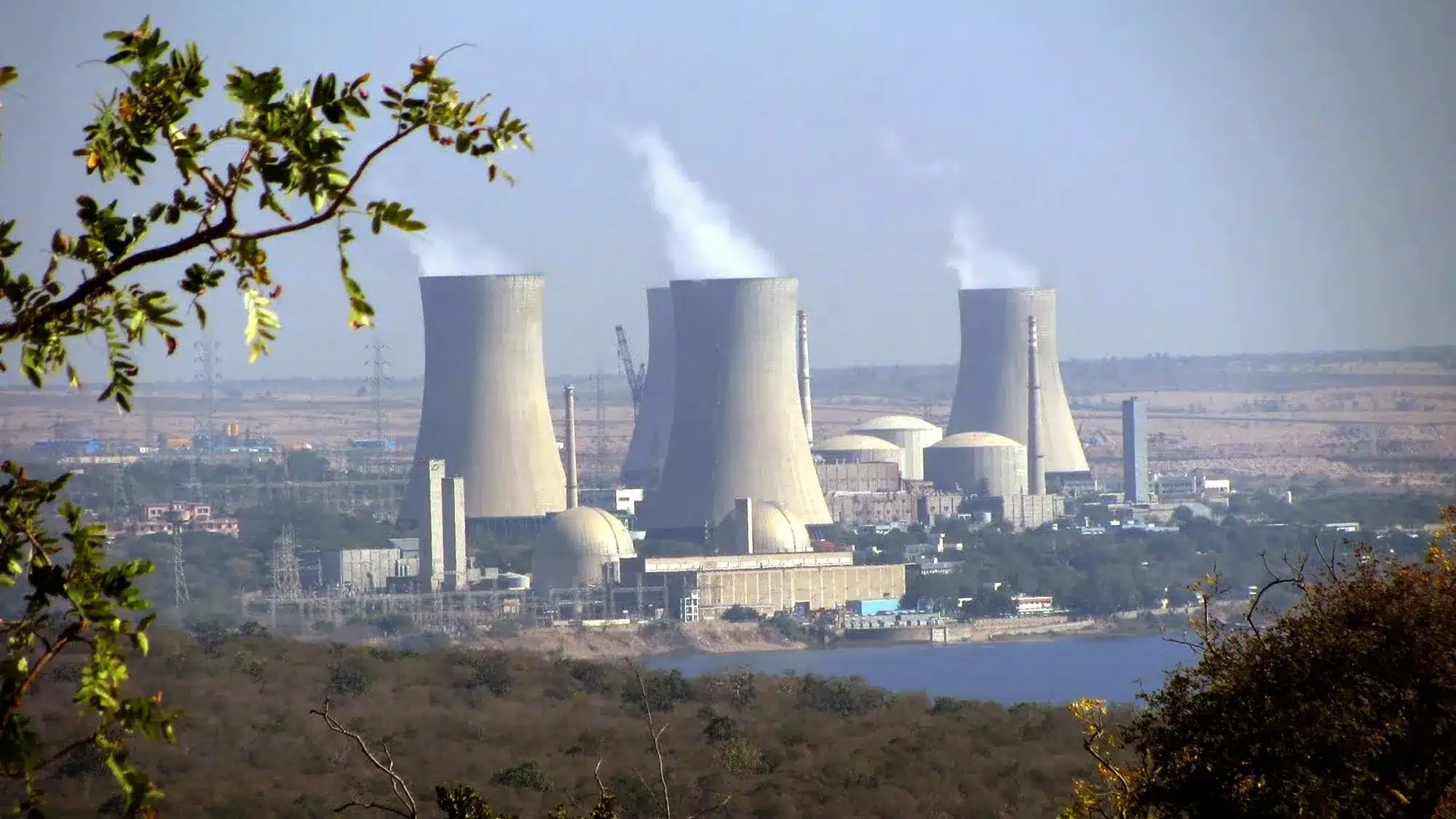
Source: India’s third home-built 700 MWe nuclear reactor achieves criticality


 Last updated on Oct, 2026
→ UPSC 2027 Notification will be released on 13 January 2027 at upsconline.nic.in.
→ Check Nobel Prize 2026 Winners List here.
→ Download PIB PRiSM Monthly Magazine 2026 here.
→ Check UPSC Monthly Current Affairs Magazine The Recitals here.
→ Check out the latest UPSC Syllabus here.
→ Download UPSC Model Answers for Mains 2026
→ UPSC Mains Question Paper 2026 is out now for Essay & GS Paper 1, 2, 3 & 4.
→ UPSC Calendar 2027 has been released.
→ Enroll in Vajiram & Ravi’s UPSC Mains Test Series 2027 for structured answer writing practice, expert evaluation, and exam-oriented feedback.
→ Join Vajiram & Ravi’s UPSC Mentorship Program 2027 for personalized guidance, strategy planning, and one-to-one support from experienced mentors.
→ Go through the UPSC Mains Previous Year Papers to enhance your preparation.
→ UPSC has released UPSC Toppers List 2025 with the Civil Services final result on its official website.
→ Also check Best UPSC Coaching in India