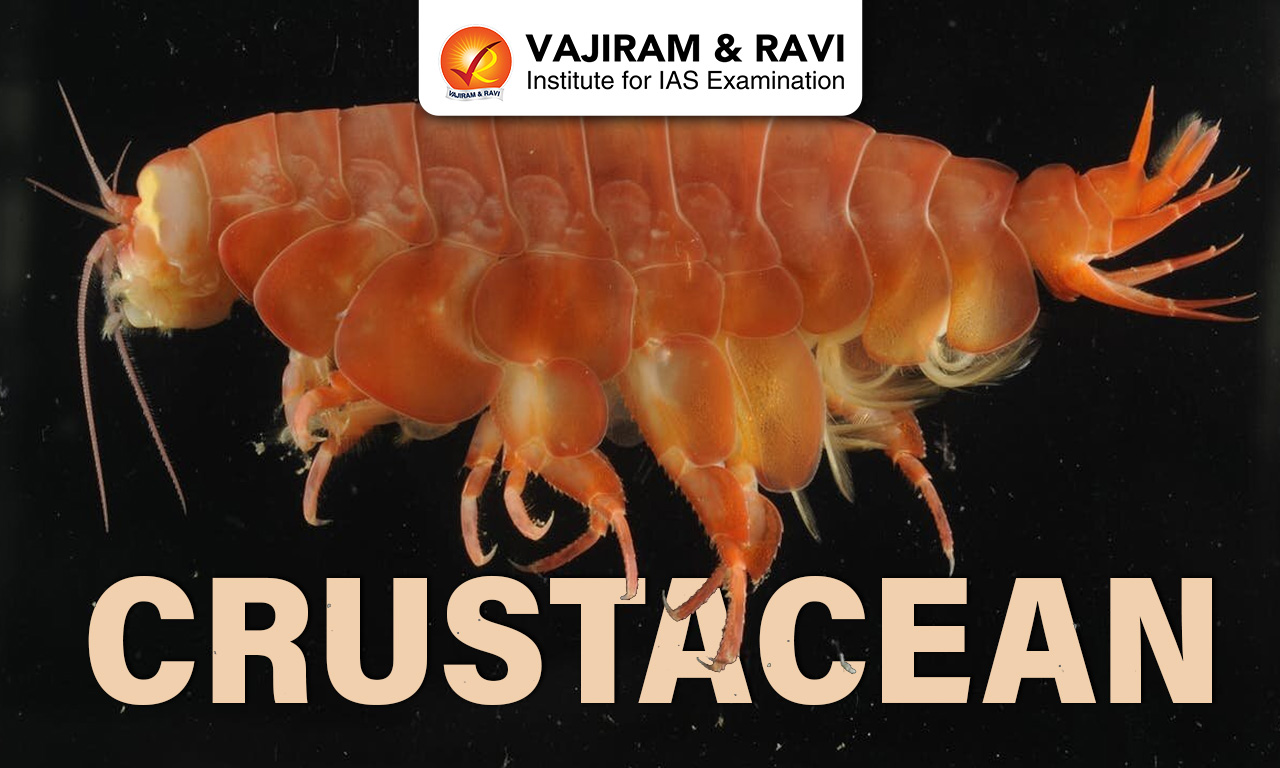
Crustaceans are a highly diverse group of invertebrate animals under the subphylum Crustacea of phylum Arthropoda, comprising nearly 45,000 species worldwide. They include crabs, lobsters, shrimps, barnacles and copepods. They are found mainly in freshwater and some terrestrial habitats. The species is characterised by a hard exoskeleton, segmented body and jointed appendages.
Crustacean Characteristics
Crustaceans display remarkable diversity in morphology, habitat and behaviour, making them one of the most complex arthropod groups across aquatic ecosystems globally.
- Body Structure: Crustaceans possess a segmented body divided into head, thorax and abdomen, often forming a cephalothorax covered by a carapace. They have two pairs of antennae and biramous limbs adapted for feeding, locomotion and sensory functions.
- Exoskeleton and Growth: Like other arthropods, they have a chitinous exoskeleton which is periodically shed through moulting.
- Habitat Diversity: Most species are aquatic, living in freshwater, marine and deep sea environments up to 10,000 metres. Some species like woodlice are terrestrial, while others inhabit extreme environments such as high altitude lakes and brine pools.
- Feeding: Many Crustaceans are bottom feeders, scavengers, or filter feeders consuming plankton and algae.
- Ecological Role: They maintain ecosystem balance by recycling nutrients and serving as prey for fish, whales and seabirds.
- Sensory and Behaviour: They possess advanced sensory organs like antennae for detecting environmental changes. Certain species exhibit social behaviour, including dominance hierarchies, courtship displays and chemical communication.
- Reproduction and Larva: Crustaceans show varied reproductive strategies including sexual reproduction, hermaphroditism and parthenogenesis. Their life cycle often includes a nauplius larval stage, unique among arthropods.
Discovery of New Crustacean Species
Recent researches has identified several new Crustaceans Species as highlighted below:
- Uranoscopicolaidae: A newly discovered crustacean family from India, parasitic on Uranoscopus guttatus at 300-550 m depth, led to identification of Hirodai ohtsukai.
- Parhyale Odian: A new amphipod species discovered in Chilika Lake, about 8 mm long with 13 pairs of legs, identified by unique stout seta feature and named after Odia language.
- Kasargodia: A newly identified freshwater crab genus from Kerala’s Western Ghats, including Kasargodia sheebae, found in isolated streams, showing nearly 70% endemism.
- Water flea: A new species Bryospilus (Indobryospilus) bharaticus discovered in moss near Korigad Fort, marking first record in Tropical Asia, adapted to semi terrestrial habitats and linked to ancient Gondwanan evolutionary history.
- Indiaphonte bijoyi: A microscopic copepod discovered in Kavaratti lagoon, Lakshadweep, recognised as a new genus due to unique traits, contributing to marine biodiversity and playing a key role in nutrient cycling and aquatic food webs.


Crustacean Significance
Crustaceans hold immense ecological and economic importance, contributing to marine food webs, fisheries and environmental balance across global aquatic ecosystems.
- Ecological Role: They form a key component of aquatic food chains, especially planktonic copepods and krill, which support fish, seabirds and whales, maintaining ocean productivity.
- Economic Value: Many species like crabs, prawns and lobsters are commercially important, forming the backbone of global fisheries and coastal economies.
- Environmental Indicators: Certain Crustaceans such as ostracods and plankton species are used in geological and ecological studies, helping in oil exploration and climate analysis.
- Aquaculture Utility: Species like Artemia salina and Daphnia magna are widely used as feed in aquaculture, supporting fish farming and sustainable food production systems.

 Last updated on Oct, 2026
→ UPSC 2027 Notification will be released on 13 January 2027 at upsconline.nic.in.
→ Check Nobel Prize 2026 Winners List here.
→ Download PIB PRiSM Monthly Magazine 2026 here.
→ Check UPSC Monthly Current Affairs Magazine The Recitals here.
→ Check out the latest UPSC Syllabus here.
→ Download UPSC Model Answers for Mains 2026
→ UPSC Mains Question Paper 2026 is out now for Essay & GS Paper 1, 2, 3 & 4.
→ UPSC Calendar 2027 has been released.
→ Enroll in Vajiram & Ravi’s UPSC Mains Test Series 2027 for structured answer writing practice, expert evaluation, and exam-oriented feedback.
→ Join Vajiram & Ravi’s UPSC Mentorship Program 2027 for personalized guidance, strategy planning, and one-to-one support from experienced mentors.
→ Go through the UPSC Mains Previous Year Papers to enhance your preparation.
→ UPSC has released UPSC Toppers List 2025 with the Civil Services final result on its official website.
→ Also check Best UPSC Coaching in India
Crustacean FAQs
Q1. What are Crustaceans?+
Q2. What is unique about Crustacean limbs?+
Q3. Where are Crustaceans found?+
Q4. Why are Crustaceans important?+
Q5. Are all Crustaceans aquatic?+
Tags: biology crustacean zoology