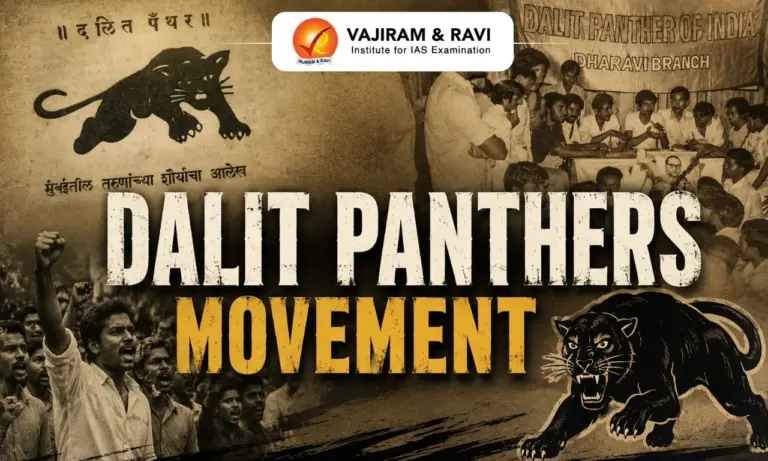
The Dalit Panthers Movement emerged in Maharashtra as a powerful expression of Dalit assertion against caste violence, social discrimination and the failure of existing political institutions to secure substantive equality.
About the Dalit Panthers Movement
The Dalit Panthers Movement was founded in Bombay by young Ambedkarite writers and activists, particularly Namdeo Dhasal, J.V. Pawar and Raja Dhale, who sought a more assertive response to continuing caste oppression.
- The movement emerged in 1972, although accounts differ on the exact founding date, with 29 May associated with the decision to establish the organisation and 9 July with its wider public emergence.
- Its ideological roots lay in Ambedkarism, particularly the principles of annihilation of caste, equality, dignity and social justice.
- The name “Dalit Panthers” was inspired by the Black Panther Party in the United States, which stood for self-respect, unity and resistance against oppression; the Dalit Panthers adopted the name to express similar resistance against caste-based oppression in India.
- Its manifesto gave “Dalit” a broad political meaning, bringing SCs, STs, Neo-Buddhists, workers, landless peasants, women and other exploited groups within its vision of collective liberation.
The movement thus represented a generational shift in Dalit politics, as young activists sought to move beyond fragmented political leadership and confront caste oppression more directly.
Reasons for the Emergence of the Dalit Panthers Movement
The Dalit Panthers Movement emerged in Maharashtra in 1972 because Dalit communities continued to face discrimination and violence despite the constitutional promise of equality.
- Article 17 had abolished untouchability, but Dalits continued to face social boycotts, physical violence, humiliation, landlessness and exclusion from public places.
- Incidents in Bawda and Brahmangaon, along with other cases of violence against Dalits, showed that dominant-caste control remained strong in many parts of Maharashtra.
- After B.R. Ambedkar’s death in 1956, the Republican Party of India split into different factions, weakening its ability to provide united leadership and respond effectively to caste atrocities.
- Many educated Dalit-Buddhist youth in Bombay had grown up with Ambedkar’s ideas of equality, dignity and annihilation of caste. They were dissatisfied with established political organisations and wanted a more direct response to caste oppression.
- Writers and poets began using literature to express experiences of caste discrimination, poverty and humiliation. This growing Dalit literary movement provided an important cultural base for the Panthers.
These developments created the conditions for the Dalit Panthers Movement, which brought together Ambedkarite ideas, Dalit assertion and a more militant approach to fighting caste oppression.


Dalit Panthers Movement Methods and Activities
The Dalit Panthers Movement used political protest, social mobilisation and literature to challenge caste oppression and bring the problems faced by Dalits into public debate.
- Direct action against caste atrocities: The Panthers organised protests and visited places where Dalits faced violence, social boycott or other forms of discrimination.
- Street protests and demonstrations: They organised rallies, marches and public meetings to demand justice and put pressure on the government to act against caste violence.
- Election boycotts: The movement sometimes called for boycotting elections to protest against established political parties and their failure to address Dalit concerns.
- Grassroots mobilisation: The Panthers established local organisational units called chavanies across Maharashtra to mobilise Dalit communities.
- Use of literature as a tool of protest: Leaders such as Namdeo Dhasal and J.V. Pawar used poetry, essays and magazines to highlight caste discrimination and the everyday experiences of Dalits.
- Promotion of Dalit literature: The movement gave strong support to Dalit Sahitya, which brought the experiences of poverty, humiliation, violence and social exclusion into Marathi literature.
- Participation in the Namantar Andolan: The Panthers supported the demand to rename Marathwada University after B.R. Ambedkar, linking recognition of Ambedkar with the larger struggle for Dalit dignity.
Through these methods, the Dalit Panthers Movement combined street-level activism with cultural assertion, making caste discrimination a visible political and social issue in Maharashtra.
The most important outcome of the movement was therefore the creation of a new political and cultural vocabulary of Dalit assertion, even though the organisation itself did not survive for long.
Dalit Panthers Movement Decline
The Dalit Panthers Movement began to weaken from the mid-1970s as internal ideological differences, leadership conflicts and difficulties in sustaining a wider organisation reduced its unity.
- The Worli riots of 1974 became a major turning point. A Dalit Panthers rally in Worli, Bombay, held in the context of rising caste tensions, was attacked, leading to clashes involving Panthers activists, local groups and the police. The violence exposed the hostility faced by Dalit activists and the Panthers’ growing confrontation with established political and social forces.
- The riots also deepened differences within the movement. Namdeo Dhasal increasingly favoured a stronger Marxist orientation, while Raja Dhale emphasised Ambedkarite and Buddhist ideas. Their differences over the movement’s ideological direction became sharper after the Worli episode and eventually contributed to a major split in 1974.
- Leadership conflicts weakened organisational unity. Differences among senior leaders and personality-based rivalries made it difficult for the Panthers to maintain a coordinated organisation across Maharashtra.
- The movement struggled to expand its social base. Although it attracted strong support among urban Mahar and Neo-Buddhist youth, particularly in Bombay, its influence remained comparatively limited among rural Dalits and other Dalit communities.
- State pressure further restricted mobilisation. Arrests, police action and political pressure made it difficult for the Panthers to sustain the intense street-level activism through which they had built their influence.
By 1977, the organisation had lost much of its earlier unity and organisational strength. Raja Dhale dissolved the central organisation, but several leaders and activists rejected the decision and continued the struggle through the Bharatiya Dalit Panther. Thus, the decline of the original organisation did not end Dalit Panther politics; rather, its organisational form weakened while its ideas continued to influence Dalit literature, anti-caste politics and later movements for social justice.
Dalit Panthers Movement Legacy
The Dalit Panthers Movement left a lasting impact on Dalit politics, literature and social mobilisation, even though the organisation itself declined within a few years.
- The movement gave greater political voice to Dalit communities and encouraged them to assert equality, dignity and self-respect.
- It made caste atrocities a major public and political issue, forcing political institutions and wider society to pay greater attention to violence and discrimination against Dalits.
- The Panthers gave new strength to the Dalit Sahitya movement in Maharashtra, with writers such as Namdeo Dhasal and J.V. Pawar using literature to express the lived experiences of Dalits.
- Their broader understanding of “Dalit” connected caste oppression with poverty, landlessness, labour exploitation and gender inequality.
- The movement influenced the Namantar Andolan, which demanded the renaming of Marathwada University after Dr. B.R. Ambedkar. The university was eventually renamed Dr. Babasaheb Ambedkar Marathwada University in 1994.
- The Panthers also influenced later Dalit political organisations and movements, including leaders who moved into electoral politics and continued the struggle for Dalit representation.
- The movement gave anti-caste politics a stronger language of resistance, shifting attention from constitutional rights alone towards dignity, social equality and protection from caste violence.
The Dalit Panthers Movement therefore remains an important phase in post-independence Dalit assertion, showing how political mobilisation, literature and social protest could be combined to challenge the continuing reality of caste inequality.

 Last updated on Oct, 2026
→ UPSC 2027 Notification will be released on 13 January 2027 at upsconline.nic.in.
→ Check Nobel Prize 2026 Winners List here.
→ Download PIB PRiSM Monthly Magazine 2026 here.
→ Check UPSC Monthly Current Affairs Magazine The Recitals here.
→ Check out the latest UPSC Syllabus here.
→ Download UPSC Model Answers for Mains 2026
→ UPSC Mains Question Paper 2026 is out now for Essay & GS Paper 1, 2, 3 & 4.
→ UPSC Calendar 2027 has been released.
→ Enroll in Vajiram & Ravi’s UPSC Mains Test Series 2027 for structured answer writing practice, expert evaluation, and exam-oriented feedback.
→ Join Vajiram & Ravi’s UPSC Mentorship Program 2027 for personalized guidance, strategy planning, and one-to-one support from experienced mentors.
→ Go through the UPSC Mains Previous Year Papers to enhance your preparation.
→ UPSC has released UPSC Toppers List 2025 with the Civil Services final result on its official website.
→ Also check Best UPSC Coaching in India
Dalit Panthers Movement FAQs
Q1. When was the Dalit Panthers Movement founded?+
Q2. Why was the Dalit Panthers Movement formed?+
Q3. Why were they called the Dalit Panthers?+
Q4. What was the ideology of the Dalit Panthers?+
Q5. What was the major contribution of the Dalit Panthers Movement?+
Q6. Why did the Dalit Panthers Movement decline?+
Q7. What is the legacy of the Dalit Panthers Movement?+
Tags: dalit panthers dalit panthers movement