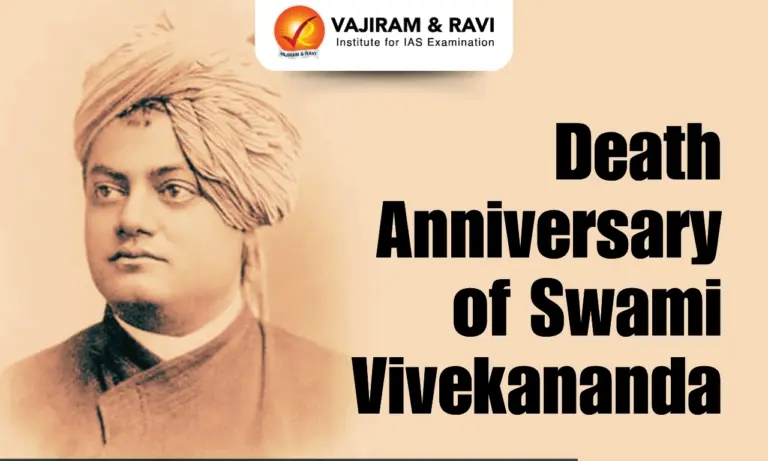
The Death Anniversary of Swami Vivekananda is observed every year on July 4 to remember his inspiring life and teachings. He was a great spiritual leader and thinker who played an important role in spreading Indian philosophy and values across the world. On this day, people pay tribute to his wisdom, dedication, and contribution to society. It is a time to reflect on his ideas about youth, strength, and humanity, which continue to guide and inspire people even today.
About Swami Vivekananda
- Birth and Early Life: Swami Vivekananda, born as Narendranath Datta on January 12, 1863, in Kolkata, belonged to an educated and progressive family. His father, Vishwanath Datta, was a lawyer with a modern outlook, while his mother, Bhuvaneshwari Devi, was deeply spiritual, shaping his moral and religious values from childhood.
- Childhood Qualities: From an early age, he showed exceptional intelligence, curiosity, and a strong inclination toward spirituality, often questioning religious beliefs and seeking deeper truths about life and existence.
- Education and Intellectual Development: He studied at the Metropolitan Institution, Kolkata, where he excelled in philosophy, logic, and reasoning. During this time, he was exposed to both Western philosophy and Indian scriptures, which helped him develop a balanced and analytical worldview.
- Study of Philosophies: In his youth, he studied the works of John Stuart Mill, David Hume, and Immanuel Kant, while also exploring the Vedas and Upanishads, combining rational thought with spiritual wisdom.
- Spiritual Quest: Despite his academic success, he remained deeply concerned with questions about God, truth, and the purpose of life, which led him on a continuous search for spiritual enlightenment.
- Meeting Ramakrishna Paramahamsa (1881): A turning point came when he met Ramakrishna Paramahamsa in 1881, who recognized his potential and guided him toward self-realisation and spiritual awakening.
- Influence of Ramakrishna: Under his teacher’s guidance, Vivekananda learned the principle of the unity of all religions, understanding that all faiths ultimately lead to the same divine reality.
- Monastic Life (1886): After the death of Ramakrishna Paramahamsa in 1886, he renounced worldly life, took monastic vows, and began living as a wandering monk dedicated to spiritual practice and service.
- Travels Across India: During his travels across India, he observed poverty, social inequality, and backwardness, which deeply influenced his thinking and strengthened his resolve to work for social upliftment and national regeneration.
- Chicago Speech (1893): He achieved worldwide fame after his speech at the Parliament of the World’s Religions in Chicago (1893), where he presented Hindu philosophy as a universal and rational tradition and emphasized religious tolerance and harmony.
- Global Recognition and Influence: After Chicago, he spent several years in the West spreading Vedanta and Yoga, gaining recognition as a global spiritual ambassador of India.
- Revival of Hinduism: He played a key role in the revival of Hinduism, presenting it as a modern, scientific, and universal religion, countering misconceptions about Indian culture.
- Concept of Neo-Vedanta: He developed the idea of Neo-Vedanta, which integrated ancient spiritual teachings with modern scientific thought, making them relevant to contemporary society.
- Foundation of Ramakrishna Mission (1897): In 1897, he founded the Ramakrishna Mission, an organization dedicated to spiritual growth and social service, working in areas like education, healthcare, and disaster relief.
- Educational Philosophy: He emphasized an education system that combines knowledge with character-building, aiming to develop confidence, moral strength, and social responsibility.
- Social Reform Efforts: Vivekananda strongly opposed caste discrimination and advocated for women’s empowerment, stressing that true national progress requires the upliftment of all sections of society.
- Literary Contributions: His major works, including “Jnana Yoga,” “Bhakti Yoga,” “Karma Yoga,” and “Raja Yoga,” explain different paths to spiritual growth and self-realisation.
- Vedantic Philosophy: His teachings were based on Vedanta, highlighting the divinity of the soul, unity of existence, and harmony among religions, encouraging individuals to realize their inner potential.
- Universal Religion: He promoted the idea of a Universal Religion, emphasizing religious pluralism, where all religions are seen as different paths to the same truth.
- Self-Realisation: According to him, the ultimate goal of life is Self-Realisation, which can be achieved through meditation, discipline, and spiritual practice.
- Service to Humanity: He stressed the principle of “Service to Humanity” through the idea “Jiva is Shiva,” meaning serving people is equivalent to serving God.
- Karma Yoga: He popularized Karma Yoga, teaching that one should perform duties selflessly without attachment to results, dedicating actions to a higher purpose.
- Role in Indian Renaissance: Vivekananda became a key figure in the Indian Renaissance, inspiring cultural revival, intellectual awakening, and national pride.
- Inspiration to Youth: His famous message, “Arise, awake, and stop not till the goal is reached,” motivated youth to contribute actively to nation-building and social reform.
- Interfaith Dialogue: His teachings promoted interfaith harmony and dialogue, encouraging respect and understanding among different religions.
- Death (1902): Swami Vivekananda passed away on July 4, 1902, at Belur Math, leaving behind a powerful legacy of spiritual wisdom and social service.
- Legacy and Global Influence: His message of universal brotherhood, spiritual strength, and service continues to inspire people across the world.
- National Youth Day: In honour of his contributions, January 12 is celebrated as National Youth Day in India, promoting his ideals among the youth.
- Ramakrishna Mission Legacy: The Ramakrishna Mission, headquartered at Belur Math, continues his work through education, healthcare, and humanitarian services based on the principles of Karma Yoga.
Also Read: Important Days in July 2026


 Last updated on Oct, 2026
→ UPSC 2027 Notification will be released on 13 January 2027 at upsconline.nic.in.
→ Check Nobel Prize 2026 Winners List here.
→ Download PIB PRiSM Monthly Magazine 2026 here.
→ Check UPSC Monthly Current Affairs Magazine The Recitals here.
→ Check out the latest UPSC Syllabus here.
→ Download UPSC Model Answers for Mains 2026
→ UPSC Mains Question Paper 2026 is out now for Essay & GS Paper 1, 2, 3 & 4.
→ UPSC Calendar 2027 has been released.
→ Enroll in Vajiram & Ravi’s UPSC Mains Test Series 2027 for structured answer writing practice, expert evaluation, and exam-oriented feedback.
→ Join Vajiram & Ravi’s UPSC Mentorship Program 2027 for personalized guidance, strategy planning, and one-to-one support from experienced mentors.
→ Go through the UPSC Mains Previous Year Papers to enhance your preparation.
→ UPSC has released UPSC Toppers List 2025 with the Civil Services final result on its official website.
→ Also check Best UPSC Coaching in India
Death Anniversary of Swami Vivekananda FAQs
Q1. What is the significance of Swami Vivekananda’s death anniversary?+
Q2. When and where was Swami Vivekananda born?+
Q3. Who was the spiritual guru of Swami Vivekananda?+
Q4. Why is the Chicago speech of 1893 important?+
Q5. What is the Ramakrishna Mission?+
Q6. What are the key teachings of Swami Vivekananda?+
Tags: Death anniversary of swami vivekananda important day important day 2026 important days important days july 2026