Dedicated Freight Corridors Latest News
- Prime Minister Narendra Modi inaugurated the last three sections of the Western Dedicated Freight Corridor in Vadodara, marking the completion of the 1,506-km corridor and taking India’s total dedicated freight network to 2,843 km.
About Dedicated Freight Corridors
- Dedicated Freight Corridors (DFCs) are rail routes built exclusively for goods traffic, separated from the passenger network.
- India’s two busiest trunk routes, Howrah-Delhi on the eastern side and Mumbai-Delhi on the western side, had become severely oversaturated, with line capacity utilisation ranging between 115% and 150%.
- This congestion caused freight traffic to decline, since passenger trains are typically given priority over goods movement.
- Separating freight onto dedicated tracks was intended to restore capacity, improve speeds and reduce transit times.


Origins of the Project
- The Dedicated Freight Corridor Corporation of India (DFCCIL), a special purpose vehicle, was incorporated in 2006, but early years primarily involved initial approvals, alignment finalization, and prolonged land acquisition.
- Rapid Execution & Commissioning (2014-2026): The vast majority of major civil engineering, track laying, electrification, and section commissioning occurred during this period.
- Financing
- The projects were financed through debt funding from two multilateral sources:
- World Bank: Rs. 14,900 crore
- Japan International Cooperation Agency: Rs. 38,722 crore
- The projects were financed through debt funding from two multilateral sources:
- Gross budgetary support accounted for the remaining amount.
The Two Corridors
- Western Dedicated Freight Corridor
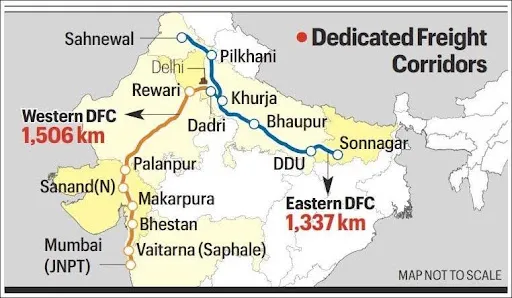
- The WDFC spans 1,506 km, running from Jawaharlal Nehru Port Trust (JNPT) in Navi Mumbai to Dadri in Uttar Pradesh, near Delhi.
- Traffic on this corridor consists mainly of ISO containers from JNPT and Mumbai Port in Maharashtra, and from Pipavav, Mundra and Kandla ports in Gujarat. These containers are headed for Inland Container Depots (ICDs) in north India, primarily at Tughlakabad in Delhi, Dadri in Uttar Pradesh, Dhandari Kalan in Punjab and Khatuwas in Rajasthan.
- The corridor is also expected to carry fertilisers, foodgrain, salt, coal, iron, steel and cement.
- Eastern Dedicated Freight Corridor
- The EDFC spans 1,337 km, running from Ludhiana in Punjab to Sonnagar in Bihar. It caters mostly to coal and mineral traffic from eastern India.
- It comprises two distinct segments:
- An electrified double-line segment of 936 km between Sonnagar and Dadri
- An electrified single-track segment of 401 km between Ludhiana (Sahnewal) and Khurja
- The EDFC was fully commissioned in October 2023. Its alignment deliberately takes a detour to bypass densely populated towns including Mirzapur, Allahabad, Kanpur, Etawah, Firozabad, Tundla, Hathras, Aligarh, Hapur, Meerut, Muzaffarnagar, Ambala, Rajpura, Sirhind, Doraha and Sahnewal.
News Summary: Completion of the Western Corridor
- The three sections inaugurated cover 326 kilometres and were developed at a cost of over Rs. 20,700 crore. These sections lie between Gujarat and Maharashtra:
- New Sanand (N) to New Makarpura
- New Umbergaon to New Saphale
- New Saphale to New JNPT
- With the last remaining stretch between Vaitarna (Saphale) and JNPT now operational, the WDFC gains direct connectivity to JNPT.
- Freight loading on the corridor is expected to increase further as a result.
- Together, the two corridors now form a 2,843-km dedicated freight network carrying about 426 freight trains daily.
Performance and Impact
- Speed Gains
- The most measurable benefit has been in average speeds.
- Railways data shows the average speed of trains on DFCs was over 50 kmph, roughly double the average speed of freight trains on the non-DFC network. In April and May, recorded speeds were:
- EDFC: 44.9 kmph and 44.7 kmph
- WDFC: 53.6 kmph and 52.3 kmph
- Other Benefits
- Reduced transit time, since freight trains are no longer held for passenger services.
- Lower logistics cost per tonne moved.
- Last-mile connectivity at certain locations, including direct port links.
Why Freight Matters for Railways
- Freight is the financial backbone of Indian Railways. Freight services account for over 65% of total earnings, and this revenue plays a crucial role in subsidising passenger travel.
- The scale of the shift being attempted is significant:
- Current share of freight traffic moved by rail: around 27%
- Target under the National Rail Plan: 45% by 2030, equivalent to 3,000 million tonnes
- Highest ever loading achieved: 1,670 million tonnes in 2025-26
- The Road-Rail Comparison
- The National Highways running along the DFC routes constitute just 0.5% of India’s road network, yet they carry almost 40% of total road freight.
- This concentration explains why shifting even a portion of that traffic to rail can meaningfully reduce congestion, fuel consumption and emissions.
- The Third Corridor
- In the Budget this year, the government announced plans for a third dedicated freight corridor, connecting Dankuni in West Bengal to Surat in Gujarat.
- The detailed project report is currently being prepared. This corridor would create an east-west link, complementing the existing north-south and north-west alignments.
Significance
- For logistics costs: India’s logistics expenditure as a share of GDP has historically been higher than in comparable economies. Faster, more reliable freight movement addresses one component of that gap.
- For port connectivity: Direct rail links to JNPT and Gujarat ports reduce dependence on road transport for container movement, improving turnaround times for exporters and importers.
- For emissions: Rail freight is considerably less carbon-intensive per tonne-kilometre than road transport, making modal shift relevant to India’s climate commitments.
- For passenger services: Freeing capacity on trunk routes creates room for additional passenger trains, which had previously competed with goods traffic for the same tracks.
Source: IE

 Last updated on Oct, 2026
→ UPSC 2027 Notification will be released on 13 January 2027 at upsconline.nic.in.
→ Check Nobel Prize 2026 Winners List here.
→ Download PIB PRiSM Monthly Magazine 2026 here.
→ Check UPSC Monthly Current Affairs Magazine The Recitals here.
→ Check out the latest UPSC Syllabus here.
→ Download UPSC Model Answers for Mains 2026
→ UPSC Mains Question Paper 2026 is out now for Essay & GS Paper 1, 2, 3 & 4.
→ UPSC Calendar 2027 has been released.
→ Enroll in Vajiram & Ravi’s UPSC Mains Test Series 2027 for structured answer writing practice, expert evaluation, and exam-oriented feedback.
→ Join Vajiram & Ravi’s UPSC Mentorship Program 2027 for personalized guidance, strategy planning, and one-to-one support from experienced mentors.
→ Go through the UPSC Mains Previous Year Papers to enhance your preparation.
→ UPSC has released UPSC Toppers List 2025 with the Civil Services final result on its official website.
→ Also check Best UPSC Coaching in India
Dedicated Freight Corridors FAQs
Q1. What is the total length of India's Dedicated Freight Corridors?+
Q2. Which agency implements the DFC project?+
Q3. What is the average speed of trains on the DFCs?+
Q4. What is the National Rail Plan target for rail freight share?+
Q5. Where will the proposed third freight corridor run?+
Tags: Dedicated Freight Corridors mains articles upsc current affairs upsc mains current affairs