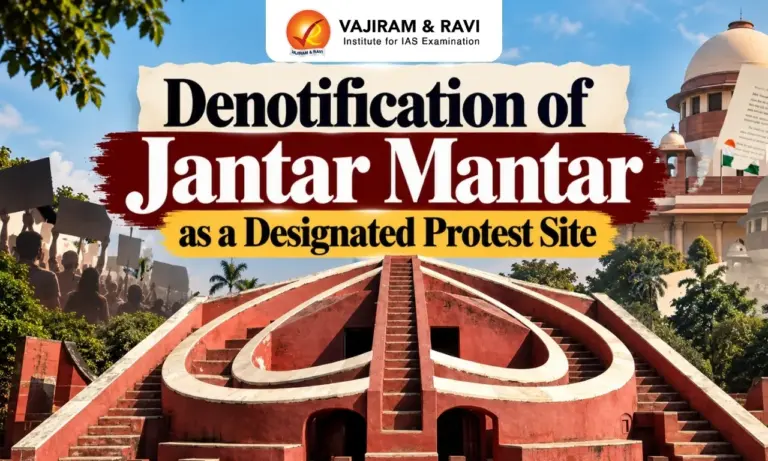
Delhi Police has withdrawn Jantar Mantar’s status as an officially designated protest site following recommendations made by a committee of the Ministry of Home Affairs (MHA). Three alternative locations have been identified for public demonstrations: Ramlila Ground, Burari Ground and CBD Ground in East Delhi.
Jantar Mantar From an Astronomical Observatory to a Public Gathering Place
Jantar Mantar is a historic scientific site in New Delhi that is known today for both its astronomical heritage and its role in public demonstrations.
- Built in 1724: Maharaja Sawai Jai Singh II of Jaipur established the Delhi observatory to study astronomical movements and improve the accuracy of observations.
- Origin of the Name: The name combines the Sanskrit words Yantra, meaning instrument, and Mantra, meaning calculation or formula.
- Scientific Design: The observatory contains 13 architectural instruments that were designed to study celestial movements through direct observation.
- Samrat Yantra: This large triangular structure functions as a sundial and helps determine local solar time.
- Misra Yantra: The instrument was designed to identify the longest and shortest days of the year.
- Jaya Prakash and Ram Yantras: These structures help determine the positions and coordinates of celestial objects.
- Five Historical Observatories: Jai Singh II established observatories in Delhi, Jaipur, Ujjain, Varanasi and Mathura.
- Protection of the Delhi Site: The Archaeological Survey of India (ASI) protects Jantar Mantar in Delhi as a Monument of National Importance.
- UNESCO World Heritage Recognition: Jantar Mantar in Jaipur received UNESCO World Heritage status in 2010 because of its outstanding astronomical instruments and scientific significance.
How Did Jantar Mantar Become a Major Centre for Public Demonstrations?
The rise of Jantar Mantar as a protest venue is linked to changes in the management of public gatherings in the national capital.
- Restrictions at the Boat Club in 1993: The Boat Club lawns near India Gate had previously hosted large public rallies, including farmers’ demonstrations. Security concerns and traffic disruption led to restrictions on major gatherings there, increasing the importance of Jantar Mantar.
- A Visible Platform for Public Demands: Its location near Parliament and central government offices made Jantar Mantar a convenient place for groups seeking official attention.
- Anti-Corruption Movement of 2011: Demonstrations demanding a strong Lokpal law brought the site into national focus.
- Women’s Safety Protests in 2012: Demonstrations following the Nirbhaya case highlighted demands for stronger measures against sexual violence and improved public safety.
- Citizenship-Related Demonstrations: Protests against the Citizenship (Amendment) Act and other government policies made Jantar Mantar an important location for political expression.
- Wrestlers’ Demonstration in 2023: Wrestlers gathered to demand action over allegations of sexual harassment in Indian wrestling administration.
- Student and Recruitment-Related Demonstrations: The site has also provided a platform for groups raising concerns about examinations, recruitment processes and public policy.


Why Have Authorities and Courts Regulated Protests at Jantar Mantar?
The legal history of Jantar Mantar reflects the need to accommodate peaceful demonstrations while addressing environmental, health and public-order concerns.
Environmental Concerns and the NGT Order of 2017
In 2017, the National Green Tribunal (NGT) ordered restrictions on protest activities at Jantar Mantar Road and directed that demonstrations be shifted elsewhere.
The decision followed concerns about noise, inadequate sanitation, waste disposal and the effect of prolonged gatherings on people living nearby. These issues also raised questions about the relationship between environmental protection and the right to life under Article 21.
Supreme Court’s Intervention in 2018
The dispute reached the Supreme Court in Mazdoor Kisan Shakti Sangathan v. Union of India.
The Court examined the interests of demonstrators, residents and other members of the public. Its approach highlighted the importance of creating workable rules for protests rather than treating the right to peaceful assembly and public order as incompatible.
The judgment remains relevant to the regulation of Jantar Mantar because it addresses the need to balance constitutional freedoms with the practical challenges of managing a busy urban area.
Constitutional Rules Governing Public Protests in Delhi
The regulation of demonstrations must operate within the framework of fundamental rights and the reasonable restrictions permitted by the Constitution.
Article 19 Freedom of Expression and Peaceful Assembly
Article 19 protects citizens’ ability to express opinions and gather peacefully for a common purpose.
- Article 19(1)(a): Protects freedom of speech and expression, including the ability to criticise policies and communicate public grievances.
- Article 19(1)(b): Protects the right to assemble peacefully and without arms.
- Article 19(2): Permits reasonable restrictions on freedom of expression on specified constitutional grounds, including public order.
- Article 19(3): Permits reasonable restrictions on peaceful assembly in the interests of the sovereignty and integrity of India and public order.
Article 21 Life, Personal Liberty and Public Well-Being
Article 21 protects life and personal liberty. In disputes over protest venues, the interests of residents and commuters may involve concerns about health, safety, access and the conditions in which they live.
Authorities must consider these concerns alongside the rights of protesters. The objective should be to protect public well-being without unnecessarily limiting peaceful political expression.
Article 239AA Delhi’s Special Administrative Structure
Delhi has a distinctive constitutional arrangement under Article 239AA.
Under Article 239AA(3)(a), the Delhi Legislative Assembly does not have legislative power over public order, police and land, which fall under Entries 1, 2 and 18 of the State List.
Important Court Rulings on Peaceful Demonstrations and Public Spaces
The Supreme Court of India has delivered several important judgments explaining how the right to peaceful protest can be balanced with public order, traffic management and the rights of other citizens.
- Himat Lal K. Shah v. Commissioner of Police (1972): The Court recognised the importance of public meetings under Articles 19(1)(a) and 19(1)(b) and held that authorities may regulate assemblies but cannot impose arbitrary restrictions on them.
- In Re: Ramlila Maidan Incident (2012): The Court examined police action against a public gathering and emphasised the protection of peaceful assembly and fundamental rights against unjustified state action.
- Mazdoor Kisan Shakti Sangathan v. Union of India (2018): The Court considered protests at Jantar Mantar and stressed the need to balance demonstrators’ rights with residents’ interests through appropriate regulation.
- Amit Sahni v. Commissioner of Police (2020): The Court held that public roads cannot be occupied indefinitely for protests in a manner that prevents other citizens from using them, highlighting the need to balance the right to protest with public access and convenience.
Way Forward
The way forward for Jantar Mantar as a designated protest site should focus on protecting the right to peaceful protest while ensuring public order, traffic movement and the convenience of local residents.
- Protect the Right to Protest: Authorities should respect the fundamental rights guaranteed under Articles 19(1)(a) and 19(1)(b) of the Constitution, which protect freedom of speech and peaceful assembly, subject to reasonable restrictions.
- Provide Designated Protest Spaces: The government should identify suitable locations in Delhi where people can organise peaceful demonstrations without causing major disruption to essential public services.
- Ensure Transparent Rules: Clear guidelines should be established for permissions, crowd limits, timings, sound levels and security arrangements to prevent arbitrary restrictions on demonstrations.
- Balance Competing Rights: Authorities should consider the rights of protesters alongside the needs of residents, commuters, businesses and other users of public spaces.
- Encourage Dialogue: Government departments and police should engage with protest organisers to address concerns and find practical solutions before imposing restrictive measures.
- Use Proportionate Restrictions: Restrictions on demonstrations should be reasonable, necessary and based on specific concerns relating to public order, safety or traffic management.
- Strengthen Judicial Oversight: Courts should continue to examine disputes involving protest restrictions to ensure that administrative decisions remain consistent with constitutional principles.

 Last updated on Oct, 2026
→ UPSC 2027 Notification will be released on 13 January 2027 at upsconline.nic.in.
→ Check Nobel Prize 2026 Winners List here.
→ Download PIB PRiSM Monthly Magazine 2026 here.
→ Check UPSC Monthly Current Affairs Magazine The Recitals here.
→ Check out the latest UPSC Syllabus here.
→ Download UPSC Model Answers for Mains 2026
→ UPSC Mains Question Paper 2026 is out now for Essay & GS Paper 1, 2, 3 & 4.
→ UPSC Calendar 2027 has been released.
→ Enroll in Vajiram & Ravi’s UPSC Mains Test Series 2027 for structured answer writing practice, expert evaluation, and exam-oriented feedback.
→ Join Vajiram & Ravi’s UPSC Mentorship Program 2027 for personalized guidance, strategy planning, and one-to-one support from experienced mentors.
→ Go through the UPSC Mains Previous Year Papers to enhance your preparation.
→ UPSC has released UPSC Toppers List 2025 with the Civil Services final result on its official website.
→ Also check Best UPSC Coaching in India
Denotification of Jantar Mantar as a Designated Protest Site FAQs
Q1. What is the denotification of Jantar Mantar as a designated protest site?+
Q2. Why has Jantar Mantar been denotified as a protest site?+
Q3. Which alternative protest sites have been designated in Delhi?+
Q4. Which fundamental rights protect peaceful protests in India?+
Q5. Which Supreme Court judgment dealt with protests at Jantar Mantar?+
Q6. Can citizens still organise peaceful protests in Delhi?+
Q7. How does the denotification affect the right to protest?+
Tags: denotification of jantar mantar as a designated protest site jantar mantar