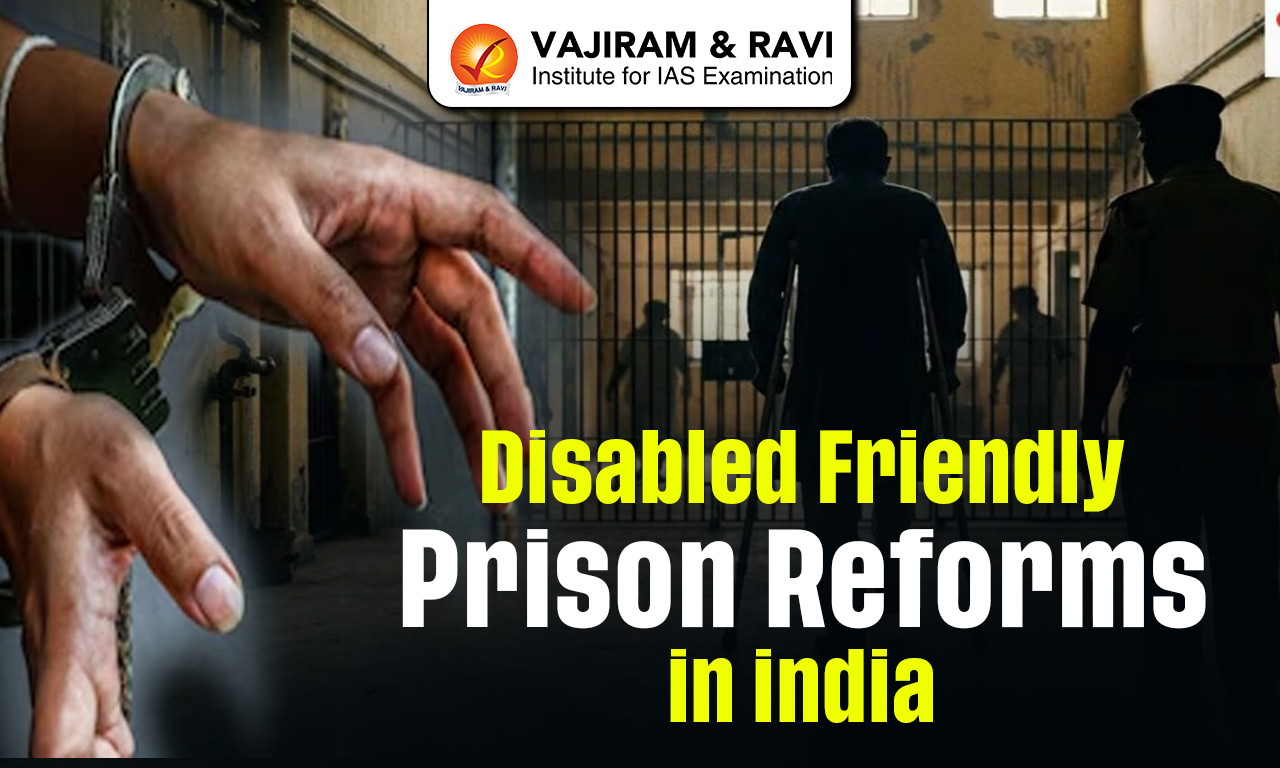
The Supreme Court directed a high-powered committee chaired by S. Ravindra Bhat to prepare a comprehensive plan for making prisons across India disabled-friendly, while ensuring that security requirements are not compromised. This marks an important step towards inclusive and humane prison reforms.
Disabled Friendly Prison Refirms Constitutional and Legal Basis
The need for disabled-friendly prison reforms is rooted in the constitutional guarantees of equality and dignity.
- The Supreme Court, in its recent observation by Justices Vikram Nath and Sandeep Mehta, emphasized that prisoners with disabilities are entitled to full protection under Article 14 and Article 21 of the Constitution.
- The Rights of Persons with Disabilities Act, 2016 mandates accessibility, non-discrimination, and reasonable accommodation for persons with disabilities. However, existing prison laws like the Prisons Act, 1894 and the Model Prison Manual, 2016 do not adequately address disability-specific needs, creating a gap between legal principles and ground realities.
- In addition, principles of human rights and international standards such as the UN Convention on the Rights of Persons with Disabilities support the idea that prisons must be inclusive spaces that respect the needs of all individuals.
Need for Disabled-Friendly Prison Reforms
Prisons in India are generally not designed to accommodate persons with disabilities.
- Many inmates face difficulties in accessing basic facilities such as toilets, medical care, and movement within prison premises. This leads to neglect, discrimination, and violation of basic human rights.
- Persons with disabilities in prisons are often more vulnerable to abuse, isolation, and mental health issues.
- Lack of trained staff and absence of assistive infrastructure further worsen their condition.
This not only violates constitutional rights but also goes against the principles of reformative justice, which aim to rehabilitate rather than punish. Therefore, reforms are necessary to ensure humane treatment and equal access to facilities.


Key Areas of Disabled-Friendly Prison Reform
The key areas of disabled-friendly prison reforms focus on ensuring accessibility, dignity, and equal treatment for prisoners with disabilities while maintaining necessary security standards.
- Infrastructure Accessibility: Prisons need to be redesigned to include ramps, handrails, accessible toilets, and barrier-free pathways. Cells and common areas should be adapted to suit prisoners with mobility, visual, or hearing impairments.
- Healthcare and Assistive Support: Regular medical check-ups, availability of assistive devices such as wheelchairs and hearing aids, and specialized healthcare services are essential for disabled inmates.
- Training of Prison Staff: Prison personnel must be sensitized and trained to handle the needs of prisoners with disabilities in a respectful and professional manner.
- Legal and Administrative Safeguards: Policies should ensure that prisoners with disabilities are not discriminated against in access to legal aid, parole, or rehabilitation programs.
- Balancing Security and Inclusion: While making prisons accessible, authorities must also ensure that security concerns are addressed effectively, as highlighted by the Supreme Court.
Challenges
- One major challenge is the lack of adequate infrastructure and financial resources to implement such reforms across all prisons.
- Another issue is the absence of reliable data on disabled prisoners, which makes targeted policy implementation difficult.
- Administrative inertia and lack of awareness among prison authorities also hinder progress.
- Ensuring accessibility without compromising prison security requires careful planning and coordination.
Way Forward
- A comprehensive national framework is needed to make prisons disability-friendly. The committee led by S. Ravindra Bhat can play a crucial role in setting standards and guidelines.
- Regular audits of prison facilities and strict monitoring mechanisms should be introduced to ensure compliance.
- Investment in infrastructure, staff training, and technology is essential.
- Collaboration with experts in disability rights and civil society organizations can improve the quality of reforms.
- Strengthening legal enforcement and ensuring accountability under the Rights of Persons with Disabilities Act, 2016 will be crucial for long-term success.

 Last updated on Oct, 2026
→ UPSC 2027 Notification will be released on 13 January 2027 at upsconline.nic.in.
→ Check Nobel Prize 2026 Winners List here.
→ Download PIB PRiSM Monthly Magazine 2026 here.
→ Check UPSC Monthly Current Affairs Magazine The Recitals here.
→ Check out the latest UPSC Syllabus here.
→ Download UPSC Model Answers for Mains 2026
→ UPSC Mains Question Paper 2026 is out now for Essay & GS Paper 1, 2, 3 & 4.
→ UPSC Calendar 2027 has been released.
→ Enroll in Vajiram & Ravi’s UPSC Mains Test Series 2027 for structured answer writing practice, expert evaluation, and exam-oriented feedback.
→ Join Vajiram & Ravi’s UPSC Mentorship Program 2027 for personalized guidance, strategy planning, and one-to-one support from experienced mentors.
→ Go through the UPSC Mains Previous Year Papers to enhance your preparation.
→ UPSC has released UPSC Toppers List 2025 with the Civil Services final result on its official website.
→ Also check Best UPSC Coaching in India
Disabled Friendly Prison Reforms FAQs
Q1. Which committee has the Supreme Court directed for disabled-friendly prison reforms?+
Q2. What are disabled-friendly prison reforms?+
Q3. Why disabled-friendly prison reforms are necessary in India?+
Q4. What is the constitutional basis for disabled-friendly prison reforms?+
Q5. Which international convention supports disability rights in prisons?+
Tags: disabled friendly prison reforms