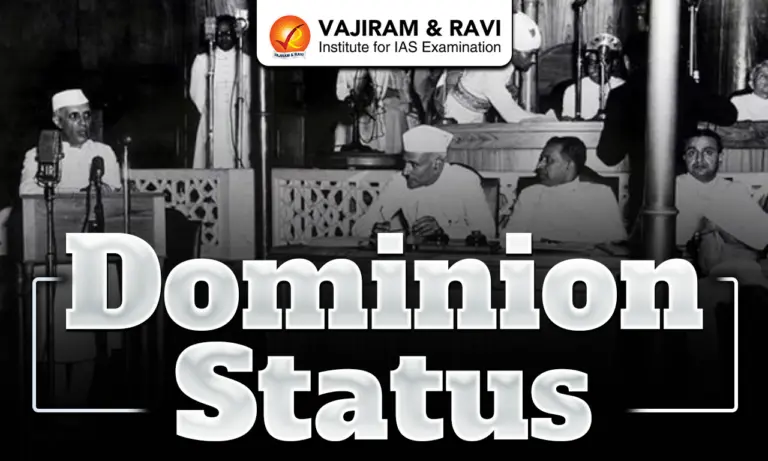
Dominion Status refers to a form of government where a country is self-governing but still remains a part of a larger empire, usually under a monarch. In this system, the country has control over its internal affairs, such as laws and administration, but may still recognize an external authority for certain matters like foreign policy or symbolic leadership. It was often seen as a transitional stage between colonial rule and complete independence.
About Dominion Status
- The concept of Dominion Status developed through a number of laws passed by the British Parliament, starting with the Dominion of Canada Act in 1867 (officially known as the British North America Act, 1867), which gave Canada a significant level of self-rule.
- Under this system, countries like Canada, Australia, New Zealand, South Africa, Eire (Ireland), and Newfoundland were given the status of “Dominions” before 1939.
- These countries were allowed to govern themselves in most internal matters. They had their own parliaments, laws, and administrative systems, giving them control over domestic affairs.
- However, Britain still handled important areas like foreign policy and defence, especially in the earlier phase of Dominion Status.
- There was no clear legal definition of Dominion Status at first, but in the Imperial Conference of 1926, it was described as:
- Self-governing communities within the British Empire
- Equal in status to Britain
- Not subordinate to one another
- United by a shared loyalty to the British Crown
- A major development came with the Statute of Westminster in 1931, which gave dominions full legislative independence, meaning they could make their own laws without British interference.
- In terms of executive power, dominion governments gained the right to advise the British monarch directly, instead of going through British ministers.
- Internationally, dominions (except Newfoundland) started to be treated as separate countries:
- They had their own representation in global organizations like the League of Nations
- They could appoint ambassadors
- They could sign their own international treaties
- Even with these powers, dominions were still not considered completely separate foreign countries from Britain or from each other.
- After 1947, the term “dominion” was gradually dropped because it was seen as suggesting dependence. Instead, countries began to be called “members of the Commonwealth.”
- In 1949, the system was further changed to allow countries to remain part of the Commonwealth without recognizing the British monarch as their ruler.
- The monarch then became only a symbolic head of the Commonwealth, representing unity among independent nations.
- India was the first country to adopt this new arrangement, and later many other countries followed the same path.
India’s Demand for Dominion Status
- India’s demand for Dominion Status was an important stage in its freedom struggle, where leaders wanted self-rule while still being linked to the British Empire.
- This demand was mainly supported by moderate leaders, but it later created differences of opinion within the national movement.
- The demand was first clearly raised by the Indian National Congress in 1917, when Indian leaders began asking for greater control over their own governance.
- Later, this demand was included in the Nehru Report (1928), which was a major proposal for constitutional reforms in India.
- The idea behind demanding Dominion Status was that India should be treated like other dominions such as Canada or Australia:
- It should have self-government in internal matters
- It should be able to run its own administration and make its own laws
- But it could still remain connected to the British Empire for the time being
- Indian leaders believed that India was fully capable of responsible self-rule, and that Dominion Status would act as a stepping stone towards complete independence.
- This demand also reflected a moderate and gradual approach, where leaders wanted political progress without sudden disruption.
- Despite several discussions and negotiations with the British government, India was not granted full Dominion Status immediately.
- The Irwin Declaration (1929)
- In response, Lord Irwin, the British Viceroy, announced that Dominion Status was the ultimate goal for India. However, this statement did not satisfy Indian leaders because:
- It did not give any clear timeline
- It lacked a proper plan for transferring power
- In response, Lord Irwin, the British Viceroy, announced that Dominion Status was the ultimate goal for India. However, this statement did not satisfy Indian leaders because:
- As a result, many leaders felt it was only a delaying tactic by the British.
- Shift to Complete Independence (1929-1930)
- Over time, the demand for Dominion Status was gradually replaced by the demand for complete independence (Purna Swaraj), especially after growing dissatisfaction with British policies. Younger leaders like Jawaharlal Nehru and Subhash Chandra Bose began to oppose Dominion Status.
- They believed it was not enough and that India should aim for complete freedom.
- In the Lahore Session of 1929, the Indian National Congress officially:
- Rejected Dominion Status
- Adopted the goal of Purna Swaraj (Complete Independence)
- This decision was publicly declared on 26 January 1930, which later became an important date in Indian history.
- Instead, the Government of India Act, 1935 was passed:
- It provided limited self-governance to Indians
- It expanded provincial autonomy
- But it still kept major powers in British hands and did not grant true Dominion Status
- Later Developments and Final Outcome (1942-1947)
- During World War II, the British government sent the Cripps Mission (1942):
- It offered Dominion Status to India after the war
- Indian leaders rejected it, calling it a “post-dated cheque” because it did not give immediate power
- During World War II, the British government sent the Cripps Mission (1942):
- Finally, in 1947, India achieved full independence after the British Parliament passed the Indian Independence Act 1947.
- This marked the end of British rule, and India moved beyond the idea of Dominion Status to become a fully sovereign nation.


 Last updated on Oct, 2026
→ UPSC 2027 Notification will be released on 13 January 2027 at upsconline.nic.in.
→ Check Nobel Prize 2026 Winners List here.
→ Download PIB PRiSM Monthly Magazine 2026 here.
→ Check UPSC Monthly Current Affairs Magazine The Recitals here.
→ Check out the latest UPSC Syllabus here.
→ Download UPSC Model Answers for Mains 2026
→ UPSC Mains Question Paper 2026 is out now for Essay & GS Paper 1, 2, 3 & 4.
→ UPSC Calendar 2027 has been released.
→ Enroll in Vajiram & Ravi’s UPSC Mains Test Series 2027 for structured answer writing practice, expert evaluation, and exam-oriented feedback.
→ Join Vajiram & Ravi’s UPSC Mentorship Program 2027 for personalized guidance, strategy planning, and one-to-one support from experienced mentors.
→ Go through the UPSC Mains Previous Year Papers to enhance your preparation.
→ UPSC has released UPSC Toppers List 2025 with the Civil Services final result on its official website.
→ Also check Best UPSC Coaching in India
Dominion Status FAQs
Q1. What is Dominion Status?+
Q2. Which countries were given Dominion Status?+
Q3. What was the role of the Statute of Westminster, 1931?+
Q4. Why did India demand Dominion Status?+
Q5. What was the Nehru Report (1928)?+
Tags: dominion status history history notes