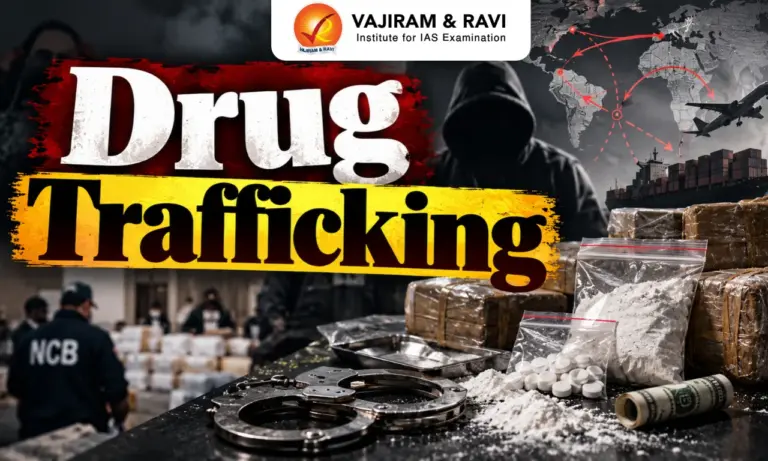
According to a Ministry of Home Affairs, India registered 38,064 cases involving possession of drugs for trafficking under the Narcotic Drugs and Psychotropic Substances (NDPS) Act, 1985, in 2022, compared with 26,560 cases in 2020. The government also reported the growing use of darknet platforms, cryptocurrencies and courier services for illegal drug transactions. These developments highlight the need for stronger border security, better coordination among law enforcement agencies and greater international cooperation to combat drug trafficking.
What is Drug Trafficking?
Drug trafficking refers to the illegal production, cultivation, manufacture, transportation, distribution, sale or supply of prohibited drugs and controlled substances. It may take place within a country or across international borders.
Drug trafficking is often carried out by organised criminal networks that earn money by supplying illegal drugs to consumers. These networks may use land routes, sea routes, air transport, postal services and digital platforms to conduct their activities.
According to the United Nations Office on Drugs and Crime (UNODC), drug trafficking is a major part of the international illicit drug trade, which affects public health, security, governance and economic development.
Types of Drug Trafficking
Drug trafficking can take different forms depending on the substance, the people involved and the method of illegal supply.
- Domestic drug trafficking: Illegal movement and distribution of drugs within a country.
- International drug trafficking: Illegal trade in drugs across national borders, often involving criminal networks in multiple countries.
- Cross-border smuggling: Illegal movement of narcotic drugs through land borders, seaports or airports.
- Online drug trafficking: Sale and distribution of illegal drugs through online platforms, social media or darknet marketplaces.
- Pharmaceutical drug trafficking: Illegal production, sale or diversion of certain medicines and controlled substances from legitimate supply chains.
- Synthetic drug trafficking: Illegal trade in chemically manufactured substances, including methamphetamine and other amphetamine-type stimulants.


Major Drugs Involved in Illegal Trafficking
Drug trafficking involves the illegal trade of various narcotic drugs, psychotropic substances and synthetic drugs that can affect physical health, mental well-being and public safety. Major drugs involved include:
- Cannabis: A psychoactive substance obtained from the cannabis plant.
- Heroin: An opioid drug associated with a high risk of dependence and overdose.
- Cocaine: A powerful stimulant derived from coca leaves.
- Methamphetamine: A synthetic stimulant that can cause serious physical and mental health problems.
- Opium: A substance obtained from the opium poppy and used to produce opioid drugs.
- Synthetic Opioids: Chemically manufactured substances, some of which have medical uses but can cause severe harm when misused.
- Psychotropic Substances: Substances that affect the mind, mood, perception or behaviour and are subject to legal controls.
Causes of Drug Trafficking
Drug trafficking continues due to high illegal profits, demand for drugs, organised crime, weak enforcement and cross-border smuggling. The major causes are explained below:
| Causes of Drug Trafficking | |
|
Cause |
Explanation |
|
High Profits |
The illegal drug trade generates substantial profits, encouraging criminal networks to expand their activities. |
|
Demand for Drugs |
Demand for illegal substances creates markets for traffickers and suppliers. |
|
Poverty and Unemployment |
Limited livelihood opportunities can make vulnerable individuals more susceptible to recruitment by criminal networks. |
|
Porous Borders |
Difficult terrain, long coastlines and gaps in border surveillance create opportunities for drug smuggling. |
|
Organised Criminal Networks |
Criminal groups coordinate the production, transportation and distribution of illegal drugs across regions and countries. |
|
Use of Technology |
Darknet marketplaces, encrypted communication and cryptocurrencies can be exploited to facilitate illegal drug transactions. |
|
Corruption and Weak Enforcement |
Bribery, inadequate resources and gaps in law enforcement can allow trafficking networks to operate. |
|
Lack of Awareness and Treatment |
Limited awareness about drug-related harms and inadequate access to treatment can contribute to substance-use problems and sustain demand for illegal drugs. |
Major Drug Trafficking Routes and India’s Geographical Vulnerability
India’s geographical position makes it important to regional efforts against drug trafficking. It shares land borders with several countries and has a long coastline connected to major maritime trade routes.
The following are broad areas of concern, not fixed routes used in every trafficking case.
- North-Western border: Punjab, Jammu and Kashmir, and parts of Rajasthan and Gujarat face challenges associated with cross-border smuggling.
- North-Eastern border: The proximity of parts of the region to Myanmar and the wider Golden Triangle creates concerns about heroin and synthetic drugs, including amphetamine-type stimulants.
- Maritime routes: India’s extensive coastline and busy ports require effective cargo screening, intelligence sharing and coastal surveillance.
- Airports, railways and courier networks: Passenger movement, freight and parcel services can be exploited to transport illegal substances.
- Online and financial networks: Digital platforms and suspicious financial transactions can support the coordination and financing of illegal drug sales.
The Golden Triangle is a region in Southeast Asia associated historically with illicit opium production and the drug trade. It broadly covers parts of Myanmar, Laos and Thailand. Developments in the region have implications for neighbouring countries, including India.
The Golden Crescent refers to parts of Afghanistan, Iran and Pakistan historically associated with opium cultivation and trafficking. These regional labels help explain the broader geography of illicit drug markets, but they should not be treated as proof that every drug seized in India originated in these regions.
Effects of Drug Trafficking
Drug trafficking creates serious health, social, economic and national security problems. It affects individuals, families and society and can also strengthen organised criminal networks. Its major effects include:
- Public Health Problems: Illegal drugs can cause addiction, overdose, serious health complications and mental health problems.
- Impact on Youth: Drug availability can expose young people to substance dependence, affecting their education, relationships and career opportunities.
- Organised Crime and Violence: Drug trafficking networks may engage in violence, intimidation and other criminal activities to protect their illegal markets.
- Threat to National Security: Cross-border drug trafficking can strengthen criminal networks and, in certain cases, support terrorist financing.
- Corruption: Illegal profits may encourage bribery and weaken law enforcement agencies and public institutions.
- Economic Losses: Drug trafficking can reduce productivity and increase expenditure on healthcare, policing, investigation and rehabilitation.
- Family and Social Problems: Substance dependence can contribute to family disputes, financial hardship, social isolation and difficulties in employment.
- Money Laundering: Criminal networks may attempt to conceal illegal drug profits through financial transactions and other unlawful activities.
- Environmental Damage: Illegal drug cultivation and manufacture can contribute to deforestation, soil degradation and water pollution.
- Social Inequality: Vulnerable communities may face greater risks of exploitation, criminal recruitment and barriers to healthcare and rehabilitation.
Drug Trafficking Laws in India
India has established a legal framework to control illegal drug production, possession, transportation, sale and trafficking. These laws also address related financial crimes and the illegal movement of controlled substances.
- Narcotic Drugs and Psychotropic Substances (NDPS) Act, 1985: India’s principal drug-control law. It regulates specified activities involving narcotic drugs and psychotropic substances, prohibits unauthorised activities and prescribes penalties for offences.
- Prevention of Illicit Traffic in Narcotic Drugs and Psychotropic Substances (PITNDPS) Act, 1988: Provides for preventive detention in specified circumstances to prevent illicit trafficking in narcotic drugs and psychotropic substances.
- Prevention of Money Laundering Act (PMLA), 2002: Provides for action against money laundering involving proceeds of crime associated with scheduled offences, including relevant drug-related offences.
- Customs Act, 1962: Supports enforcement against prohibited or restricted imports and exports, including the illegal movement of narcotic substances across international borders.
- Drugs and Cosmetics Act, 1940: Regulates the import, manufacture, distribution and sale of drugs and cosmetics. It is relevant to illegal activities involving medicines and unauthorised pharmaceutical products.
- Bharatiya Nyaya Sanhita (BNS), 2023: Addresses general criminal offences that may arise alongside drug trafficking, depending on the facts of a case. Drug-specific offences are principally governed by the NDPS Act.
Important Government Agencies to Combat Drug Trafficking
- Narcotics Control Bureau (NCB): Coordinates drug law enforcement and investigates major drug trafficking cases.
- Central Bureau of Narcotics (CBN): Regulates specified narcotic drugs and controlled substances.
- State Police and Anti-Narcotics Task Forces (ANTFs): Investigate drug-related offences and trafficking networks.
- Directorate of Revenue Intelligence (DRI): Investigates smuggling and customs-related offences involving narcotic drugs.
- Customs Authorities: Detect illegal drug imports and exports through cargo and passenger screening.
- Border Security Force (BSF): Helps prevent drug smuggling across designated international borders.
- Indian Coast Guard: Supports maritime surveillance and interception of illegal activities at sea.
- Railway Protection Force (RPF): Assists in preventing the illegal movement of drugs through railway networks.
Government Measures to Control Drug Trafficking in India
- Narco-Coordination Centre (NCORD): Improves coordination among central and state agencies combating drug trafficking.
- Anti-Narcotics Task Forces (ANTFs): Strengthen state-level investigations and enforcement against drug-related offences.
- MANAS Helpline (1933): Enables people to report drug-related information and suspected narcotics crimes.
- NIDAAN Portal: Helps authorised agencies access information about offenders arrested under the NDPS Act.
- Nar-K9 Pool: Uses trained dogs to assist in detecting narcotic substances.
- Darknet and Cryptocurrency Monitoring: Helps investigate illegal online drug transactions and suspicious digital financial activities.
- Nasha Mukt Bharat Abhiyaan (NMBA): Promotes drug awareness, prevention and community participation.
- National Action Plan for Drug Demand Reduction (NAPDDR): Supports drug-use prevention, treatment, rehabilitation and social reintegration.
- Border Surveillance: Strengthens monitoring and intelligence sharing to prevent cross-border drug smuggling.
International Efforts to Prevent Drug Trafficking
- United Nations Office on Drugs and Crime (UNODC): Supports countries through research, technical assistance and international cooperation against drug trafficking.
- 1988 UN Convention: Provides a framework for international cooperation against illicit drug trafficking and related financial crimes.
- Single Convention on Narcotic Drugs, 1961: Establishes international controls on narcotic drugs for medical and scientific purposes.
- Convention on Psychotropic Substances, 1971: Regulates specified psychotropic substances through international controls.
- Intelligence Sharing: Countries exchange information about trafficking networks and cross-border smuggling.
- Joint Investigations: Countries cooperate in gathering evidence, tracing suspects and investigating transnational drug crimes.
- World Drug Report: UNODC publishes global data and analysis on drug markets, trafficking trends and drug use.
- Regional Cooperation: Countries coordinate border security, maritime surveillance and enforcement against organised criminal networks.
Challenges in Controlling Drug Trafficking
Drug trafficking remains difficult to control due to organised criminal networks, changing smuggling methods and gaps in law enforcement. Major challenges include:
- Porous Borders: Difficult terrain and long coastlines make surveillance and interception challenging.
- Organised Crime: Criminal networks operate across states and countries, complicating investigations.
- Use of Technology: Darknet platforms, encrypted communication and cryptocurrencies can conceal illegal transactions.
- Corruption: Bribery and weak accountability may allow trafficking networks to operate.
- Limited Coordination: Gaps in information sharing among enforcement agencies can delay investigations.
- Financial Networks: Tracing and recovering illegal profits can be difficult due to money laundering.
- Rising Drug Demand: Substance dependence and limited access to treatment can sustain illegal drug markets.
- Limited Resources: Shortages of trained personnel, modern equipment and forensic facilities can affect enforcement.
Way Forward
A comprehensive approach combining law enforcement, public health and international cooperation is essential to control drug trafficking.
- Strengthen Border Security: Improve surveillance, cargo screening and coastal monitoring.
- Improve Intelligence Sharing: Strengthen coordination among central agencies, state police and international partners.
- Follow Illegal Money: Trace drug-related proceeds and take action against money laundering.
- Use Advanced Technology: Improve digital forensics and monitoring of technology-enabled trafficking.
- Strengthen International Cooperation: Promote joint investigations, intelligence exchange and mutual legal assistance.
- Prevent Corruption: Improve accountability, transparency and oversight within enforcement agencies.
- Increase Public Awareness: Educate young people and communities about the harmful effects of drugs.
- Expand Rehabilitation Services: Improve access to counselling, treatment and social reintegration.
- Support Vulnerable Communities: Promote education, skill development and sustainable livelihood opportunities.
- Improve Data Collection: Maintain reliable and timely data on trafficking cases, seizures, convictions and drug-use trends.

 Last updated on Oct, 2026
→ UPSC 2027 Notification will be released on 13 January 2027 at upsconline.nic.in.
→ Check Nobel Prize 2026 Winners List here.
→ Download PIB PRiSM Monthly Magazine 2026 here.
→ Check UPSC Monthly Current Affairs Magazine The Recitals here.
→ Check out the latest UPSC Syllabus here.
→ Download UPSC Model Answers for Mains 2026
→ UPSC Mains Question Paper 2026 is out now for Essay & GS Paper 1, 2, 3 & 4.
→ UPSC Calendar 2027 has been released.
→ Enroll in Vajiram & Ravi’s UPSC Mains Test Series 2027 for structured answer writing practice, expert evaluation, and exam-oriented feedback.
→ Join Vajiram & Ravi’s UPSC Mentorship Program 2027 for personalized guidance, strategy planning, and one-to-one support from experienced mentors.
→ Go through the UPSC Mains Previous Year Papers to enhance your preparation.
→ UPSC has released UPSC Toppers List 2025 with the Civil Services final result on its official website.
→ Also check Best UPSC Coaching in India
Drug Trafficking FAQs
Q1. What is drug trafficking?+
Q2. Which law controls drug trafficking in India?+
Q3. Which agency is responsible for controlling drug trafficking in India?+
Q4. What are the major causes of drug trafficking?+
Q5. How does drug trafficking affect national security?+
Q6. What is the role of UNODC in controlling drug trafficking?+
Q7. What is the MANAS helpline number in India?+
Tags: drug drug trafficking drug trafficking in india