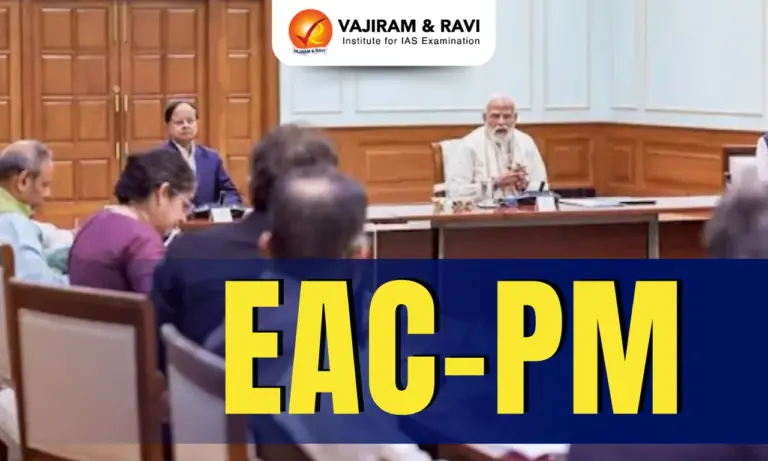
EAC-PM Latest News
- The Indian PM chaired a meeting of the Economic Advisory Council to the Prime Minister (EAC-PM) to –
- Review India’s economic outlook,
- Discuss reform priorities,
- Assess external risks such as the West Asia conflict, and
- Examine measures to sustain high economic growth.
- The discussions also focused on attracting foreign capital, improving ease of doing business, and reducing vulnerabilities arising from climatic uncertainties.
Key Outcomes of the Meeting
- Focus on sustaining economic growth: The EAC-PM deliberated on policy measures to maintain and accelerate India’s growth trajectory despite a challenging global environment marked by geopolitical tensions and economic uncertainty.
- Major themes included:
- Strengthening long-term economic transformation.
- Deepening structural reforms.
- Enhancing Ease of Doing Business (EoDB) and Ease of Living.
- Preserving macroeconomic stability while promoting investment-led growth.


Measures to Boost Foreign Capital Inflows
- Tax reforms for foreign investors: The government announced significant tax relief measures for Foreign Institutional Investors (FIIs):
- Removal of Short-Term Capital Gains Tax (STCG) on investments in government bonds.
- Removal of Long-Term Capital Gains Tax (LTCG) on such investments.
- Elimination of withholding tax on interest income earned by FIIs from government securities.
- RBI measures: The Reserve Bank of India (RBI) complemented these reforms by:
- Easing norms for banks to mobilise foreign currency deposits.
- Reviving the Foreign Currency Non-Resident (Bank) [FCNR(B)] Deposit Scheme, under which the RBI bears exchange-rate hedging costs.
- Providing a temporary concessional forex swap facility for Public Sector Undertakings (PSUs) raising External Commercial Borrowings (ECBs).
- Significance: These measures are expected to improve liquidity and make India more attractive to global investors.
Potential Foreign Fund Inflows
- Estimated inflows of around $70 billion:
- According to discussions at the meeting, the combined impact of fiscal and monetary measures could attract nearly $70 billion in foreign capital.
- A major share depends on India’s inclusion in the Bloomberg Global Aggregate Bond Index, which would:
- Increase passive investments from global funds tracking benchmark indices.
- Expand demand for Indian government securities.
- Reduce government borrowing costs by lowering bond yields.
- Importance of global bond indices:
- India has already been included in:
- JPMorgan Emerging Market Bond Index (from June 2024).
- Bloomberg Emerging Market Local Currency Index (from January 2025).
- FTSE Russell Emerging Market Bond Index (from September 2025).
- Inclusion in Bloomberg’s flagship Global Aggregate Bond Index could potentially bring $20–25 billion in additional inflows over about ten months.
- India has already been included in:
Assessment of Global and Domestic Risks
- West Asia conflict:
- No major immediate concerns were expressed regarding its impact on India.
- However, geopolitical developments continue to be monitored due to their implications for energy prices, trade flows, and global financial markets.
- El Niño and monsoon vulnerability:
- A major concern discussed was the possibility of sub-par rainfall due to El Niño conditions.
- The need to reduce India’s dependence on monsoon outcomes.
- The discussion highlighted the importance of climate-resilient agriculture, irrigation expansion, water management reforms, and diversification of growth drivers beyond agriculture.
Strong Economic Performance
- Better-than-expected GDP growth:
- The Council took note of encouraging growth data for FY 2025–26.
- For example,
- GDP growth of 7.8% in the January–March 2026 quarter.
- Full-year provisional GDP growth estimate revised to 7.7%, higher than the earlier estimate of 7.6%.
- Significance:
- Growth remained robust despite global uncertainties and the overlap of the West Asia conflict with the final month of the quarter.
- Strong economic performance reinforced investor confidence and supported positive market sentiment.
About the EAC-PM
- Nature and composition:
- It is a non-constitutional, non-permanent and independent advisory body constituted directly by an executive order.
- It has been constituted several times since the independence of India. In the latest occurrence, the council was reconstituted in 2017, and is currently chaired by S. Mahendra Dev.
- It includes full-time and part-time members from economics, finance, academia, banking, and public policy.
- Functions:
- Provides inputs to the PM on economic and related policy matters.
- Advises on macroeconomic policy.
- Evaluates economic trends and risks.
- Suggests reforms for sustainable and inclusive growth.
- Provides analytical inputs on development priorities.
Conclusion
- The EAC-PM meeting underscored India’s strategy of combining structural reforms, investor-friendly taxation, monetary support measures, and macroeconomic stability to sustain high growth.
- While geopolitical tensions and climate-related risks remain concerns, strong GDP performance, prospects of higher foreign capital inflows, and continued reform momentum position India favourably for long-term economic development.

 Last updated on Oct, 2026
→ UPSC 2027 Notification will be released on 13 January 2027 at upsconline.nic.in.
→ Check Nobel Prize 2026 Winners List here.
→ Download PIB PRiSM Monthly Magazine 2026 here.
→ Check UPSC Monthly Current Affairs Magazine The Recitals here.
→ Check out the latest UPSC Syllabus here.
→ Download UPSC Model Answers for Mains 2026
→ UPSC Mains Question Paper 2026 is out now for Essay & GS Paper 1, 2, 3 & 4.
→ UPSC Calendar 2027 has been released.
→ Enroll in Vajiram & Ravi’s UPSC Mains Test Series 2027 for structured answer writing practice, expert evaluation, and exam-oriented feedback.
→ Join Vajiram & Ravi’s UPSC Mentorship Program 2027 for personalized guidance, strategy planning, and one-to-one support from experienced mentors.
→ Go through the UPSC Mains Previous Year Papers to enhance your preparation.
→ UPSC has released UPSC Toppers List 2025 with the Civil Services final result on its official website.
→ Also check Best UPSC Coaching in India
EAC-PM FAQs
Q1. How can inclusion of Indian government bonds in global bond indices benefit the Indian economy?+
Q2. What measures were announced to enhance foreign investment in Indian government securities?+
Q3. Why is El Niño a concern for India's economic growth?+
Q4. What is the role of the Economic Advisory Council to the Prime Minister (EAC-PM)?+
Q5. What does India's GDP growth of 7.7% in FY 2025–26 indicate?+
Tags: eac-pm mains articles upsc current affairs upsc mains current affairs