Earthquake Swarm Latest News
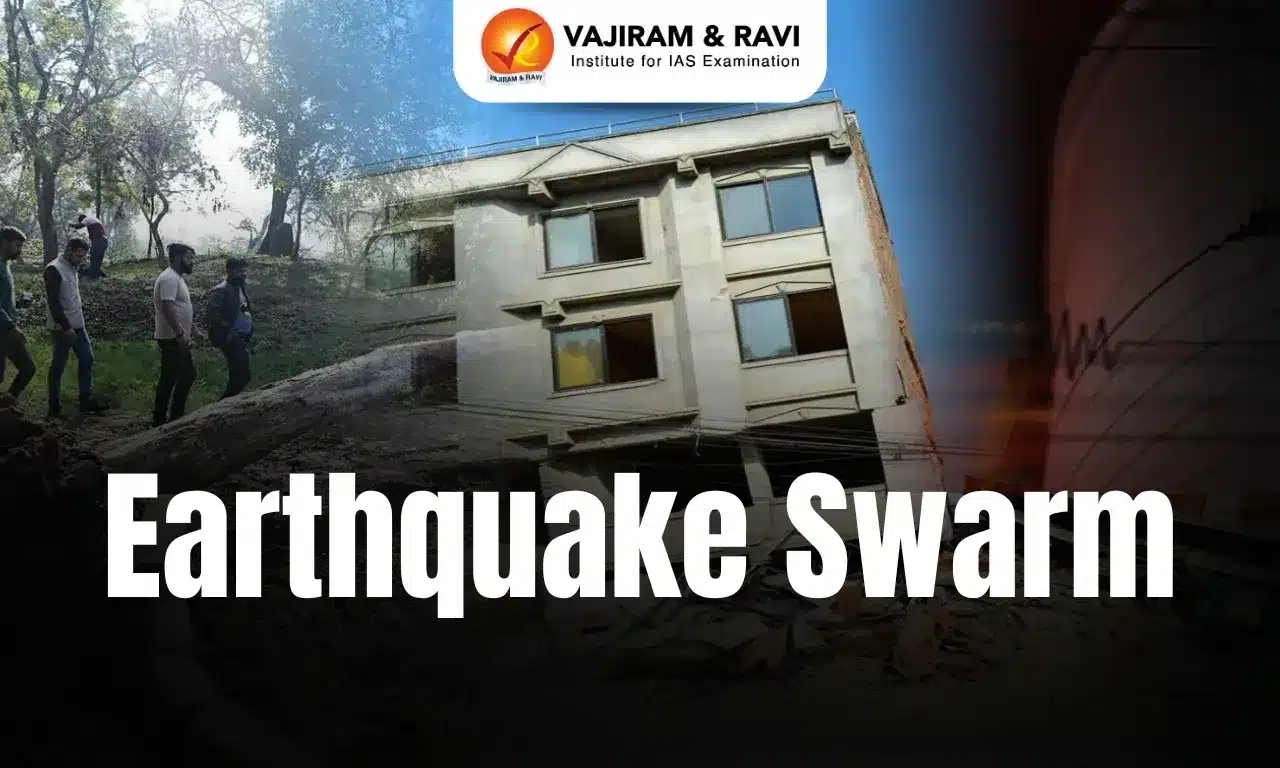
Recently, there has been a spate of small earthquakes in Maharashtra and seismologists call this pattern of quakes an earthquake swarm, and Maharashtra has experienced them often before.
About Earthquake Swarm
- Occurance: It occurs when multiple seismic events of comparable intensity strike a small area in relatively quick succession.
- Intensity: It involves a series of many (sometimes thousands) low-intensity earthquakes without a discernible main shock that can occur over weeks in active geothermal areas.
- When seismic energy piles up inside the Earth and is released in small amounts from certain points, such a series of earthquakes can occur.
What Causes Swarm Sequences?
- Fluid movement
- In volcanic environments, this can be fluid released from deeper magma or circulating within active geothermal areas (in volcanic areas such as the Taupō Volcanic Zone).
- The earthquakes triggered by fluids occur as fault slip on the cracks and faults through which the water is moving.
- Active volcanism
- Magma movement can also act as the ‘driving mechanism’ for swarms, creating the earthquakes as magma-filled cracks push their way through the Earth’s crust.
- In such a case the earthquakes commonly occur near the crack tip (ahead of the magma where the crack is starting to open), or off to the side of the crack.
- Slow-slip events
- A slow-slip event is essentially an earthquake in slow-motion, and typically involves centimetres to tens of centimetres of movement along a fault, over weeks to years.
- We commonly see slow slip events at the Hikurangi subduction zone, usually at least one or two per year.
Source: TH


 Last updated on Oct, 2026
→ UPSC 2027 Notification will be released on 13 January 2027 at upsconline.nic.in.
→ Check Nobel Prize 2026 Winners List here.
→ Download PIB PRiSM Monthly Magazine 2026 here.
→ Check UPSC Monthly Current Affairs Magazine The Recitals here.
→ Check out the latest UPSC Syllabus here.
→ Download UPSC Model Answers for Mains 2026
→ UPSC Mains Question Paper 2026 is out now for Essay & GS Paper 1, 2, 3 & 4.
→ UPSC Calendar 2027 has been released.
→ Enroll in Vajiram & Ravi’s UPSC Mains Test Series 2027 for structured answer writing practice, expert evaluation, and exam-oriented feedback.
→ Join Vajiram & Ravi’s UPSC Mentorship Program 2027 for personalized guidance, strategy planning, and one-to-one support from experienced mentors.
→ Go through the UPSC Mains Previous Year Papers to enhance your preparation.
→ UPSC has released UPSC Toppers List 2025 with the Civil Services final result on its official website.
→ Also check Best UPSC Coaching in India
Earthquake Swarm FAQs
Q1. What is a "Slow-slip event" in context of earthquakes?+
Q2. What are the causes of earthquake swarms?+
Tags: earthquake swarm