Ehlers-Danlos Syndrome Latest News
Recent researches across the world provided new insights about causes of Ehlers-Danlos Syndrome and its association with hormone levels and sleep apnea.
About Ehlers-Danlos Syndrome
- It is a group of conditions that affect the connective tissue of the human body, typically loosening or weakening it.
- Connective tissue supports and provides flexibility to the skin, tendons, ligaments, bones, blood vessels, and organs.
- EDS is generally inherited and is commonly associated with hypermobility, meaning one’s joints can move past their normal range of motion.
- Cause: EDS is caused by certain genetic changes and is generally passed down to children by their parents.
- Treatment: There is no cure for EDS, but symptoms, especially those of hEDS, can be managed.


Types of Ehlers-Danlos Syndrome
- Hypermobile EDS (hEDS)
- It is the most common form of EDS.
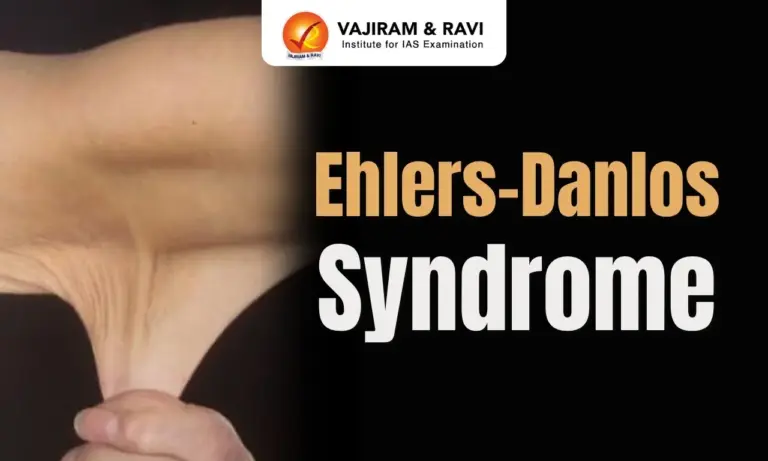
- It shows symptoms such as stretchy, fragile skin, loose and clicky joints that dislocate easily, joint pain, and joint hypermobility.
- hEDS may also manifest as extreme fatigue, skin that bruises quickly, digestive issues, and poor bladder control etc.
- Classical EDS
- It is a less common type of EDS, also exhibits similar symptoms, but it mostly affects the skin.
- A person with this condition might have very stretchy and fragile skin that bruises easily or splits easily, especially around the elbows, on the forehead, and on the knees.
- Vascular EDS
- It affects one’s internal organs.
- This results in fragile blood vessels that can tear easily and cause internal bleeding, which can be life-threatening.
- This condition poses a serious risk of bowel tearing, womb tearing during pregnancy, and lung collapse, among others.
- Kyphoscoliotic EDS (kEDS)
- It affects the curvature of the spine. It might manifest during early childhood and is also characterised by joint hypermobility and loose joints.
Source: TH

 Last updated on Oct, 2026
→ UPSC 2027 Notification will be released on 13 January 2027 at upsconline.nic.in.
→ Check Nobel Prize 2026 Winners List here.
→ Download PIB PRiSM Monthly Magazine 2026 here.
→ Check UPSC Monthly Current Affairs Magazine The Recitals here.
→ Check out the latest UPSC Syllabus here.
→ Download UPSC Model Answers for Mains 2026
→ UPSC Mains Question Paper 2026 is out now for Essay & GS Paper 1, 2, 3 & 4.
→ UPSC Calendar 2027 has been released.
→ Enroll in Vajiram & Ravi’s UPSC Mains Test Series 2027 for structured answer writing practice, expert evaluation, and exam-oriented feedback.
→ Join Vajiram & Ravi’s UPSC Mentorship Program 2027 for personalized guidance, strategy planning, and one-to-one support from experienced mentors.
→ Go through the UPSC Mains Previous Year Papers to enhance your preparation.
→ UPSC has released UPSC Toppers List 2025 with the Civil Services final result on its official website.
→ Also check Best UPSC Coaching in India
Ehlers-Danlos Syndrome FAQs
Q1. What is Ehlers-Danlos Syndrome?+
Q2. What is cause for Ehlers-Danlos Syndrome?+
Tags: ehlers-danlos syndrome prelims pointers upsc current affairs upsc prelims current affairs