About Elasmobranch
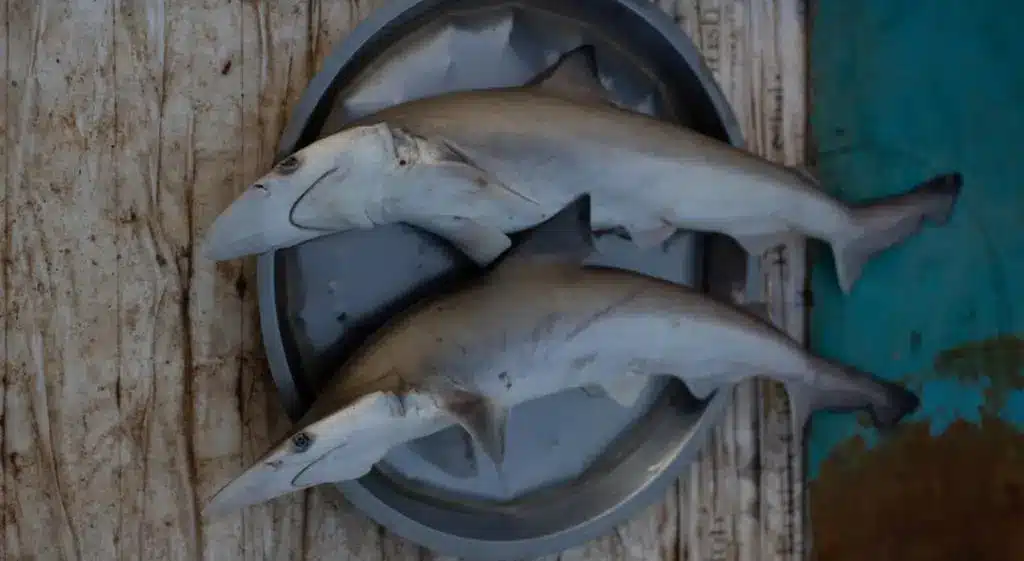
- The term elasmobranch refers to the sharks, rays, and skates.
- These animals have a skeleton made of cartilage, rather than bone.
- The other subclass of cartilaginous fish, the Holocephali, consists of Chimaeras – ratfish (Genus Chimaera) and elephantfish (Genus Callorhynchus).
- The main differences between these two subclasses are the structure of their gills and how they grow in the embryo.
- Holocephali has four gill slits with a gill cover (an operculum), while Elasmobranchs have five to seven external gill slits with no gill cover.
- Characteristics of Elasmobranchs
- Its skeleton is made of cartilage rather than bone.
- They have five to seven gill openings on each side.
- Rigid dorsal fins (and spines if present)
- Spiracles to aid in breathing
- The upper jaw of elasmobranchs is not fused to their skull.
- Elasmobranchs have several rows of teeth which are continually replaced.
- They don’t have swim bladders, but instead their large livers are full of oil to provide buoyancy.
- They reproduce sexually with internal fertilization and either bear live young or lay eggs.
- Elasmobranch skin is made of tiny, hard, tooth-like placoid scales called denticles.
- These are renowned for their highly tuned senses, which make them incredibly successful in their environment.
- Their distribution ranges from nearshore regions to the deep oceanic waters.
- Some species are known to travel long distances, hence can be considered as highly migratory. Their stock can be found in more than one Exclusive Economic Zone (EEZ)
- They are widely distributed in the Oceans but are most diverse in the tropical and subtropical IndoPacific Ocean.
Q1) What is cartilage?
Cartilage is a strong, flexible connective tissue that protects your joints and bones. It acts as a shock absorber throughout your body. Cartilage at the end of your bones reduces friction and prevents them from rubbing together when you use your joints.
Source: Shark & ray meat consumption no longer restricted to India’s tribal & coastal peoples: Paper


 Last updated on Oct, 2026
→ UPSC 2027 Notification will be released on 13 January 2027 at upsconline.nic.in.
→ Asian Games 2026 are being held in Aichi-Nagoya, Japan, from 19 September to 4 October.
→ Check out the latest UPSC Syllabus here.
→ Download UPSC Model Answers for Mains 2026
→ UPSC Mains Question Paper 2026 is out now for Essay & GS Paper 1, 2, 3 & 4.
→ UPSC Calendar 2027 has been released.
→ Enroll in Vajiram & Ravi’s UPSC Mains Test Series 2027 for structured answer writing practice, expert evaluation, and exam-oriented feedback.
→ Join Vajiram & Ravi’s UPSC Mentorship Program 2027 for personalized guidance, strategy planning, and one-to-one support from experienced mentors.
→ Go through the UPSC Mains Previous Year Papers to enhance your preparation.
→ UPSC has released UPSC Toppers List 2025 with the Civil Services final result on its official website.
→ Download PIB PRiSM Monthly Magazine 2026 here.
→ Also check Best UPSC Coaching in India