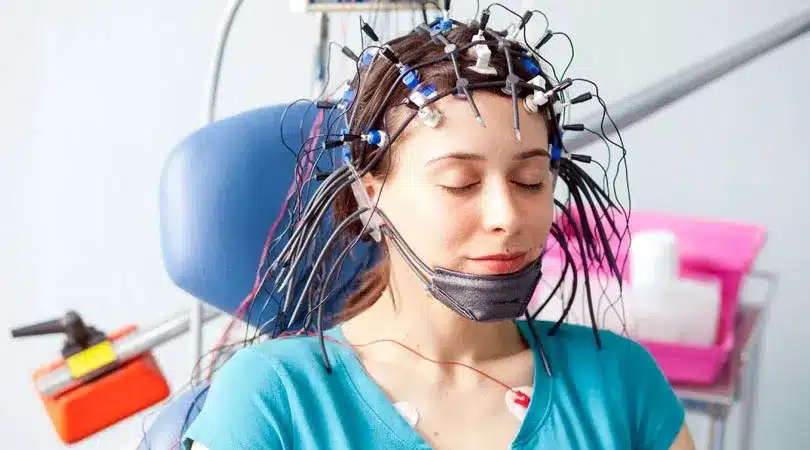
About Electroencephalogram (EEG):
- An EEG is a recording of brain activity.
- It is a test that detects abnormalities in your brain waves, or in the electrical activity of your brain.
- Procedure:
- The procedure may be short, often just a 30-minute recording.
- During the procedure, electrodes consisting of small metal discs with thin wires are pasted onto your scalp.
- The electrodes detect tiny electrical charges that result from the activity of your brain cells.
- The charges are amplified and appear as a graph on a computer screen or as a recording that may be printed out on paper.
- The EEG procedure is usually carried out by a highly trained specialist, called a clinical neurophysiologist.
- Applications:
- The EEG is used to evaluate several types of brain disorders. Examples:
- When epilepsy is present, seizure activity will appear as rapid spiking waves on the EEG.
- People with lesions of their brain, which can result from tumors or strokes, may have unusually slow EEG waves, depending on the size and location of the lesion.
The EEG may also be used to determine the overall electrical activity of the brain (for example, to evaluate trauma, drug intoxication, or extent of brain damage in comatose patients).
The EEG may also be used to monitor blood flow in the brain during surgical procedures.
Q1: What are electrodes?
An electrode is a solid electric conductor that carries electric current into non-metallic solids, or liquids, or gases, or plasmas, or vacuums. Electrodes are typically good electric conductors, but they need not be metals.
Source: A century after the EEG was discovered, it remains a crucial tool for understanding the brain


 Last updated on Oct, 2026
→ UPSC 2027 Notification will be released on 13 January 2027 at upsconline.nic.in.
→ Check Nobel Prize 2026 Winners List here.
→ Download PIB PRiSM Monthly Magazine 2026 here.
→ Check UPSC Monthly Current Affairs Magazine The Recitals here.
→ Check out the latest UPSC Syllabus here.
→ Download UPSC Model Answers for Mains 2026
→ UPSC Mains Question Paper 2026 is out now for Essay & GS Paper 1, 2, 3 & 4.
→ UPSC Calendar 2027 has been released.
→ Enroll in Vajiram & Ravi’s UPSC Mains Test Series 2027 for structured answer writing practice, expert evaluation, and exam-oriented feedback.
→ Join Vajiram & Ravi’s UPSC Mentorship Program 2027 for personalized guidance, strategy planning, and one-to-one support from experienced mentors.
→ Go through the UPSC Mains Previous Year Papers to enhance your preparation.
→ UPSC has released UPSC Toppers List 2025 with the Civil Services final result on its official website.
→ Also check Best UPSC Coaching in India