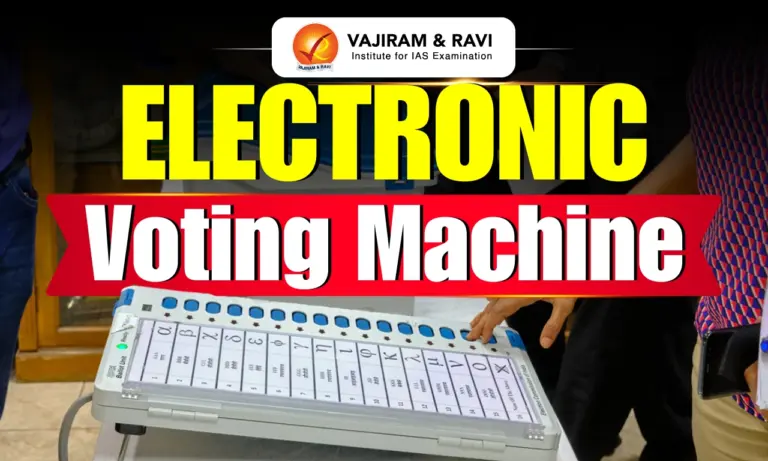
Electronic Voting Machine (EVM) is a device used to record votes during elections. India first used EVMs in the Paravur Assembly Constituency of Kerala in 1982. The Election Commission of India gradually expanded their use from 1998. All state elections and by-elections used EVMs in 2003. Since the 2004 Lok Sabha elections, EVMs have been the standard voting system across the country. The system aims to improve accuracy, speed, transparency and efficiency in the electoral process.
What is an EVM (Electronic Voting Machine)?
An Electronic Voting Machine (EVM) is a portable microcontroller based voting system developed by the Technical Experts Committee of the Election Commission of India with BEL and ECIL. It consists of a Control Unit and a Ballot Unit connected by a cable. The polling officer operates the Control Unit, while the voter presses the blue button on the Ballot Unit against the preferred candidate and symbol to record the vote electronically.
Electronic Voting Machine Features
The major features of the Electronic Voting Machine (EVM) has been listed below:
- Development: EVMs were designed by the Technical Experts Committee (TEC) with Bharat Electronics Limited under the Ministry of Defence and Electronics Corporation of India Limited under the Department of Atomic Energy.
- Model: Presently, the M3 Model consists of a Ballot Unit (BU), Control Unit (CU) and Voter Verifiable Paper Audit Trail (VVPAT).
- Voting Process: The polling officer activates the ballot from the Control Unit. The voter presses the blue button beside the candidate’s name and symbol on the Ballot Unit to cast the vote.
- Stand alone architecture: EVMs are not connected to any network and do not use an operating system. This design prevents remote access or external communication.
- Programming: The machines use one time programmable or masked microchips that cannot be read, rewritten, or reprogrammed after manufacturing.
- Voting Capacity: One EVM can record up to 2,000 votes. Generally, around 1,500 votes are recorded during actual polling for operational efficiency.
- Candidate Capacity: Each Ballot Unit supports 16 candidates including NOTA. Up to 24 Ballot Units can be linked, allowing a maximum of 384 candidates including NOTA in the M3 model.
- Counting and Control Features: Pressing the “TOTAL” button displays total votes polled without revealing candidate wise results. After the “CLOSE” button is pressed, no further voting is possible.


Voter Verifiable Paper Audit Trail (VVPAT)
Voter Verifiable Paper Audit Trail (VVPAT) is an independent verification system attached to the Electronic Voting Machine (EVM). It enables voters to confirm that their vote has been correctly recorded.
- Introduction: VVPAT was first used in the 2013 bye-election of Noksen Assembly Constituency in Nagaland. It was deployed in all constituencies during the 2019 Lok Sabha elections.
- Working Mechanism: After voting, a paper slip displaying the serial number, candidate name and symbol remains visible through a transparent window for 7 seconds before automatically dropping into a sealed box.
- Access and security: Only authorised polling officials can access the VVPAT unit. The printed slips remain sealed and are preserved for verification whenever legally required.
Electronic Voting Machine Significance
The key highlighting importance and advantages of the Electronic Voting Machine has been listed below:
- Battery operated machine: EVMs do not require electricity. They run on independent battery power, making them suitable for remote and electricity deficient polling stations.
- Anti booth capturing safeguard: EVMs permit a maximum of four votes per minute, reducing the possibility of large scale bogus voting through booth capturing.
- Faster election results: Electronic counting significantly reduces counting time. Results can generally be declared within a few hours instead of taking several days.
- Cost savings: EVMs reduce expenditure on paper, printing, transportation, storage and distribution because millions of ballot papers are no longer required for every election.
- Enhanced transparency: VVPAT enables voters to verify their vote immediately. Under Rule 56D of the Conduct of Elections Rules, 1961, VVPAT slips can be counted in specified situations and VVPAT count prevails in case of any discrepancy.
Electronic Voting Machine Challenges
Despite multiple safeguards, Electronic Voting Machines continue to face public debate regarding transparency and reliability in the electoral process as highlighted below:
- Transparency: Critics argue that the internal functioning of EVMs is not fully visible to the public, leading to demands for greater verification and independent scrutiny.
- Reliability: Concerns are occasionally raised regarding hardware failure or technical malfunction, although failed machines are replaced and examined under established procedures.
- Trust deficit: Some political parties and voters continue to seek additional safeguards, including wider VVPAT verification, despite existing technical and administrative protections.
- ADR petition: In 2023, the Association for Democratic Reforms requested a return to paper ballots, voter handling of VVPAT slips and 100% VVPAT counting. In 2024, the Supreme Court rejected these requests while introducing measures to strengthen confidence through stricter verification.

 Last updated on Oct, 2026
→ UPSC 2027 Notification will be released on 13 January 2027 at upsconline.nic.in.
→ Asian Games 2026 are being held in Aichi-Nagoya, Japan, from 19 September to 4 October.
→ Check Nobel Prize 2026 Winners List here.
→ Download PIB PRiSM Monthly Magazine 2026 here.
→ Check UPSC Monthly Current Affairs Magazine The Recitals here.
→ Check out the latest UPSC Syllabus here.
→ Download UPSC Model Answers for Mains 2026
→ UPSC Mains Question Paper 2026 is out now for Essay & GS Paper 1, 2, 3 & 4.
→ UPSC Calendar 2027 has been released.
→ Enroll in Vajiram & Ravi’s UPSC Mains Test Series 2027 for structured answer writing practice, expert evaluation, and exam-oriented feedback.
→ Join Vajiram & Ravi’s UPSC Mentorship Program 2027 for personalized guidance, strategy planning, and one-to-one support from experienced mentors.
→ Go through the UPSC Mains Previous Year Papers to enhance your preparation.
→ UPSC has released UPSC Toppers List 2025 with the Civil Services final result on its official website.
→ Also check Best UPSC Coaching in India
Electronic Voting Machine FAQs
Q1. What is an Electronic Voting Machine (EVM)?+
Q2. What is the purpose of VVPAT with an EVM?+
Q3. When were EVMs first used in India?+
Q4. Can an EVM work without electricity?+
Q5. How many votes can an EVM record?+
Tags: electronic voting machine evm