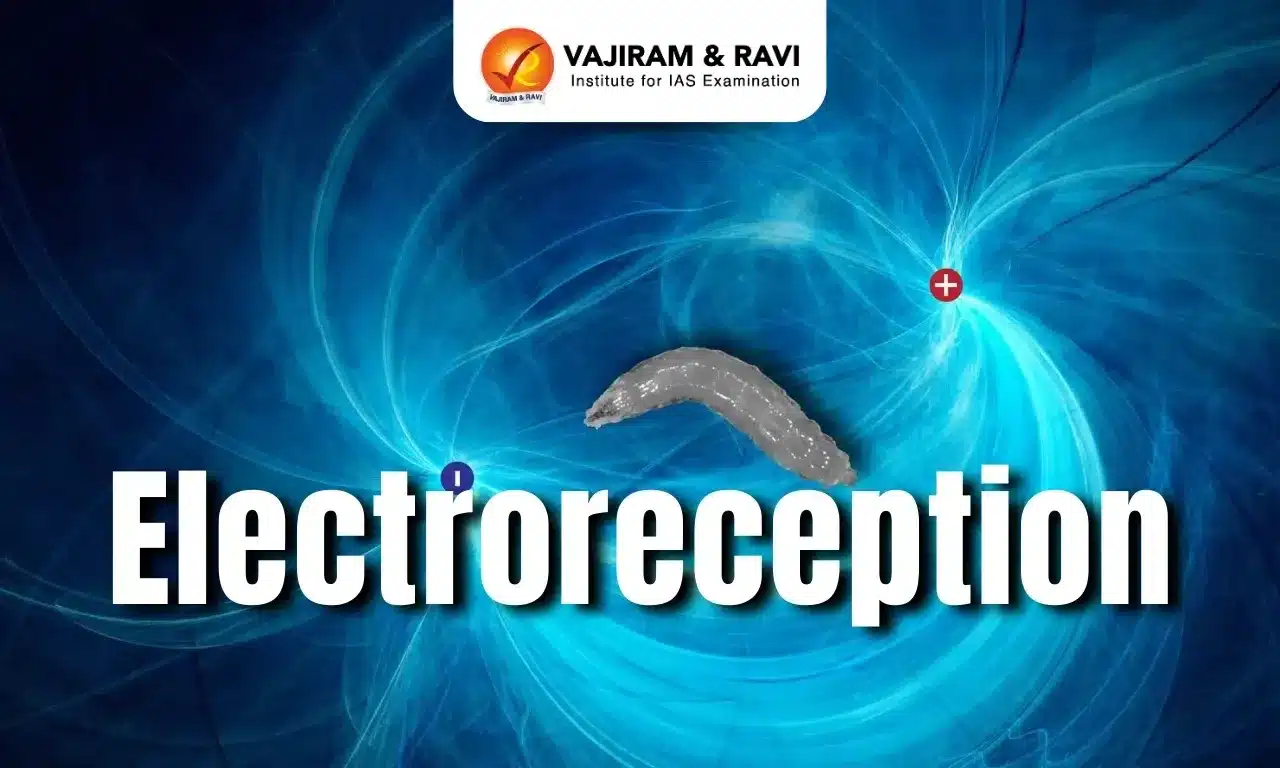
Electroreception Latest News
Researchers at the University of California, Santa Barbara have discovered that fruit fly larvae possess the ability to detect and respond to electric fields, a sensory ability known as electroreception.
About Electroreception
- Electroreception is the biological ability to detect weak electrostatic fields in the environment. It allows animals to sense electric fields generated by other living organisms or environmental factors.
- This ability is primarily found in certain vertebrate species, especially aquatic animals like sharks and electric fish, but is now also observed in invertebrates like fruit fly larvae.
- Electroreceptor organs were first discovered in the 1960s through physiological studies of weakly electric fish by Theodore H. Bullock, an American neuroscientist, and French scientists Thomas Szabo and Alfred Fessard.
- In some species, electroreception is also used for social communication, indicating its evolutionary importance beyond navigation or hunting.


Key Findings
- The researchers found that only a small cluster of sensory neurons located on either side of the larva’s head were involved in this electroreceptive behavior.
- Upon closer analysis under a microscope, it was confirmed that a single neuron in this head cluster was directly responsible for detecting the electric field.
- The neuron exhibited directional sensitivity—it was inhibited when the negative electrode was in front of the larva’s head and activated when the electrode was behind, which triggered the larva to reorient and move accordingly.
- By eliminating other possible stimuli (confounding factors), the scientists confirmed that the larval response was specifically due to the electric field itself, not other environmental cues.
- This makes fruit fly larvae one of the few organisms, along with sharks, bees, and the platypus, known to exhibit this rare sensory ability.
- In controlled experiments, larvae immersed in an electric field were observed to reorient their movement and navigate towards the negative electrode, indicating that they could detect and respond to the direction and strength of the electric field.
Electroreception FAQs
Q1. What is electroreception?
Ans. A sensory ability in some aquatic animals (e.g., sharks, platypus) to detect electric fields, aiding navigation, hunting, and communication.
Q2. How do sharks use electroreception?
Ans. Via ampullae of Lorenzini—gel-filled pores detecting prey’s muscle contractions, even in murky waters.
Q3. Are electroreceptive species found in India?
Ans. Yes! Gangetic dolphins use electroreception to navigate silt-laden rivers, while electric rays inhabit coastal waters.
Source: TH

 Last updated on Oct, 2026
→ UPSC 2027 Notification will be released on 13 January 2027 at upsconline.nic.in.
→ Check Nobel Prize 2026 Winners List here.
→ Download PIB PRiSM Monthly Magazine 2026 here.
→ Check UPSC Monthly Current Affairs Magazine The Recitals here.
→ Check out the latest UPSC Syllabus here.
→ Download UPSC Model Answers for Mains 2026
→ UPSC Mains Question Paper 2026 is out now for Essay & GS Paper 1, 2, 3 & 4.
→ UPSC Calendar 2027 has been released.
→ Enroll in Vajiram & Ravi’s UPSC Mains Test Series 2027 for structured answer writing practice, expert evaluation, and exam-oriented feedback.
→ Join Vajiram & Ravi’s UPSC Mentorship Program 2027 for personalized guidance, strategy planning, and one-to-one support from experienced mentors.
→ Go through the UPSC Mains Previous Year Papers to enhance your preparation.
→ UPSC has released UPSC Toppers List 2025 with the Civil Services final result on its official website.
→ Also check Best UPSC Coaching in India