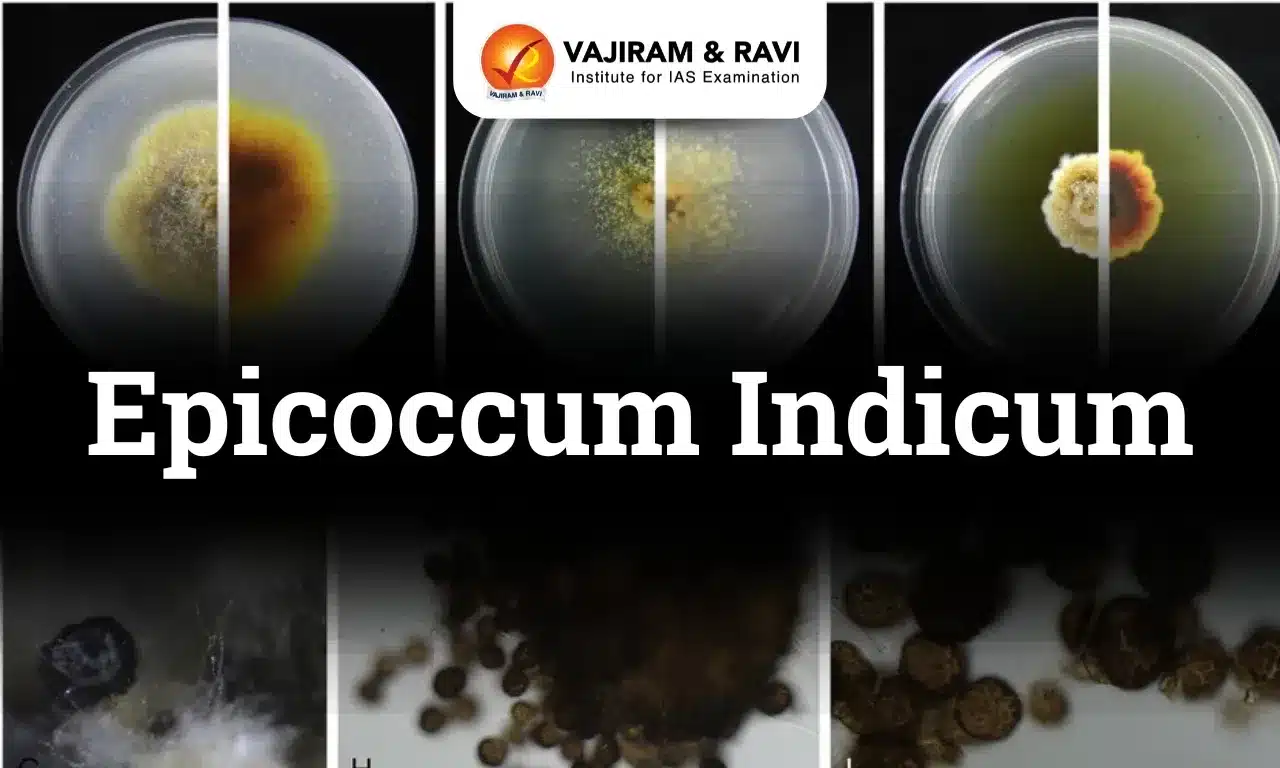
Epicoccum Indicum Latest News
A new species of phytopathogenic fungi, epicoccum indicum (Ascomycota, Didymellaceae), associated with an emerging leaf spot disease in Chrysopogon zizanioides (vetiver), was recently discovered by researchers at Banaras Hindu University.
About Epicoccum Indicum
- It is a new species of phytopathogenic fungi.
- The species name refers to India, where it was discovered.


What are Phytopathogenic Fungi?
- Phytopathogenic fungi are fungi that cause diseases in plants, leading to significant economic losses in agriculture and horticulture.
- 70–80% of plant diseases are caused by phytopathogenic fungi.
- They infect various parts of plants, including roots, stems, leaves, flowers, and fruits.
- Most phytopathogenic fungi belong to the Ascomycetes and the Basidiomycetes.
- They use various strategies to colonize plants and cause disease.
- They possess a wide range of enzymes destroying the carbohydrate polymers, which constitute the building materials of the cell walls.
- Some fungi kill their hosts and feed on dead material (necrotrophs), while others colonize the living tissue (biotrophs).
What is Leaf Spot Disease?
- Leaf spot diseases are a collective term for a variety of fungal and bacterial infections that cause discolored lesions or spots on the leaves of affected plants.
- These spots can range in size, color, and shape and can compromise the plant’s health if severe.
- Leaf spot diseases are primarily caused by pathogenic fungi, though some are caused by bacteria.
- These pathogens exploit the leaf’s surface and, once established, can quickly proliferate, producing visible spots or lesions.
Source: TOI
Epicoccum Indicum FAQs
Q1. What is Epicoccum in humans?
Ans. Epicoccum spp. is considered as one of the most important fungal allergens.
Q2. What are the symptoms of Epicoccum?
Ans: Symptoms associated with Epicoccum exposure include sneezing, runny or stuffy nose, dry and scaling skin, itchy or watery eyes, and in severe cases, difficulty in breathing.
Q3. Can mold allergy be cured?
Ans: While there’s no sure way to cure allergic rhinitis caused by a mold allergy, a number of medications can ease your symptoms.

 Last updated on Oct, 2026
→ UPSC 2027 Notification will be released on 13 January 2027 at upsconline.nic.in.
→ Asian Games 2026 are being held in Aichi-Nagoya, Japan, from 19 September to 4 October.
→ Check Nobel Prize 2026 Winners List here.
→ Download PIB PRiSM Monthly Magazine 2026 here.
→ Check UPSC Monthly Current Affairs Magazine The Recitals here.
→ Check out the latest UPSC Syllabus here.
→ Download UPSC Model Answers for Mains 2026
→ UPSC Mains Question Paper 2026 is out now for Essay & GS Paper 1, 2, 3 & 4.
→ UPSC Calendar 2027 has been released.
→ Enroll in Vajiram & Ravi’s UPSC Mains Test Series 2027 for structured answer writing practice, expert evaluation, and exam-oriented feedback.
→ Join Vajiram & Ravi’s UPSC Mentorship Program 2027 for personalized guidance, strategy planning, and one-to-one support from experienced mentors.
→ Go through the UPSC Mains Previous Year Papers to enhance your preparation.
→ UPSC has released UPSC Toppers List 2025 with the Civil Services final result on its official website.
→ Also check Best UPSC Coaching in India