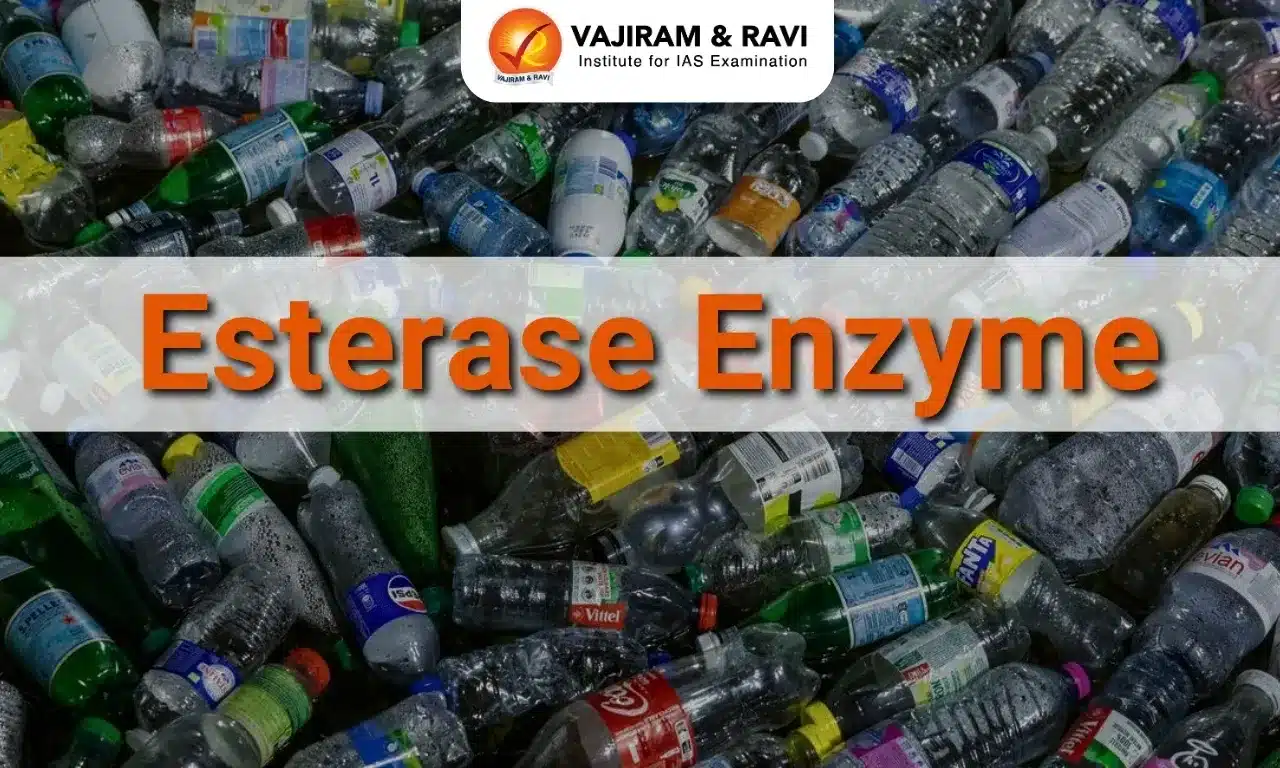
About Esterase Enzyme:
- It is produced by soil bacteria Sulfobacillus acidophilus.
- The esterase enzyme was structurally characterised using X-ray crystallography.
- It remains active for about a month and catalyzes the degradation of diethyl hexyl phthalate (DEHP) plasticizer with significant efficiency.
- The enzyme breaks down the DEHP plasticizer into two products — mono-(2-ethylhexyl) phthalate (MEHP) and 2-ethyl hexanol.
- This esterase enzyme, along with other enzymes identified by their group previously can convert high molecular weight phthalate plasticizers into water and carbon-dioxide.
- Researchers used three other enzymes in sequence are from Comamonas testosteroni bacteria.
- Putting all the five enzymes into bacteria will speed up the degradation process.
- The enzymes, whether used for degradation or not, will remain active only for a short time. But once integrated into bacteria, the enzymes remain active for a longer time and the bacteria can be used continuously for degrading the plasticizers.
- But when the enzymes are used without integrating into bacteria, a fresh batch of enzymes needs to be produced to continue the degradation process.
What are Plasticizers?
- These are chemicals added to plastics and personal care products to enhance flexibility and shine, and are commonly found in items such as baby toys, shampoos, soaps, and food containers.
- Plasticizers can be absorbed through the skin, making them a direct threat to human health.
Q1: What chemical is used as a plasticizer?
Phthalates and adipates are the most commonly used plasticizers. Trimellitates are used in wire and cable and certain other applications where a relatively higher service temperature is required.
Source: TH


 Last updated on Oct, 2026
→ UPSC 2027 Notification will be released on 13 January 2027 at upsconline.nic.in.
→ Check Nobel Prize 2026 Winners List here.
→ Download PIB PRiSM Monthly Magazine 2026 here.
→ Check UPSC Monthly Current Affairs Magazine The Recitals here.
→ Check out the latest UPSC Syllabus here.
→ Download UPSC Model Answers for Mains 2026
→ UPSC Mains Question Paper 2026 is out now for Essay & GS Paper 1, 2, 3 & 4.
→ UPSC Calendar 2027 has been released.
→ Enroll in Vajiram & Ravi’s UPSC Mains Test Series 2027 for structured answer writing practice, expert evaluation, and exam-oriented feedback.
→ Join Vajiram & Ravi’s UPSC Mentorship Program 2027 for personalized guidance, strategy planning, and one-to-one support from experienced mentors.
→ Go through the UPSC Mains Previous Year Papers to enhance your preparation.
→ UPSC has released UPSC Toppers List 2025 with the Civil Services final result on its official website.
→ Also check Best UPSC Coaching in India