Carbon Border Adjustment Latest News
- The Government of India is reportedly preparing a scheme to bear 90% of the compliance cost incurred by MSMEs exporting to the European Union under the Carbon Border Adjustment Mechanism (CBAM).
Carbon Border Adjustment Mechanism (CBAM)
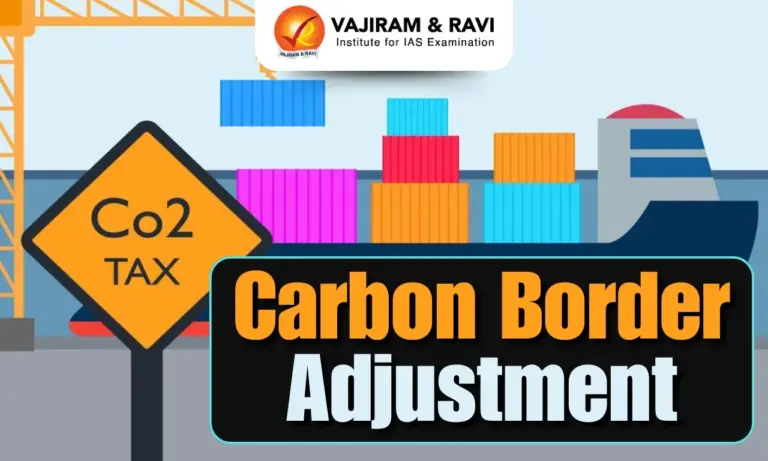
- The Carbon Border Adjustment Mechanism is a carbon pricing mechanism introduced by the European Union (EU) to prevent carbon leakage, the relocation of carbon-intensive industries to countries with less stringent climate regulations.
- Under CBAM, importers of certain goods into the EU must purchase CBAM certificates corresponding to the embedded carbon emissions generated during the production of those goods.
- The mechanism aims to ensure that imported products face a carbon cost similar to that imposed on producers within the EU under the EU Emissions Trading System (EU ETS).
- The transitional phase of CBAM began in October 2023, focusing on emissions reporting, while the financial obligations came into effect from January 1, 2026.
- CBAM currently applies to carbon-intensive products such as:
- Iron and steel, Aluminium, Cement, Fertilisers, Electricity and Hydrogen
- The scope is expected to expand gradually to include additional sectors.


How CBAM Works
- Exporters selling covered products to the EU must report the embedded emissions generated during production.
- These emissions include:
- Direct emissions from manufacturing processes
- Indirect emissions from electricity consumption (for specified sectors such as cement and fertilisers)
- EU importers are required to purchase CBAM certificates based on these verified emissions.
- If exporters fail to provide actual emissions data, the European Commission applies default emission values, which are subject to progressively increasing mark-ups:
- 10% in 2026
- 20% in 2027
- 30% from 2028 onwards
- These higher default values significantly increase compliance costs and reduce the competitiveness of exporters unable to accurately measure and report emissions.
Challenges for Indian MSMEs
- Although CBAM is often viewed as a carbon tax, experts note that the largest burden for MSMEs is compliance rather than taxation.
- To comply with the regulation, exporters must establish systems for:
- Carbon accounting
- Emissions measurement and monitoring
- Third-party verification
- Digital reporting
- Data management and documentation
- According to industry estimates, each MSME may incur compliance costs of Rs. 15-20 lakh merely to meet CBAM reporting requirements.
- Unlike large corporations, MSMEs often lack:
- Technical expertise
- Financial resources
- Dedicated sustainability teams
- Digital infrastructure for emissions reporting
- Since many of these expenses are fixed costs, they do not decrease with lower production or export volumes, placing smaller exporters at a competitive disadvantage.
Government’s Proposed Support Scheme
- Recognising the disproportionate burden on small exporters, the Central Government is working on a scheme to reimburse 90% of CBAM compliance costs for eligible MSMEs. The proposed support is intended to help exporters:
- Develop carbon accounting systems
- Obtain third-party verification
- Build reporting infrastructure
- Continue accessing European markets
- The initiative follows unsuccessful attempts by India to secure special concessions for small industries during negotiations with developed countries.
Impact on Indian Exports
- India is the world’s second-largest producer of crude steel and primary aluminium, making CBAM particularly significant for the country’s manufacturing sector.
- According to a recent Indian Council for Research on International Economic Relations (ICRIER) working paper:
- Iron and steel exports to the EU could decline by nearly 24%, making it the most affected sector.
- India’s overall global exports of iron and steel may decline by 5.7%.
- Fertilisers, aluminium, and fabricated metal products are also expected to face substantial impacts.
- The report further notes that while CBAM is likely to adversely affect India’s exports to the EU, its impact on global carbon emissions is expected to be limited, as emission reductions will depend on the technologies and production processes adopted by exporting countries.
Implications for India
- CBAM presents both challenges and opportunities for India’s manufacturing sector.
- Economic Challenges
- Increased compliance costs for exporters
- Reduced competitiveness of MSMEs in European markets
- Pressure on labour-intensive export sectors
- Additional burden due to the UK’s proposed CBAM from 2027
- Strategic Opportunities
- Adopt cleaner production technologies
- Improve energy efficiency
- Strengthen carbon accounting systems
- Enhance global competitiveness through sustainable manufacturing
- The mechanism may also accelerate India’s transition towards low-carbon industrial production, particularly as global markets increasingly prioritise environmental standards.
Way Forward
- To minimise the impact of CBAM, India should adopt a comprehensive strategy by:
- Providing financial assistance for MSME compliance
- Expanding technical support for carbon accounting and emissions reporting
- Strengthening domestic carbon measurement and verification infrastructure
- Encouraging the adoption of cleaner production technologies through targeted incentives
- Continuing bilateral negotiations with the EU to address concerns of developing countries while ensuring market access for Indian exporters
- Such measures would help Indian industries remain competitive while aligning with global climate commitments.
Source: IE

 Last updated on Oct, 2026
→ UPSC 2027 Notification will be released on 13 January 2027 at upsconline.nic.in.
→ Asian Games 2026 are being held in Aichi-Nagoya, Japan, from 19 September to 4 October.
→ Check Nobel Prize 2026 Winners List here.
→ Download PIB PRiSM Monthly Magazine 2026 here.
→ Check UPSC Monthly Current Affairs Magazine The Recitals here.
→ Check out the latest UPSC Syllabus here.
→ Download UPSC Model Answers for Mains 2026
→ UPSC Mains Question Paper 2026 is out now for Essay & GS Paper 1, 2, 3 & 4.
→ UPSC Calendar 2027 has been released.
→ Enroll in Vajiram & Ravi’s UPSC Mains Test Series 2027 for structured answer writing practice, expert evaluation, and exam-oriented feedback.
→ Join Vajiram & Ravi’s UPSC Mentorship Program 2027 for personalized guidance, strategy planning, and one-to-one support from experienced mentors.
→ Go through the UPSC Mains Previous Year Papers to enhance your preparation.
→ UPSC has released UPSC Toppers List 2025 with the Civil Services final result on its official website.
→ Also check Best UPSC Coaching in India
Carbon Border Adjustment FAQs
Q1. What is the Carbon Border Adjustment Mechanism (CBAM)?+
Q2. Which sectors are currently covered under CBAM?+
Q3. Why are Indian MSMEs particularly affected by CBAM?+
Q4. What financial support is the Government of India considering for MSMEs?+
Q5. According to the ICRIER study, which Indian sector is likely to be the most affected by CBAM?+
Tags: carbon border adjustment mains articles upsc mains current affairs uspc current affairs