Euphaea Wayanadensis Latest News
A new species of damselfly, Euphaea wayanadensis, has been discovered in the Wayanad region of the Western Ghats, Kerala.
- This discovery adds to Kerala’s 191st recorded odonate species and the 223rd odonate species documented from the Western Ghats. The findings were published in the peer-reviewed journal ENTOMON.
About Euphaea wayanadensis
- Classification: Belongs to the family Euphaeidae.
- First sightings: Initially observed in 2013 at the Kalindi River, Thirunelli, in Wayanad district, Kerala.
- Further sightings occurred from 2013 to 2019 in Wayanad, followed by more observations from 2019 to 2023 in Aralam (Kannur, Kerala) and the western slopes of Coorg (Karnataka).
- Identification challenges:
- Initially misidentified as Euphaea pseudodispar, a species from Maharashtra.
- Later confirmed as a distinct species through detailed morphological study and genetic analysis.
Key Morphological Features
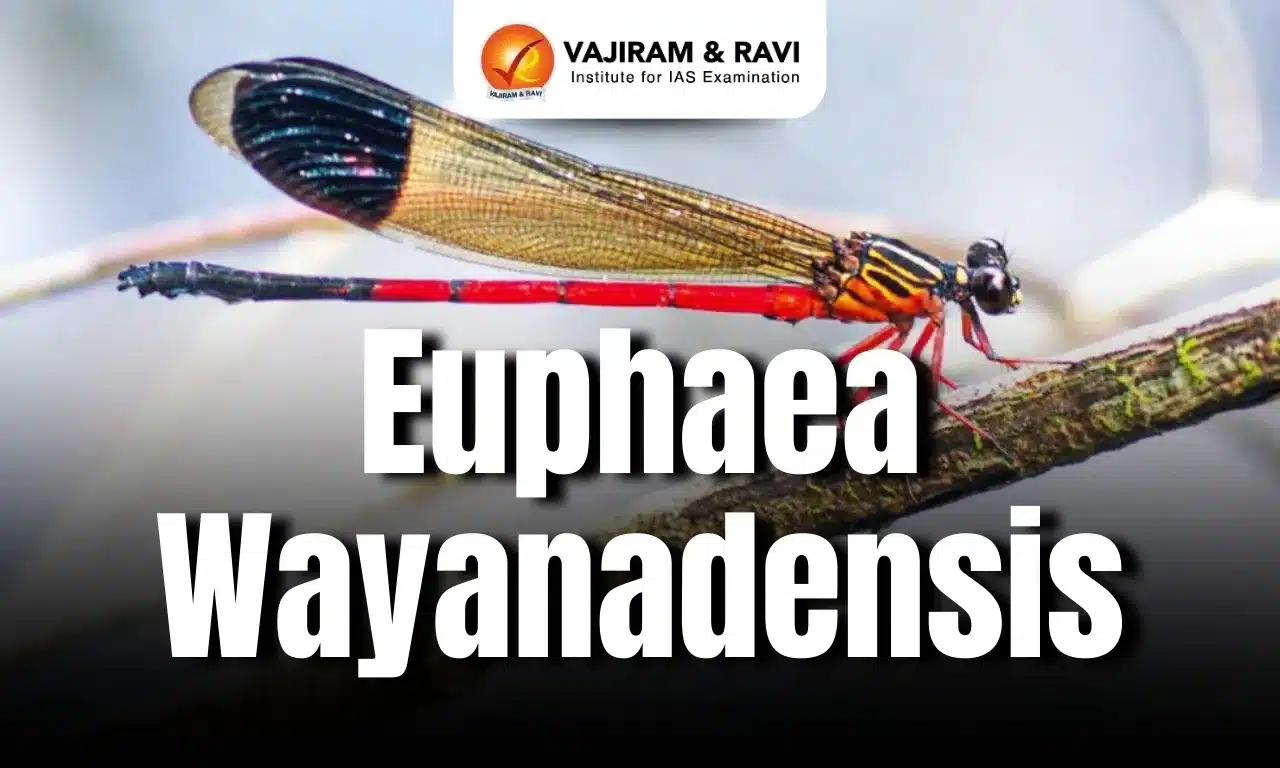
- Distinctive hind wing: Features a longer black patch compared to related species.
- Striking colouration: Males display broader and uninterrupted humeral and antehumeral stripes.
- Unique genital structure: The male genital vesicle exhibits structural traits that differ from closely related species.
Habitat and Distribution
- Prefers fast-flowing streams with rocky beds and aquatic vegetation.
- Thrives in evergreen and semi-evergreen forest regions along stream banks.
- Active throughout the year, except in the dry seasons of March and April.
- Shows highly restricted distribution, making it vulnerable to habitat loss and climate change.


Euphaea Wayanadensis FAQs
Q1. What is Euphaea wayanadensis?
Ans. It is a species of damselfly endemic to the Western Ghats, particularly found in Kerala.
Q2. Why is Euphaea wayanadensis important for ecology?
Ans. It acts as an indicator of freshwater ecosystem health since damselflies are sensitive to water pollution.
Q3. Where was Euphaea wayanadensis first discovered?
Ans. It was first described in Wayanad, Kerala, hence the name “wayanadensis.”
Source: TH

 Last updated on Oct, 2026
→ UPSC 2027 Notification will be released on 13 January 2027 at upsconline.nic.in.
→ Check Nobel Prize 2026 Winners List here.
→ Download PIB PRiSM Monthly Magazine 2026 here.
→ Check UPSC Monthly Current Affairs Magazine The Recitals here.
→ Check out the latest UPSC Syllabus here.
→ Download UPSC Model Answers for Mains 2026
→ UPSC Mains Question Paper 2026 is out now for Essay & GS Paper 1, 2, 3 & 4.
→ UPSC Calendar 2027 has been released.
→ Enroll in Vajiram & Ravi’s UPSC Mains Test Series 2027 for structured answer writing practice, expert evaluation, and exam-oriented feedback.
→ Join Vajiram & Ravi’s UPSC Mentorship Program 2027 for personalized guidance, strategy planning, and one-to-one support from experienced mentors.
→ Go through the UPSC Mains Previous Year Papers to enhance your preparation.
→ UPSC has released UPSC Toppers List 2025 with the Civil Services final result on its official website.
→ Also check Best UPSC Coaching in India