


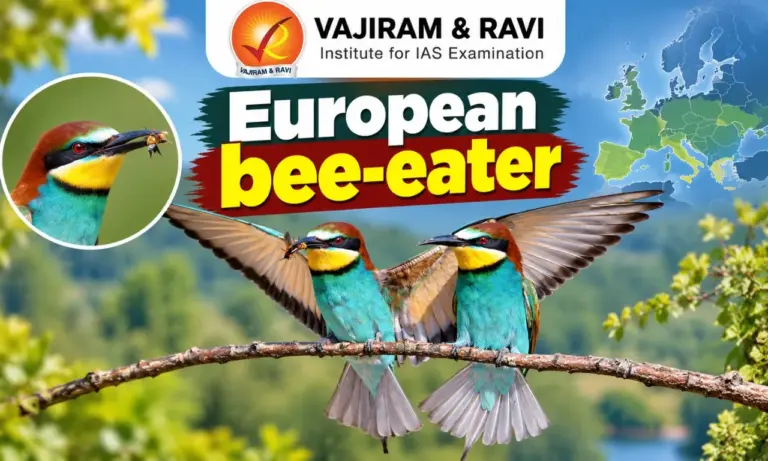
European Bee-Eater Latest News
Recently, for the first time recorded sightings of European Bee-eater in Chennai.
About European Bee-Eater
- It is a near passerine bird in the bee-eater family, Meropidae.
- These brightly-colored birds predominantly eat flying insects, especially bees and wasps
- It is also known as Golden Bee-eaters because of their beautiful coloration.
- Appearance: It has dark, thick, and slightly downward curved bills.
- Habitat: They are commonly found near freshwater systems and inhabit a variety of habitat types such as forest, savanna, shrubland, grassland, and agricultural areas.
- Distribution: The have a broad distribution covering much of Europe and Africa.
- Behavior: These are migratory, diurnal birds that spend most of their time foraging for food.
- Diet: They are carnivores (insectivores) and mainly eat insects, especially bees, wasps, and hornets.
- Conservation Status
-
- IUCN Red List: Least Concern
Source: TH


 Last updated on Oct, 2026
→ UPSC 2027 Notification will be released on 13 January 2027 at upsconline.nic.in.
→ Check Nobel Prize 2026 Winners List here.
→ Download PIB PRiSM Monthly Magazine 2026 here.
→ Check UPSC Monthly Current Affairs Magazine The Recitals here.
→ Check out the latest UPSC Syllabus here.
→ Download UPSC Model Answers for Mains 2026
→ UPSC Mains Question Paper 2026 is out now for Essay & GS Paper 1, 2, 3 & 4.
→ UPSC Calendar 2027 has been released.
→ Enroll in Vajiram & Ravi’s UPSC Mains Test Series 2027 for structured answer writing practice, expert evaluation, and exam-oriented feedback.
→ Join Vajiram & Ravi’s UPSC Mentorship Program 2027 for personalized guidance, strategy planning, and one-to-one support from experienced mentors.
→ Go through the UPSC Mains Previous Year Papers to enhance your preparation.
→ UPSC has released UPSC Toppers List 2025 with the Civil Services final result on its official website.
→ Also check Best UPSC Coaching in India
European Bee-Eater FAQs
Q1. Where do we find European Bee-Eater?+
Q2. What is the IUCN status of European Bee-Eater?+
Tags: european bee-eater









