Evaporative Demand Latest News
The rising evaporative demand in India is exposing significant gaps in the country’s climate data and research.
About Evaporative Demand
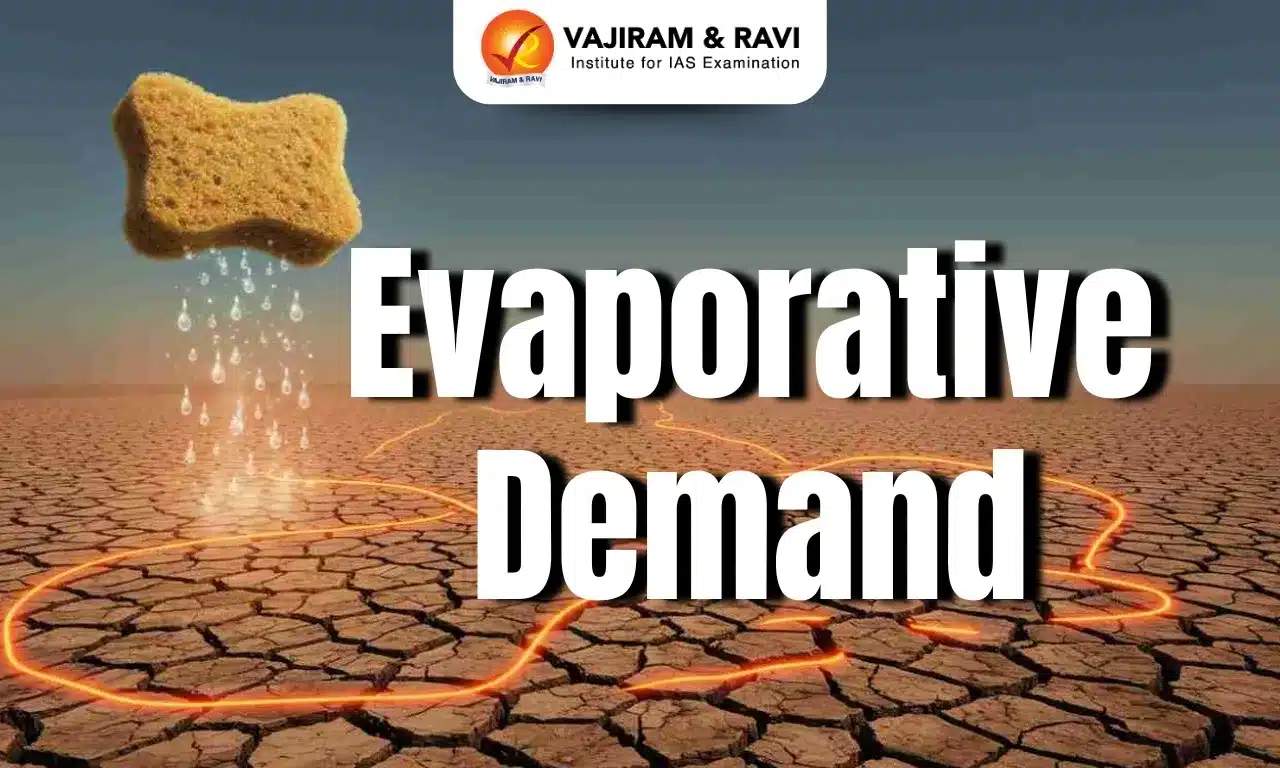
- Evaporative demand is a measure of how thirsty the atmosphere is.
- It determines the near-maximum of how much water will evaporate from a given piece of land if sufficient water is available.
- It does not necessarily relate to actual evaporation rate, as if there is little water supply there can only be a small evaporation rate, no matter how large the demand.
- It is driven by atmospheric factors including temperature, wind speed, humidity and cloud cover.
- Periods of high evaporative demand are connected to droughts and increased fire danger.
- Tracking extended periods with above normal evaporative demand can be a useful way to detect drought onset, drought intensification, and elevated fire danger.
- Above normal temperatures, clear skies, and wind speed, and below normal humidity all drive evaporative demand up and lead to quicker drying at the surface.
- Soil moisture is reduced which leads to less water available for plants and vegetation becomes stressed and more flammable.
- When extended periods of below normal precipitation overlap with extended periods of above normal evaporative demand fuels become critically dry favoring rapidly spreading wildfires.


What is a Thirstwave?
- It denotes three or more contiguous days of intense evaporative demand.
- While heat waves are caused by particular temperature and wind patterns, a thirstwave is the product of temperature, humidity, solar radiation, and wind speed.
- When temperatures rise, the consequences include more heat as well as the mechanics of water exchange between land and atmosphere, which in turn alters humidity, wind, and solar radiation.
- In a warming world, the researchers found that thirstwaves have grown more intense, are more frequent, and are lasting longer.
Source: TH

 Last updated on Oct, 2026
→ UPSC 2027 Notification will be released on 13 January 2027 at upsconline.nic.in.
→ Check Nobel Prize 2026 Winners List here.
→ Download PIB PRiSM Monthly Magazine 2026 here.
→ Check UPSC Monthly Current Affairs Magazine The Recitals here.
→ Check out the latest UPSC Syllabus here.
→ Download UPSC Model Answers for Mains 2026
→ UPSC Mains Question Paper 2026 is out now for Essay & GS Paper 1, 2, 3 & 4.
→ UPSC Calendar 2027 has been released.
→ Enroll in Vajiram & Ravi’s UPSC Mains Test Series 2027 for structured answer writing practice, expert evaluation, and exam-oriented feedback.
→ Join Vajiram & Ravi’s UPSC Mentorship Program 2027 for personalized guidance, strategy planning, and one-to-one support from experienced mentors.
→ Go through the UPSC Mains Previous Year Papers to enhance your preparation.
→ UPSC has released UPSC Toppers List 2025 with the Civil Services final result on its official website.
→ Also check Best UPSC Coaching in India
Evaporative Demand FAQs
Q1. What does evaporative demand mean?+
Q2. What atmospheric condition causes increased evaporative demand?+
Q3. What does high evaporative demand indicate about surface moisture?+
Q4. What is the relationship between evaporative demand and droughts?+
Q5. What impact does high evaporative demand have on vegetation?+
Tags: evaporative demand prelims pointers upsc current affairs upsc prelims current affairs