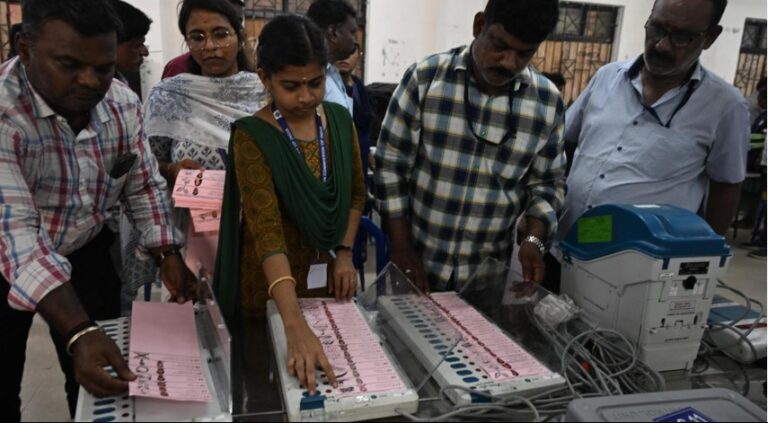
EVM Totaliser Latest News
- Recently, a Supreme Court Bench of Chief Justice Surya Kant, Justice Joymalya Bagchi, and Justice V. Mohana asked the Central government to examine introducing “totaliser” machines for counting EVM votes.
- The goal: protect the secrecy of booth-wise voting patterns and prevent voters at individual booths from being identified and potentially victimised.
What Is a Totaliser?
- A totaliser is a device that allows votes from about 14 polling booths to be counted together, instead of the current practice of tallying votes booth by booth.
- It is developed by Bharat Electronics Limited (Bengaluru) and Electronics Corporation of India Limited (Hyderabad).
- It works as an interface connected to the main control unit of a cluster of 14 EVMs.
- Pressing a single result button gives the consolidated vote count for each candidate across that entire cluster — without revealing how votes were split booth-wise.


How Did This Case Begin?
- The case dates back to 2014, when two individuals — Yogesh Gupta and Imran Khan — filed a public interest petition asking the Election Commission to mix up votes across polling stations within a constituency.
- Their argument: this was necessary to stop candidates from intimidating voters in areas that had rejected them in the past.
- They cited an alleged instance involving former Maharashtra Deputy CM Ajit Pawar in the Baramati constituency, where he reportedly threatened that his party (NCP) could identify anti-party voting patterns from EVM data and cut off water supply to those areas as retaliation.
The Centre’s Position: Historically Opposed
- The Central government has consistently resisted the totaliser proposal:
- In 2017, the Centre told the Court that knowledge of booth-wise voting patterns does not lead to intimidation — instead, it helps candidates work harder in areas with low support, benefiting everyone.
- A Law Ministry affidavit cited a Group of Ministers (headed by then-Home Minister Rajnath Singh) which concluded that large-scale voter intimidation was unlikely “in this era of media activism”.
- In 2018, Additional Solicitor General argued that installing a totaliser could cause a data breach even before counting begins.
- More recently, the Centre again raised concerns about potential EVM data leaks before counting — prompting the Court to give the Election Commission two weeks to respond to these specific concerns
The Election Commission’s Position: Consistently Supportive
- Unlike the Centre, the Election Commission of India (ECI) has backed totalisers for years:
- First proposed the idea to the UPA government in 2008.
- In a 2018 submission to the Supreme Court, it stated: “a time has come for introduction of totaliser for counting of votes”.
- In the current hearings, the EC reaffirmed its support for protecting voter anonymity, while also flagging practical and legal challenges — particularly around booth-wise verification and VVPAT (Voter Verified Paper Audit Trail).
What Did the Supreme Court Say Now?
- The Court directed the Central government to clearly state its position on introducing totalisers, specifically asking:
- Whether there are any impediments to implementing such a system;
- Whether it would have any negative impact.
- The Election Commission has also been asked to submit its formal proposal to the Union government.
Why This Matters
- This case touches a fundamental tension in electoral democracy: the right to a secret ballot versus the practical benefits candidates derive from booth-level voting data.
- If large-scale voter intimidation based on booth-wise EVM results is a real risk, totalisers could offer a technological safeguard — but concerns around data security and verification mechanisms like VVPAT remain unresolved.
Conclusion
- The totaliser debate reflects a long-standing tussle between safeguarding voter anonymity and the Centre’s practical and security-related reservations.
- With the Supreme Court now directing both the Centre and the Election Commission to clarify their positions, the coming weeks could determine whether India moves toward a more anonymised, cluster-based EVM counting system — a significant step for electoral integrity.

 Last updated on Oct, 2026
→ UPSC 2027 Notification will be released on 13 January 2027 at upsconline.nic.in.
→ Check Nobel Prize 2026 Winners List here.
→ Download PIB PRiSM Monthly Magazine 2026 here.
→ Check UPSC Monthly Current Affairs Magazine The Recitals here.
→ Check out the latest UPSC Syllabus here.
→ Download UPSC Model Answers for Mains 2026
→ UPSC Mains Question Paper 2026 is out now for Essay & GS Paper 1, 2, 3 & 4.
→ UPSC Calendar 2027 has been released.
→ Enroll in Vajiram & Ravi’s UPSC Mains Test Series 2027 for structured answer writing practice, expert evaluation, and exam-oriented feedback.
→ Join Vajiram & Ravi’s UPSC Mentorship Program 2027 for personalized guidance, strategy planning, and one-to-one support from experienced mentors.
→ Go through the UPSC Mains Previous Year Papers to enhance your preparation.
→ UPSC has released UPSC Toppers List 2025 with the Civil Services final result on its official website.
→ Also check Best UPSC Coaching in India
EVM Totaliser FAQs
Q1. What is an EVM Totaliser?+
Q2. How does an EVM Totaliser protect voter anonymity?+
Q3. Why has the Supreme Court considered an EVM Totaliser?+
Q4. What is the Election Commission's position on an EVM Totaliser?+
Q5. Why has the Centre opposed an EVM Totaliser?+
Tags: EVM Totaliser mains articles upsc current affairs upsc mains current affairs