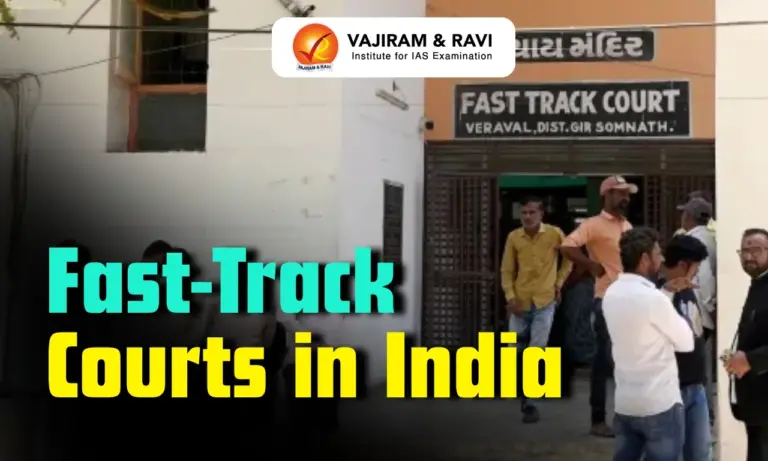
Fast-Track Courts in India Latest News
- PM Modi has proposed setting up fast-track courts (FTCs) to try paper leak cases amid ongoing protests.
- This has renewed focus on whether such courts can genuinely deliver on their promise of speedy justice, given India’s persistent judicial backlog.
What Are Fast-Track Courts?
- FTCs are not governed by a single central legislation. Their origin lies in the recommendations of the Fourteenth Finance Commission (2015–2020), which proposed setting up 1,800 FTCs to expedite trials of:
- Heinous crimes such as murder, kidnapping, and extortion
- Property disputes pending for over five years
- Cases involving vulnerable groups — women, children, senior citizens, persons with disabilities, and those with terminal illnesses


Fast-Track Special Courts (FTSCs)
- In 2019, following a criminal law amendment and a Supreme Court directive, the Union government launched a centrally sponsored scheme for FTSCs.
- Partly funded through the Nirbhaya Fund, these courts are dedicated exclusively to time-bound trials of rape cases and offences under the POCSO Act.
Can a Special Court Be Set Up for a Single Case?
- Setting up special courts must satisfy Article 14 (equality before law).
- In State of West Bengal vs Anwar Ali Sarkar (1952), the Supreme Court struck down a law allowing arbitrary selection of cases for special courts merely for “speedier trial,” holding that speed alone is too vague a justification.
- Any classification for fast-tracking must rest on a rational, objective basis — such as the nature of the offence or victim vulnerability.
Precedents of case-specific special courts
- Andhra Pradesh High Court set up a special court in 2010 for the Satyam Computer Services scam.
- The Supreme Court directed a dedicated special court for the 2G spectrum allocation scam (notified March 2011, Patiala House Courts).
- It remains to be seen whether the NEET paper leak case, currently before a Delhi court, will similarly be referred to a special court.
Speed and Targets
- Litigants have no automatic statutory right to a fixed trial deadline.
- The Bharatiya Nagarik Suraksha Sanhita (BNSS) recommends trials be completed within two years generally, and within two months for sexual offences.
- Each FTSC is expected to dispose of 41–42 cases per quarter, translating to at least 165 cases annually.
Performance So Far
- As of January 2026: 862 regular FTCs functioning across 21 states/UTs, alongside 774 FTSCs (including 398 exclusive POCSO courts) across 29 states/UTs.
- FTSC disposal rate stands at around 96%.
- In 2024, 88,902 new cases were filed in FTSCs while 85,595 were resolved.
- An FTSC disposes of about 9.5 cases per month — nearly three times the 3.3 cases cleared monthly by a regular trial court of similar jurisdiction.
- Despite high clearance rates, pendency remains significant: over 2.4 lakh cases were pending in FTSCs by end-2023.
Why Delays Persist
- The Ministry of Law and Justice, in a March 2026 Lok Sabha response, attributed delays to multiple factors: infrastructure availability, case complexity, investigation quality, evidence nature, and cooperation among the bar, investigating agencies, forensic support, witnesses, and litigants.
- Legal experts note mixed efficacy across subject areas — FTCs handling POCSO and IPC cases face heavy case volumes and judge shortages, while those under the Prevention of Corruption Act show comparatively better outcomes.
Judicial Position on Trial Timelines
- In P. Rama Chandra Rao vs State of Karnataka (2002), a seven-judge Constitution Bench ruled it is “neither advisable nor judicially permissible” to prescribe a fixed outer limit for concluding criminal trials, holding that such rigid limitation would amount to impermissible judicial legislation.
Conclusion
- Fast-track courts offer measurably faster case disposal than regular courts, but their success is constrained by infrastructure gaps, judge shortages, and rising case inflow.
- Without addressing these root causes, fast-tracking risks becoming a symbolic response to public pressure rather than a durable fix for India’s justice delivery system.
Source: IE

 Last updated on Oct, 2026
→ UPSC 2027 Notification will be released on 13 January 2027 at upsconline.nic.in.
→ Check Nobel Prize 2026 Winners List here.
→ Download PIB PRiSM Monthly Magazine 2026 here.
→ Check UPSC Monthly Current Affairs Magazine The Recitals here.
→ Check out the latest UPSC Syllabus here.
→ Download UPSC Model Answers for Mains 2026
→ UPSC Mains Question Paper 2026 is out now for Essay & GS Paper 1, 2, 3 & 4.
→ UPSC Calendar 2027 has been released.
→ Enroll in Vajiram & Ravi’s UPSC Mains Test Series 2027 for structured answer writing practice, expert evaluation, and exam-oriented feedback.
→ Join Vajiram & Ravi’s UPSC Mentorship Program 2027 for personalized guidance, strategy planning, and one-to-one support from experienced mentors.
→ Go through the UPSC Mains Previous Year Papers to enhance your preparation.
→ UPSC has released UPSC Toppers List 2025 with the Civil Services final result on its official website.
→ Also check Best UPSC Coaching in India
Fast-Track Courts in India FAQs
Q1. What are Fast-Track Courts in India and why were they established?+
Q2. How are Fast-Track Courts in India different from Fast-Track Special Courts?+
Q3. Can Fast-Track Courts in India be established for a single case?+
Q4. Why do Fast-Track Courts in India continue to face delays despite higher disposal rates?+
Q5. Why are Fast-Track Courts in India important for judicial reforms?+
Tags: Fast-Track Courts in India mains articles upsc current affairs upsc mains current affairs