FCRA Bill and JPC Latest News
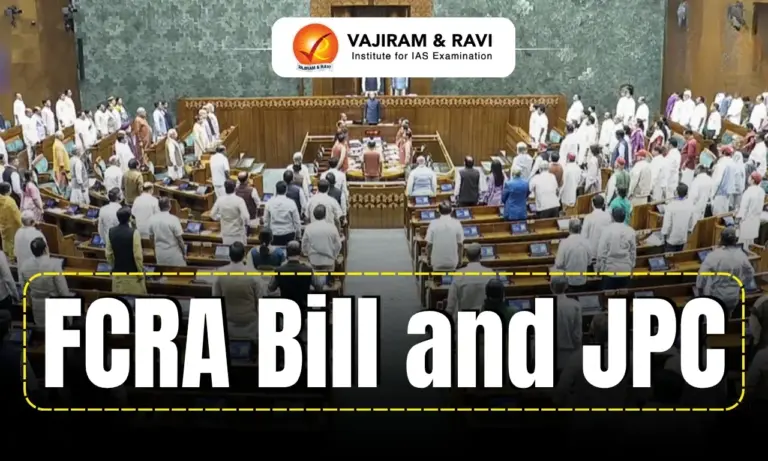
- The Lok Sabha has referred the Foreign Contribution (Regulation) Amendment Bill, 2026 to a Joint Parliamentary Committee (JPC), amid strong objections over provisions including the retrospective vesting of foreign-funded assets in a government-designated authority.
- This has renewed debate on how much difference parliamentary committees actually make when the ruling party holds a majority within them.
Purpose of Parliamentary Committees
- Parliamentary committees exist to address a basic limitation of Parliament: the two Houses have limited time to examine an increasingly complex body of legislation and policy.
- Smaller committees can:
- Spend considerably more time examining a Bill
- Question officials and hear experts/stakeholders
- Scrutinise provisions clause by clause
- The committee system is not meant to replicate the political contest on the House floor.
- As Rajya Sabha’s literature describes it, the underlying philosophy is:
- influence, not direct control;
- advise, not command;
- criticism, not obstruction;
- scrutiny, not initiative;
- accountability, not prior approval.


Types of Parliamentary Committees
- Department-related Standing Committees: Examine the functioning and policies of ministries on an ongoing basis.
- Financial Committees: Scrutinise government expenditure.
- Select Committees: Constituted by one House to examine a specific Bill.
- Joint Parliamentary Committee (JPC): Has members from both Lok Sabha and Rajya Sabha, constituted for a specific Bill or issue.
- Committees can call for persons, papers, and records, and take evidence — but their recommendations are not binding on the government.
The Central Limitation: Ruling Party Majority
- JPC membership broadly reflects the strength of parties in Parliament.
- Since the ruling party or alliance typically has a majority in the Lok Sabha, it also holds a majority in the JPC, and the chairperson is usually from the government benches.
- Decisions are taken by majority vote, with the chairperson holding a casting vote in case of a tie.
- However, this does not render the Opposition powerless. Within a committee, the Opposition can:
- Demand specific witnesses
- Question officials
- Put evidence on record
- Propose changes to the draft report
- File a dissent note if it disagrees with the majority
- The real question, therefore, is not whether Opposition MPs are heard, but whether they can actually change the law — and here, the record is far less encouraging.
Have JPCs Actually Changed Laws?
- Yes — but by modification, not by overturning.
- Stock Market Scam JPC (2001-02): Under the then NDA government, produced detailed recommendations on regulatory surveillance and coordination between SEBI and stock exchanges. The government reported action on 236 recommendations.
- Pesticide Residues JPC (2004): Confirmed unacceptable pesticide levels in soft drinks and recommended stringent safety standards, contributing to subsequent regulatory action.
- Multi-State Co-operative Societies (Amendment) Bill, 2022: The JPC’s recommendations on the Cooperative Election Authority’s composition and functioning were largely incorporated into the final law.
- Biological Diversity (Amendment) Bill, 2021: Retained the government’s broad approach but incorporated some safeguards and clarifications.
- Financial Resolution and Deposit Insurance (FRDI) Bill, 2017: Following JPC scrutiny of controversial “bail-in” provisions and concerns over depositor protection, the government eventually withdrew the Bill altogether — though broader public and political opposition also contributed.
When Opposition Dissent Didn’t Prevail
- Personal Data Protection Bill JPC: Retained broad government exemptions despite Opposition objections on surveillance safeguards. The 2019 Bill was eventually withdrawn, and a new law was introduced in 2022 — though it too retained broad exemption powers for the government.
- Citizenship (Amendment) Bill, 2016: The JPC retained the Bill’s central objective despite Opposition concerns on the religious criterion and implications for Assam and secularism. The 2019 Act broadly followed the original approach.
- 2G JPC: Broadly defended the government’s position on telecom allocation despite Opposition dissent notes. Its conclusions had limited influence — the legal and political trajectory was shaped more directly by CAG findings and the Supreme Court’s cancellation of licences.
- This shows the partisan character of JPCs is not unique to any one government — when an issue is politically central to the ruling side, its majority tends to be decisive.
Has the Committee System Weakened Over Time?
- Data from PRS Legislative Research shows a sharp decline in the referral of Bills to parliamentary committees generally:
- 14th (2004-09) ~60%
- 15th (2009-14) ~71%
- 16th (2014-19) ~25%
- 17th (2019-24) ~16%
- The emerging pattern: routine scrutiny has weakened, even as JPCs are increasingly reserved for particularly contentious legislation.
Why the FCRA Referral Matters
- The government had the numbers to push the FCRA Bill through the Lok Sabha directly.
- Instead, following strong objections, it opted for a JPC — giving stakeholders a formal forum to place concerns on record, while the government retains the discretion to decide which concerns it is willing to accommodate.
Conclusion
- JPCs rarely overturn a government’s core legislative intent, but they consistently force explanation, modification, and public scrutiny — a meaningful check even within majoritarian limits.
- The declining use of committee scrutiny overall makes the FCRA Bill’s JPC referral a notable, if modest, reaffirmation of deliberative process over numerical dominance.
Source: IE

 Last updated on Oct, 2026
→ UPSC 2027 Notification will be released on 13 January 2027 at upsconline.nic.in.
→ Check Nobel Prize 2026 Winners List here.
→ Download PIB PRiSM Monthly Magazine 2026 here.
→ Check UPSC Monthly Current Affairs Magazine The Recitals here.
→ Check out the latest UPSC Syllabus here.
→ Download UPSC Model Answers for Mains 2026
→ UPSC Mains Question Paper 2026 is out now for Essay & GS Paper 1, 2, 3 & 4.
→ UPSC Calendar 2027 has been released.
→ Enroll in Vajiram & Ravi’s UPSC Mains Test Series 2027 for structured answer writing practice, expert evaluation, and exam-oriented feedback.
→ Join Vajiram & Ravi’s UPSC Mentorship Program 2027 for personalized guidance, strategy planning, and one-to-one support from experienced mentors.
→ Go through the UPSC Mains Previous Year Papers to enhance your preparation.
→ UPSC has released UPSC Toppers List 2025 with the Civil Services final result on its official website.
→ Also check Best UPSC Coaching in India
FCRA Bill and JPC FAQs
Q1. Why was the FCRA Bill referred to a JPC?+
Q2. What is the role of a JPC in examining legislation?+
Q3. Can parliamentary committees override the government's legislative position?+
Q4. What limits the effectiveness of parliamentary committees? +
Q5. Why is the FCRA Bill's JPC referral significant?+
Tags: FCRA Bill and JPC mains articles upsc current affairs upsc mains current affairs