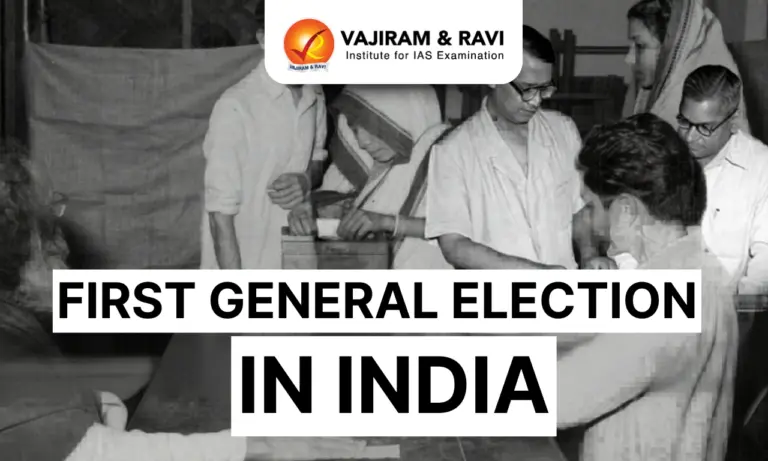
First General Election in India held during 1951-52 became one of the most important democratic exercises in modern history. It was conducted between 25 October 1951 and 21 February 1952 and marked the beginning of parliamentary democracy in independent India. The election introduced universal adult franchise for citizens above 21 years of age and involved nearly 17.32 crore eligible voters across the country except Jammu and Kashmir. It was the largest election ever conducted globally at that time and established India’s commitment to democratic governance despite poverty, illiteracy and administrative challenges.
First General Election in India Historical Background
Independent India needed an elected government after the Constitution came into force and the interim Constituent Assembly system ended gradually.
- Adoption of Constitution: India adopted the Constitution on 26 November 1949, signed it on 24 January 1950 and implemented it on 26 January 1950, making democratic elections necessary for forming a representative government.
- Interim Government System: After independence in August 1947, the country was governed by the Constituent Assembly functioning as an interim legislature until elected representatives could take charge through national elections.
- Commitment to Democracy: Several newly independent nations moved toward military or one party rule, but Indian leaders chose parliamentary democracy despite concerns about illiteracy, poverty, linguistic diversity and regional differences.
- Universal Adult Franchise Decision: India granted voting rights to every citizen above 21 years irrespective of caste, gender, education, religion, or wealth, making it one of the boldest democratic experiments globally during that period.
- Ambedkar’s View: B R Ambedkar warned against hero worship in politics during the Constituent Assembly debates on 25 November 1949 and stressed the importance of constitutional democracy over authoritarian leadership.
- Establishment of Election Commission: The Election Commission of India was established in January 1950 to supervise free and fair elections, with Sukumar Sen appointed as the country’s first Chief Election Commissioner.
- Massive Electoral Preparation: Electoral rolls had to be prepared for nearly 17 crore eligible voters while constituency boundaries were drawn through delimitation before the country’s first democratic exercise could begin.
- Global Democratic Experiment: Many foreign observers doubted whether democracy could survive in an illiterate and poor country like India, making the first election an important global test of democratic governance.
First General Election in India
The First General Election in India introduced several unique administrative and democratic practices to manage voting across a vast and diverse country successfully.
- Election Timeline: The first general election started on 25 October 1951 and continued till 21 February 1952, while most polling across India took place during January and February 1952.
- Scale of Election: Nearly one-sixth of the world’s population participated in the process, making it the biggest election conducted anywhere in the world at that point in history.
- Eligible Voters: Around 17.32 crore citizens out of India’s 36 crore population became eligible voters, while nearly 82% of electors were unlettered and unfamiliar with democratic voting procedures.
- Voter Participation: The election recorded approximately 45% voter turnout, which was considered encouraging for a newly independent country conducting its first democratic exercise on such a massive scale.
- Political Party Participation: A total of 53 political parties contested the elections, including 14 national parties such as Indian National Congress, Communist Party of India, Socialist Party, Kisan Mazdoor Praja Party and Akhil Bharatiya Hindu Mahasabha.
- Constituencies and Candidates: About 1,874 candidates contested for 489 Lok Sabha seats from 401 constituencies, while some constituencies had multiple seats before the system was abolished during the 1960s.
- Use of Election Symbols: Due to low literacy rates of around 18.33% in 1951, candidates were identified through election symbols displayed on separate ballot boxes placed at polling stations.
- Ballot Paper Design: Ballot papers were pink in colour and carried the words “Election Commission India” along with serial numbers and state identification letters such as BR for Bihar and AS for Assam.
- Separate Ballot Boxes: Different ballot boxes were kept for every candidate at polling booths because the earlier proposal of coloured ballot boxes for candidates was considered administratively impractical.
- Training of Election Staff: The Election Commission trained more than 3 lakh officers and polling personnel to manage voting, counting, transportation, security and administrative coordination across the country.
- Mock Election Exercise: A practice election was conducted in September 1951 to educate voters about voting procedures because millions of citizens had never participated in elections earlier.
- First Vote Cast: The first vote of India’s inaugural general election was cast at Chini village in Himachal Pradesh due to weather conditions and accessibility concerns in mountainous regions.
- Notable Election Winners: Important leaders elected included Jawaharlal Nehru, Lal Bahadur Shastri, Sucheta Kripalani, Gulzari Lal Nanda, Kakasaheb Kalelkar and Shyama Prasad Mukherjee.
- Significant Achievement: Ravi Narayana Reddy from Telangana, representing the People’s Democratic Front, became the first person to enter Parliament and secured more votes than Jawaharlal Nehru.


First General Election in India Legal Framework
The process of the First General Election in India was supported by constitutional provisions, parliamentary laws and independent institutional mechanisms for democratic functioning in India.
- Constitutional Foundation: The Constitution of India established parliamentary democracy, universal adult franchise, independent elections and representative government as essential principles of the political system.
- Representation of the People Act, 1950: This law provided rules regarding preparation of electoral rolls, allocation of seats and delimitation of constituencies for conducting democratic elections effectively.
- Representation of the People Act, 1951: The Act defined voter qualifications, election procedures, disqualifications, corrupt practices, candidate nominations, election disputes and administrative aspects of electoral management.
- Role of Election Commission: The Election Commission received constitutional authority to supervise, direct and control elections to Parliament and state legislatures while ensuring neutrality and fairness.
- Universal Adult Suffrage Provision: Every Indian citizen above 21 years received voting rights without discrimination, while the voting age was later reduced to 18 years through the Constitution (Sixty first Amendment) Act, 1989.
- Delimitation Mechanism: Electoral constituencies were carefully demarcated before elections to ensure balanced representation of population and fair participation across different geographical regions of India.
First General Election in India Outcomes
The First General Election in India established Congress dominance while also creating a functioning parliamentary system and opposition politics in independent India successfully.
- Electoral Victory: The Indian National Congress led by Jawaharlal Nehru secured a massive victory by winning 364 out of 489 Lok Sabha seats with nearly 47,665,875 votes.
- Other Parties’ Performance:
- The Communist Party of India emerged as the second largest party with 16 seats and around 3,484,401 votes, becoming the principal opposition force in Parliament.
- The Socialist Party led by Ram Manohar Lohia and Jayaprakash Narayan won 12 seats despite securing over 11,266,779 votes nationwide during the election.
- Bharatiya Jana Sangh under Shyama Prasad Mukherjee secured 3 seats and approximately 3,246,288 votes, marking the beginning of a future national political force.
- The party led by Acharya Kripalani obtained 9 seats and received more than 6,156,558 votes during the first parliamentary election process.
- Independent candidates collectively won 37 seats and secured nearly 16,817,910 votes, showing strong local influence in many constituencies during the early democratic phase.
- Formation of First Lok Sabha: The first Lok Sabha started functioning in April 1952 and completed its full constitutional term till April 1957 with a record 677 sittings.
- First Prime Minister: Jawaharlal Nehru became India’s first democratically elected Prime Minister after the Congress victory and represented the Phulpur constituency in Uttar Pradesh till 1964.
- Speaker of Lok Sabha: G V Mavalankar became the first Speaker of the Lok Sabha and played an important role in establishing parliamentary traditions and legislative procedures.
- Anglo Indian Representation: Two members from the Anglo Indian community were nominated to the Lok Sabha to ensure minority representation within India’s parliamentary democratic framework.
First General Election in India Significance
The First General Election in India proved the success of democracy in India and shaped the country’s long term constitutional and political development strongly.
- Democratic Consolidation: The election established democratic governance immediately after independence and prevented authoritarian or military rule that emerged in several newly decolonised countries during the same period.
- Success of Universal Franchise: India successfully implemented universal adult suffrage despite widespread illiteracy and poverty, demonstrating that democratic participation was possible beyond developed Western nations.
- Strengthening Constitutional Institutions: The successful functioning of the Election Commission, Parliament and electoral laws strengthened faith in constitutional institutions among citizens across diverse regions of India.
- Political Participation of Masses: Millions of ordinary citizens voted for the first time, integrating rural populations, women, marginalised groups and poor communities into national political processes.
- International Democratic Example: India’s 1952 election became a global landmark proving that democracy could function successfully in a newly independent, multilingual and economically underdeveloped society.
- Foundation of Parliamentary Tradition: The first Lok Sabha established legislative debates, parliamentary procedures, opposition participation, cabinet responsibility and electoral accountability that later became permanent democratic traditions in India.
- Rise of Competitive Politics: Although Congress dominated initially, opposition parties such as CPI, Socialist Party, Bharatiya Jana Sangh and regional leaders laid foundations for future competitive multi party politics.
- Public Faith in Elections: The peaceful and organised conduct of elections increased public confidence in ballots over violence and strengthened democratic culture within Indian political life for future generations.

 Last updated on Oct, 2026
→ UPSC 2027 Notification will be released on 13 January 2027 at upsconline.nic.in.
→ Asian Games 2026 are being held in Aichi-Nagoya, Japan, from 19 September to 4 October.
→ Check Nobel Prize 2026 Winners List here.
→ Download PIB PRiSM Monthly Magazine 2026 here.
→ Check UPSC Monthly Current Affairs Magazine The Recitals here.
→ Check out the latest UPSC Syllabus here.
→ Download UPSC Model Answers for Mains 2026
→ UPSC Mains Question Paper 2026 is out now for Essay & GS Paper 1, 2, 3 & 4.
→ UPSC Calendar 2027 has been released.
→ Enroll in Vajiram & Ravi’s UPSC Mains Test Series 2027 for structured answer writing practice, expert evaluation, and exam-oriented feedback.
→ Join Vajiram & Ravi’s UPSC Mentorship Program 2027 for personalized guidance, strategy planning, and one-to-one support from experienced mentors.
→ Go through the UPSC Mains Previous Year Papers to enhance your preparation.
→ UPSC has released UPSC Toppers List 2025 with the Civil Services final result on its official website.
→ Also check Best UPSC Coaching in India
First General Election in India FAQs
Q1. When were the First General Election in India held?+
Q2. Who was the first Chief Election Commissioner of India?+
Q3. Which party won the First General Election in India?+
Q4. What was the voter turnout in the First General Election in India?+
Q5. How many political parties participated in the First General Election in India?+
Tags: first general election in india history history notes