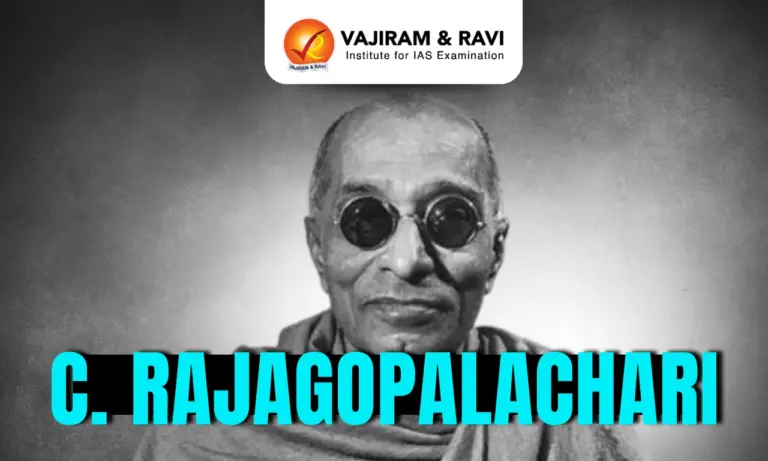
C. Rajagopalachari, popularly known as Rajaji, was one of the most influential leaders of modern India. He was a freedom fighter, lawyer, administrator, writer, social reformer and independent India’s first and only Indian Governor General. Rajaji played a major role in the national movement, temple entry reforms, education policy, economic liberalism and literary development in Tamil and English languages. His ideas on Swaraj, self reliance and ethical governance continue to shape Indian political and social thought.
C. Rajagopalachari Biography
C. Rajagopalachari’s life reflected intellectual brilliance, administrative capability and commitment towards India’s political and social transformation.
- C. Rajagopalachari was born on December 10, 1878, at Thorapalli in present day Tamil Nadu. He belonged to a Tamil Brahmin family and displayed exceptional academic ability from an early age.
- He studied law at Presidency College, Madras and started legal practice at Salem in 1900. Rajaji soon became one of the most respected lawyers of the Madras Presidency.
- Rajaji joined the Salem Municipal Council in 1911 and later became Chairman of Salem Municipality in 1917. His administrative work improved sanitation, education and civic governance in the region.
- He attended the 1906 Calcutta and 1907 Surat sessions of the Indian National Congress. His active participation gradually transformed him into an important nationalist leader from South India.
- In 1916, Rajaji founded the Tamil Scientific Terms Society to simplify scientific terminology in Tamil for subjects like mathematics, astronomy, chemistry, biology and physics.
- Rajaji met Mahatma Gandhi in 1919 at Madras. Their close association was based on mutual trust, non violence and commitment towards Indian independence.
- He died on December 25, 1972 and was accorded full state honours.
Role of C. Rajagopalachari in Pre Independence Era
C. Rajagopalachari Rajaji emerged as a major nationalist strategist and social reformer during India’s struggle against British colonial rule and political domination.
- Non Cooperation Movement: Rajaji actively participated in Gandhi’s Non Cooperation Movement and gave up his profitable legal profession. He was imprisoned in Vellore Jail in 1920 for nationalist activities against British rule.
- Promotion of Gandhian Ideals: After release from prison, Rajaji established an ashram promoting Hindu-Muslim Unity, khadi usage, village upliftment and abolition of untouchability across southern India.
- Rowlatt Satyagraha Participation: Rajaji supported the 1919 Rowlatt Satyagraha against repressive colonial laws and became one of the strongest voices against arbitrary British governance and civil rights suppression.
- Vaikom Satyagraha Contribution: He participated in the Vaikom Satyagraha movement in Kerala against caste discrimination and restrictions imposed on lower castes around temple roads and public spaces.
- Vedaranyam Salt March: During the Civil Disobedience Movement in 1930, Rajaji led the Trichy to Vedaranyam Salt March, considered the southern counterpart of Gandhi’s Dandi March against salt laws.
- Editor of Young India: Rajaji also worked as editor of Gandhi’s newspaper Young India and used journalism as a tool to spread nationalist thought and anti colonial political awareness.
- Premier of Madras Presidency: In 1937, Rajaji became the first Premier of the Madras Presidency under the Government of India Act, 1935, strengthening responsible provincial governance.
- Stand During Quit India Movement: Rajaji opposed the Quit India Movement initially because he believed negotiations with the British and Muslim League would better protect India from political instability and partition.
- Governor of West Bengal: During Partition in 1947, Rajaji served as Governor of West Bengal and handled difficult communal tensions during one of India’s most sensitive transitional periods.
- Last Governor General of India: In 1948, Rajaji succeeded Lord Mountbatten as Governor General, becoming the only Indian to occupy the post before India became a republic in 1950.


CR Formula
The CR Formula also known as Rajaji Formula was Chakravarti Rajagopalachari’s political proposal aimed at resolving the deadlock between the Indian National Congress and the Muslim League before independence.
- Background of the Formula: Rajaji developed the proposal during the Second World War when political differences between Congress and the Muslim League had intensified over partition demands.
- Main Objective: The CR Formula attempted to secure Muslim League cooperation for Indian independence while providing a constitutional mechanism regarding demands for a separate Muslim majority state.
- Support for Independence: The proposal asked the Muslim League to support the Congress demand for complete independence from British rule before discussing future territorial arrangements.
- Provisional Government Proposal: Rajaji suggested that Congress and Muslim League should jointly cooperate in forming a provisional interim government at the Centre before British withdrawal.
- Plebiscite Provision: The formula proposed that after independence, people of Muslim majority districts in north-western and north-eastern India would decide through plebiscite about separation.
- Safeguards After Partition: Rajaji recommended mutual agreements regarding defence, communications, commerce and minority protection even if partition eventually took place after public voting.
- Gandhi-Jinnah Discussions: In 1944, Gandhi presented the proposal to Muhammad Ali Jinnah during negotiations, but Jinnah rejected important provisions of the formula.
- Causes of Failure: Jinnah opposed participation of non Muslims in plebiscites and rejected the concept of a common centre, resulting in collapse of the compromise initiative.
- Significance: Despite failure, the CR Formula represented one of the earliest constitutional attempts to peacefully address communal and political tensions before India’s partition.
C. Rajagopalachari Role in Post Independence India
C. Rajagopalachari played a major role in shaping India’s governance, economic thinking, administrative institutions and democratic political opposition after independence.
- Home Affairs Minister: After the death of Sardar Vallabhbhai Patel in 1950, Rajaji became India’s Home Affairs Minister and handled internal administration during an important nation building phase.
- Chief Minister of Madras: Rajaji became Chief Minister of Madras in April 1952 and introduced reforms in education, governance, agriculture and rural development during his tenure until 1954.
- Hindi Language Policy: Rajaji introduced compulsory Hindi education for Classes 6 to 8 in Madras Presidency earlier, but later opposed making Hindi the sole national language during anti Hindi agitations.
- Free Market Economic Vision: Rajaji strongly opposed excessive state control and centralized economic planning. He supported private enterprise, competition, limited government intervention and economic liberalism.
- Founding of Swatantra Party: In 1959, Rajaji founded the Swatantra Party as a liberal political alternative opposing the license permit system and Soviet style economic policies adopted during early planning years.
- Opposition Politics: The Swatantra Party emerged as one of India’s strongest opposition parties during the 1960s and advocated civil liberties, market economy and individual freedom.
- Agricultural Self Reliance: Rajaji encouraged food grain cultivation inside Rashtrapati Bhavan during food shortages and personally ploughed fields to motivate farmers towards agricultural productivity and self sufficiency.
C. Rajagopalachari Contributions
C. Rajagopalachari contributed significantly to literature, social reform, governance, culture, economics and India’s intellectual development through multidimensional public service.
- Literary Contributions: Rajaji authored simplified retellings of the Ramayana and Mahabharata in Tamil and English, making classical Indian literature accessible to common readers across generations.
- Promotion of Tamil Language: Through the Tamil Scientific Terms Society, Rajaji simplified scientific terminology into Tamil and promoted regional language based modern education and knowledge dissemination.
- Social Reform Activities: Rajaji consistently campaigned against untouchability, caste discrimination and social exclusion while supporting temple entry rights and upliftment of weaker communities.
- Temple Entry Reforms: Rajaji introduced the Madras Temple Entry Authorisation and Indemnity Act in 1939, allowing Dalits to enter temples legally and reducing caste based social discrimination. On July 8, 1939, Dalits entered the Meenakshi Temple with official approval under Rajaji’s reform measures, marking a landmark achievement in India’s social reform history.
- Educational Reforms: He attempted educational restructuring focused on vocational learning and local occupations. His proposals generated major debates regarding social equality and hereditary occupations.
- Khadi and Swadeshi Promotion: Inspired by Gandhian ideals, Rajaji strongly promoted khadi, village industries, self reliance and indigenous economic development throughout the national movement period.
- Economic Liberalism: He warned against over centralisation and excessive bureaucracy in economic policy, advocating free enterprise and individual initiative decades before economic liberalisation gained national acceptance.
- Mental Decolonisation Vision: Rajaji symbolically promoted Indian consciousness by placing portraits of Ramakrishna Paramahamsa and Gandhi at Government House, reflecting psychological freedom beyond political independence.
C. Rajagopalachari Recent Awards and Recognitions
Recent recognitions and historical honours reflect C. Rajagopalachari’s continuing importance in India’s democratic, intellectual and civilisational memory.
- Bharat Ratna Recognition: Rajaji received India’s highest civilian award Bharat Ratna in 1954 for his exceptional contributions to public life, governance, literature and the freedom movement.
- Sahitya Akademi Award: His Tamil Ramayana titled Chakravarthi Thirumagan received the Sahitya Akademi Award in 1958 for literary excellence and cultural contribution.
- Rajaji Utsav 2026: On February 23, 2026, President Droupadi Murmu attended Rajaji Utsav at Rashtrapati Bhavan highlighting Rajaji’s contributions towards governance, reforms and national consciousness.
- Bust Installation at Rashtrapati Bhavan: President Droupadi Murmu unveiled Rajaji’s statue at Rashtrapati Bhavan near Ashok Mandap, replacing the bust of Edwin Lutyens as part of decolonisation efforts.
- Exhibition on Rajaji’s Life: A public exhibition showcasing Rajaji’s photographs, books, political contributions and intellectual legacy was organised from February 24 to March 1, 2026 at Amrit Udyan.
- Recognition of Mental Decolonisation: National leaders described Rajaji’s symbolic actions at Government House as examples of mental decolonisation and promotion of Indian civilisational confidence after independence.
- Prime Minister’s Tribute: Prime Minister Narendra Modi stated that installation of Rajaji’s bust honours leaders who shaped democratic India and strengthens remembrance of freedom movement ideals.
- Symbol of Democratic India: Rajaji’s recognition at Rashtrapati Bhavan reflects India’s broader effort to replace colonial symbols with national icons representing sacrifice, reform and indigenous leadership traditions.

 Last updated on Oct, 2026
→ UPSC 2027 Notification will be released on 13 January 2027 at upsconline.nic.in.
→ Asian Games 2026 are being held in Aichi-Nagoya, Japan, from 19 September to 4 October.
→ Check Nobel Prize 2026 Winners List here.
→ Download PIB PRiSM Monthly Magazine 2026 here.
→ Check UPSC Monthly Current Affairs Magazine The Recitals here.
→ Check out the latest UPSC Syllabus here.
→ Download UPSC Model Answers for Mains 2026
→ UPSC Mains Question Paper 2026 is out now for Essay & GS Paper 1, 2, 3 & 4.
→ UPSC Calendar 2027 has been released.
→ Enroll in Vajiram & Ravi’s UPSC Mains Test Series 2027 for structured answer writing practice, expert evaluation, and exam-oriented feedback.
→ Join Vajiram & Ravi’s UPSC Mentorship Program 2027 for personalized guidance, strategy planning, and one-to-one support from experienced mentors.
→ Go through the UPSC Mains Previous Year Papers to enhance your preparation.
→ UPSC has released UPSC Toppers List 2025 with the Civil Services final result on its official website.
→ Also check Best UPSC Coaching in India
C. Rajagopalachari FAQs
Q1. Who was C. Rajagopalachari?+
Q2. What was the CR Formula proposed by C. Rajagopalachari?+
Q3. What was the contribution of C. Rajagopalachari in India’s freedom struggle?+
Q4. Which award was given to C. Rajagopalachari?+
Q5. What literary work of Rajaji won the Sahitya Akademi Award?+
Tags: C. Rajagopalachari history history notes