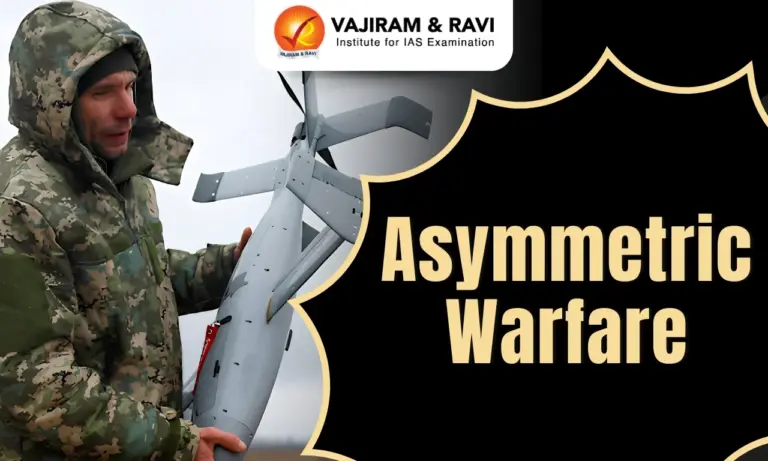
Asymmetric Warfare Latest News
- The recent conflict in southern Lebanon has highlighted the growing use of fibre-optic drones, which have proven difficult to counter despite advanced electronic warfare systems deployed by modern militaries.
Asymmetric Warfare
- Asymmetric warfare refers to a conflict in which opposing sides possess significantly different military capabilities, resources, or technologies.
- In such situations, the weaker side often relies on unconventional tactics and relatively inexpensive weapons to offset the advantages of a stronger adversary.
- Common features of asymmetric warfare include:
- Use of guerrilla tactics and irregular forces.
- Reliance on low-cost technologies.
- Exploitation of vulnerabilities in conventional military systems.
- Emphasis on mobility, surprise, and adaptability.
- In recent years, drones have become one of the most important tools of asymmetric warfare because they can inflict significant damage at a fraction of the cost of traditional military platforms.


Drone Warfare and Its Evolution
- The increasing availability of commercial drone technology has transformed modern battlefields. Initially, drones were primarily used for:
- Surveillance and reconnaissance
- Target acquisition
- Intelligence gathering
- Over time, they evolved into offensive platforms capable of carrying explosives, conducting precision strikes, and functioning as loitering munitions.
- The Russia-Ukraine conflict demonstrated how inexpensive drones could challenge tanks, artillery systems, and even advanced air defence networks. This has accelerated innovation in drone technology worldwide.
About Fibre-Optic Drones
- Fibre-optic drones are unmanned aerial vehicles connected directly to their operators through a fibre-optic cable rather than relying on radio-frequency (RF) communication or satellite navigation systems.
- The drone carries a spool containing a thin fibre-optic cable that unwinds during flight. Through this cable, data and control signals are exchanged between the drone and its operator in real time.
- Key characteristics include:
- High-speed data transmission
- Real-time video and operational feedback
- Reduced dependence on GPS and radio communications
- Ability to operate over distances reportedly ranging from 5 km to 30 km
- Since communication occurs through a physical cable, these drones emit virtually no radio signals, making them significantly harder to detect.
Advantages of Fibre-Optic Drones
- The growing popularity of fibre-optic drones stems from their ability to overcome many vulnerabilities associated with conventional drones.
- Resistance to Electronic Warfare
- Traditional drones depend on radio signals and GPS navigation. These signals can be:
- Jammed
- Spoofed
- Detected and tracked
- Fibre-optic drones avoid these vulnerabilities because communication occurs through the cable rather than radio transmissions.
- As a result, they are often described as “invisible drones” in electronic warfare environments.
- Traditional drones depend on radio signals and GPS navigation. These signals can be:
- Real-Time Control
- The fibre-optic link enables operators to receive continuous visual feedback and adjust the drone’s flight path with precision.
- This improves targeting accuracy and situational awareness during combat operations.
- Cost-Effectiveness
- Compared to advanced missile systems or sophisticated military aircraft, fibre-optic drones are relatively inexpensive while retaining significant offensive capabilities.
- This makes them attractive tools for non-state actors and smaller military forces engaged in asymmetric warfare.
Role in Recent Conflicts
- Russia-Ukraine War
- The Russia-Ukraine conflict has emerged as a major testing ground for drone warfare innovation.
- As both sides developed increasingly sophisticated electronic warfare systems, conventional drones became more vulnerable to jamming and interception. Fibre-optic drones emerged as a response to these challenges by providing a communication method that could not be disrupted through traditional electronic countermeasures.
- Southern Lebanon Conflict
- Recent fighting between Hezbollah and the Israel Defence Forces (IDF) has demonstrated the operational effectiveness of fibre-optic drones.
- Reports indicate that despite Israel’s advanced electronic warfare capabilities, these drones have successfully targeted military assets, including armoured vehicles and personnel.
- The conflict has highlighted the limitations of existing counter-drone systems when confronting drones that do not emit detectable radio signals.
Challenges in Detecting and Neutralising Fibre-Optic Drones
- The primary challenge arises from their limited electronic signature.
- Unlike conventional drones, fibre-optic drones cannot easily be detected through radio-frequency monitoring. Detection therefore, depends largely on:
- Radar systems
- Electro-optical sensors
- Infrared tracking systems
- However, identifying small, slow-moving, low-flying drones remains technically difficult.
- Counter-Drone Measures
- Advanced radar networks
- Directed-energy weapons
- Electromagnetic capture systems
- Kinetic interception systems (“hit-to-kill” technologies)
- Physical barriers such as protective nets and cages
- These solutions are often expensive and require multiple sensors and interception layers.
Limitations of Fibre-Optic Drones
- Strong winds and adverse weather conditions
- Heavy rainfall
- Physical obstacles such as trees, buildings, and terrain features
- Breakage of the fibre-optic cable during flight
- A snapped cable can immediately disrupt communication and render the drone ineffective
Implications for India
- India’s conflict with Pakistan in the aftermath of the Pahalgam terror attack highlighted the increasing role of drone swarms and loitering munitions in regional security challenges.
- The emergence of fibre-optic drones presents new operational concerns because traditional electronic jamming may prove ineffective against them.
- Experts suggest that India should focus on:
- Developing advanced radar and sensor systems
- Strengthening hard-kill counter-drone capabilities
- Integrating AI-enabled detection systems
- Enhancing mobile air defence networks
- Utilising platforms such as the Light Combat Helicopter (LCH) and Light Combat Aircraft (LCA) for counter-drone operations
- As drone technology continues to evolve, adapting defence strategies will become increasingly important for maintaining battlefield superiority.
Source: IE

 Last updated on Oct, 2026
→ UPSC 2027 Notification will be released on 13 January 2027 at upsconline.nic.in.
→ Asian Games 2026 are being held in Aichi-Nagoya, Japan, from 19 September to 4 October.
→ Check Nobel Prize 2026 Winners List here.
→ Download PIB PRiSM Monthly Magazine 2026 here.
→ Check UPSC Monthly Current Affairs Magazine The Recitals here.
→ Check out the latest UPSC Syllabus here.
→ Download UPSC Model Answers for Mains 2026
→ UPSC Mains Question Paper 2026 is out now for Essay & GS Paper 1, 2, 3 & 4.
→ UPSC Calendar 2027 has been released.
→ Enroll in Vajiram & Ravi’s UPSC Mains Test Series 2027 for structured answer writing practice, expert evaluation, and exam-oriented feedback.
→ Join Vajiram & Ravi’s UPSC Mentorship Program 2027 for personalized guidance, strategy planning, and one-to-one support from experienced mentors.
→ Go through the UPSC Mains Previous Year Papers to enhance your preparation.
→ UPSC has released UPSC Toppers List 2025 with the Civil Services final result on its official website.
→ Also check Best UPSC Coaching in India
Asymmetric Warfare FAQs
Q1. What are fibre-optic drones?+
Q2. Why are fibre-optic drones difficult to detect?+
Q3. What is asymmetric warfare?+
Q4. In which recent conflicts have fibre-optic drones gained prominence?+
Q5. Why are conventional jamming systems less effective against fibre-optic drones?+
Tags: asymmetric warfare mains articles upsc current affairs upsc mains current affairs