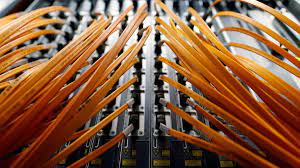
About Fibre Optic Cables
- Optical fibres are made of thin cylindrical strands of glass.
- The diameter of a typical fibre is close to the diameter of a human hair.
- These fibres can carry information, such as text, images, voices, videos, telephone calls, and anything that can be encoded as digital information, across large distances almost at the speed of light.
- They are strong, light, and flexible, and ideal to be buried underground, drawn underwater, or bent around a spool.
How do optical fibres work?
- These cables work basically on the principle of Total internal reflection.
- The signals encoded as electromagnetic waves can be fed into one end of an optical fibre and they will reflect and bounce many times between the glass walls as they traverse several kilometres bearing the information in the signals.
- A fibre optic communication system consists of three parts.
- A transmitter encodes information into optical signals (in the form of rapidly blinking light pulses of zeros and ones).
- An optical fibre carries the signal to its destination. There a receiver reproduces the information from the encoded signal.
- Optical waves allow a high data-transmission rate up to several terabits per second in a single fibre.
- Unlike radio or copper-cable-brd communication, fibre cables are also insensitive to external perturbations such as lightning and bad weather.


How are these fibres developed?
- Nowadays, glass fibres are manufactured using the fibre-drawing technique.
- First, a thick glass rod, called preform, of high purity and an engineered refractive index profile is prepared using chemical vapour decomposition.
- The preform is heated to about 1,600 degrees C until it melts and is then drawn into a thin, long fibre.
- The drawing process reduces the fibre’s diameter while maintaining its length. The drawn fibre is coated with a protective layer to enhance strength and durability.
Applications
- Fibre optics technology has since been widely used in telecommunication, medical science, laser technology, and sensing.
- Optical fibres are an essential part of this development in communication.
Q1) What is Total internal reflection (TIR)?
In physics TIR means a complete reflection of a ray of light within a medium such as water or glass from the surrounding surfaces back into the medium. The phenomenon occurs if the angle of incidence is greater than a certain limiting angle, called the critical angle.
Source: What are fibre optic cables and how do they work? | Explained

 Last updated on Oct, 2026
→ UPSC 2027 Notification will be released on 13 January 2027 at upsconline.nic.in.
→ Check Nobel Prize 2026 Winners List here.
→ Download PIB PRiSM Monthly Magazine 2026 here.
→ Check UPSC Monthly Current Affairs Magazine The Recitals here.
→ Check out the latest UPSC Syllabus here.
→ Download UPSC Model Answers for Mains 2026
→ UPSC Mains Question Paper 2026 is out now for Essay & GS Paper 1, 2, 3 & 4.
→ UPSC Calendar 2027 has been released.
→ Enroll in Vajiram & Ravi’s UPSC Mains Test Series 2027 for structured answer writing practice, expert evaluation, and exam-oriented feedback.
→ Join Vajiram & Ravi’s UPSC Mentorship Program 2027 for personalized guidance, strategy planning, and one-to-one support from experienced mentors.
→ Go through the UPSC Mains Previous Year Papers to enhance your preparation.
→ UPSC has released UPSC Toppers List 2025 with the Civil Services final result on its official website.
→ Also check Best UPSC Coaching in India