


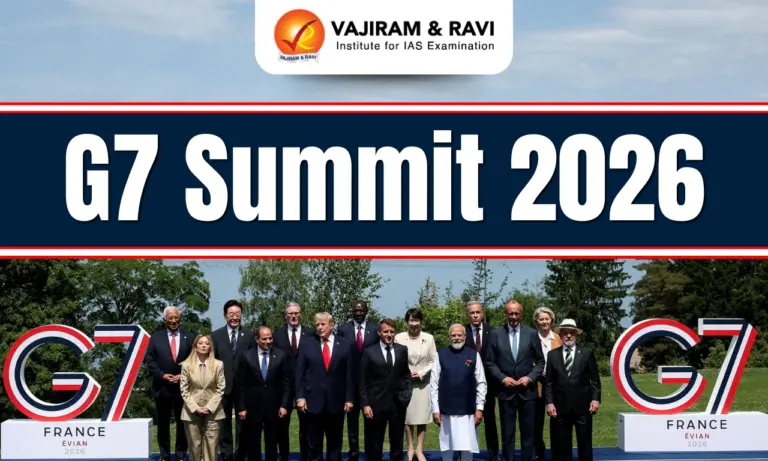
The 52nd G7 Summit was held from 15-17 June 2026 in Évian-les-Bains, France, under the presidency of France. The summit brought together leaders of the world’s most advanced economies to discuss pressing global challenges such as economic slowdown, artificial intelligence governance, climate change, energy security, geopolitical conflicts, debt distress in developing countries, and supply chain resilience. India participated as a special invitee and used the platform to highlight the concerns of the Global South.
G7 Summit 2026 Theme
The theme of the G7 Summit 2026, “Forging New Partnerships and Rebuilding International Solidarity,” reflects the need for greater cooperation among nations in addressing global challenges such as economic uncertainty, climate change, technological transformation, and geopolitical conflicts.
Major Agenda of G7 Summit 2026
The G7 Summit 2026 focused on addressing some of the most pressing global challenges facing the international community. Under France’s presidency, leaders discussed economic resilience, technological governance, international security, climate action, and development cooperation to promote global stability and sustainable growth.
Economic Security and Global Growth
Economic security remained a key priority as countries sought to strengthen resilience against global economic uncertainties and supply chain disruptions.
- Strengthening Global Supply Chains: Reducing overdependence on a few countries for critical goods and promoting diversified supply networks.
- Enhancing Economic Resilience: Developing strategies to protect economies from inflation, financial instability, and external shocks.
- Promoting Sustainable Growth: Encouraging investments in innovation, infrastructure, and green technologies.
- Trade Cooperation: Expanding fair and rules-based international trade while addressing protectionist tendencies.
- Critical Minerals Security: Securing access to essential minerals required for clean energy technologies and advanced manufacturing.
- Investment Protection: Strengthening frameworks for secure and transparent international investments.
- Reducing Economic Vulnerabilities: Building resilient production networks for semiconductors, pharmaceuticals, and strategic sectors.
- Supporting Developing Economies: Promoting inclusive economic growth and development financing.
Artificial Intelligence (AI) Governance
Artificial Intelligence emerged as one of the most important discussion areas due to its growing impact on economies, societies, and national security.
- Developing Ethical AI Frameworks: Ensuring AI systems operate responsibly and transparently.
- AI Safety Standards: Establishing international norms for safe deployment of advanced AI technologies.
- Combating Misinformation: Addressing the misuse of AI-generated content and deepfakes.
- Cybersecurity Protection: Strengthening defenses against AI-enabled cyber threats.
- Balancing Innovation and Regulation: Encouraging technological advancement while minimizing risks.
- International Cooperation: Promoting global collaboration in AI research and governance.
- Data Security and Privacy: Protecting personal and national data in the age of AI.
- Future Workforce Preparedness: Addressing employment challenges arising from automation and AI adoption.
Climate Change and Energy Transition
Climate action remained central to discussions as countries sought to accelerate the transition towards cleaner and more sustainable energy systems.
- Reducing Carbon Emissions: Advancing efforts to achieve climate goals under international agreements.
- Renewable Energy Expansion: Increasing investments in solar, wind, and other clean energy sources.
- Green Technology Development: Promoting innovation in sustainable technologies.
- Climate Financing: Supporting developing countries in climate adaptation and mitigation efforts.
- Energy Security: Ensuring stable and affordable energy supplies during the energy transition.
- Green Hydrogen Cooperation: Expanding partnerships in emerging clean fuel technologies.
- Sustainable Infrastructure: Encouraging environmentally friendly infrastructure development.
- Biodiversity Conservation: Protecting ecosystems and natural resources from environmental degradation.
International Security and Geopolitical Stability
Global security challenges and ongoing conflicts were major topics of discussion during the summit.
- Russia–Ukraine Conflict: Assessing its impact on global security, food supplies, and energy markets.
- West Asia Tensions: Discussing measures to prevent regional instability and escalation of conflicts.
- Maritime Security: Ensuring the safety of international sea lanes and trade routes.
- Counterterrorism Cooperation: Strengthening intelligence-sharing and joint security initiatives.
- Protection of Critical Infrastructure: Safeguarding digital and physical infrastructure from threats.
- Strategic Stability: Promoting peaceful conflict resolution through diplomacy and dialogue.
- Global Food Security: Addressing disruptions in agricultural exports caused by conflicts.
- Rules-Based International Order: Reinforcing respect for international law and sovereignty.
Development Cooperation and Global South Engagement
The summit emphasized creating more inclusive and equitable development partnerships with emerging and developing economies.
- Reforming Development Models: Moving beyond traditional donor-recipient relationships toward equal partnerships.
- Supporting the Global South: Addressing the priorities and concerns of developing countries.
- Debt Sustainability: Exploring solutions to debt crises faced by vulnerable nations.
- Infrastructure Development: Promoting investment in sustainable infrastructure projects.
- Capacity Building: Enhancing education, healthcare, and digital connectivity in developing regions.
- South-South Cooperation: Encouraging collaboration among developing countries.
- Inclusive Global Governance: Advocating greater representation of emerging economies in international institutions.
- Sustainable Development Goals (SDGs): Accelerating progress toward achieving global development targets.
Maritime Security and Trade Connectivity
Given rising geopolitical tensions and disruptions in key trade routes, maritime security received significant attention.
- Freedom of Navigation: Ensuring uninterrupted movement of commercial vessels.
- Protection of Global Trade Routes: Safeguarding strategic waterways such as the Strait of Hormuz.
- Supply Chain Stability: Preventing disruptions to global trade networks.
- Regional Cooperation: Strengthening maritime partnerships among nations.
- Blue Economy Development: Promoting sustainable use of ocean resources.
- Combating Maritime Threats: Addressing piracy, smuggling, and illegal activities at sea.
- Port Connectivity: Enhancing global logistics and transportation infrastructure.
- Energy Transportation Security: Protecting critical oil and gas shipping routes.
Global Trust and International Solidarity
A central theme of the summit was rebuilding trust among nations and strengthening international solidarity in an increasingly fragmented world.
- Promoting Multilateralism: Strengthening international cooperation through dialogue and consensus.
- Building Mutual Trust: Encouraging transparent and predictable international partnerships.
- Inclusive Decision-Making: Ensuring broader participation of developing countries in global discussions.
- Addressing Global Challenges Collectively: Tackling climate change, pandemics, and economic crises through coordinated action.
- Strengthening International Institutions: Supporting reforms to improve the effectiveness of global organizations.
- Reducing Geopolitical Divisions: Encouraging constructive engagement among nations with differing interests.
- Shared Responsibility: Promoting collective action in addressing transnational challenges.
- Rebuilding International Solidarity: Creating stronger partnerships for a stable, peaceful, and prosperous future.


India at the G7 Summit 2026
India participated in the 52nd G7 Summit held in Évian, France, from 15–17 June 2026 as an invited guest country. Prime Minister Narendra Modi attended the Outreach Session and several bilateral meetings, using the platform to advocate for the interests of the Global South, strengthen strategic partnerships, and promote a more inclusive framework of global governance.
India’s intervention at the Outreach Session centered on the need to rebuild trust, reform development cooperation, and ensure greater representation for developing countries in global decision-making.
Addressing the Global Trust Deficit
- India emphasized that mutual trust is the world’s most valuable strategic asset.
- Prime Minister Modi stated that many global crises stem from a shortage of trust rather than a shortage of resources.
- He called for strengthening confidence among nations to address global economic, security, and developmental challenges.
- India stressed that international cooperation must be based on transparency, reliability, and shared commitments.
Reforming the Development Paradigm
- India advocated moving beyond the traditional donor-recipient model of development.
- It called for partnerships based on equality, mutual respect, and shared responsibility.
- India emphasized that sustainable development can only be achieved through collaborative and inclusive approaches.
- The country highlighted the need for developing nations to become active partners rather than passive beneficiaries.
Amplifying the Voice of the Global South
- India reiterated that developing and middle-income countries seek equitable participation in global governance.
- It emphasized that the Global South requires a greater role in shaping international policies and institutions.
- India argued that developing nations seek fair representation, not merely financial assistance.
- The country positioned itself as a bridge between advanced economies and emerging nations.
Showcasing India–Africa Cooperation
- India highlighted its development partnership model with African nations.
- The cooperation focuses on capacity building, digital connectivity, healthcare, education, and infrastructure development.
- India presented its Africa engagement as a successful example of South-South Cooperation.
- The partnership is based on local priorities and mutual benefits rather than conditional assistance.
India’s Stand on Maritime Security
India expressed concern over disruptions in global trade routes and emphasized the need to protect international shipping lanes.
- Called for safe and secure sea routes.
- Highlighted the importance of protecting seafarers.
- Stressed uninterrupted maritime trade for global economic stability.
- Supported freedom of navigation in accordance with international law.
About G7 Summit
The G7 Summit (Group of Seven Summit) is an annual meeting of the world’s leading advanced economies that aims to discuss and coordinate responses to major global economic, political, security, technological, and environmental challenges. It serves as an important platform for international cooperation and policy coordination among developed democracies.
- Origin and Formation: The G7 was established in 1975 as the G6 during the global economic crisis and oil shocks of the 1970s. Its founding members were France, West Germany, Italy, Japan, the United Kingdom, and the United States.
- Formation of G7: In 1976, Canada joined the group, transforming it into the Group of Seven (G7).
- Expansion into G8: In 1998, Russia became a member, and the forum was renamed the G8 to encourage greater cooperation with Russia on global political and economic issues.
- Return to G7: Russia was suspended from the group in 2014 following its annexation of Crimea and concerns over Ukraine’s sovereignty, leading the forum to revert to the G7 format.
- Current G7 Members: The G7 currently consists of Canada, France, Germany, Italy, Japan, the United Kingdom, and the United States. The European Union also participates as a non-enumerated member.
- Informal Organization: The G7 is not a treaty-based institution and has no permanent secretariat, constitution, or headquarters. It operates through informal consultations and consensus-based decision-making.
- Rotating Presidency: The presidency rotates annually among member countries. The host nation is responsible for setting the summit agenda, organizing meetings, and hosting the leaders’ summit.
- Major Areas of Focus: The G7 discusses issues related to global economic governance, international security, trade, climate change, energy security, emerging technologies, artificial intelligence, and sustainable development.
- Economic Importance: Although G7 countries represent only about 10% of the world’s population, they account for approximately 43% of global nominal GDP, making the group highly influential in shaping international economic policies.
- Outreach and Guest Participation: To broaden representation, the host country invites emerging economies and international organizations to participate in Outreach Sessions. Countries such as India, Brazil, South Africa, South Korea, and Australia have frequently been invited to contribute to discussions on global challenges.

 Last updated on Oct, 2026
→ UPSC 2027 Notification will be released on 13 January 2027 at upsconline.nic.in.
→ Check Nobel Prize 2026 Winners List here.
→ Download PIB PRiSM Monthly Magazine 2026 here.
→ Check UPSC Monthly Current Affairs Magazine The Recitals here.
→ Check out the latest UPSC Syllabus here.
→ Download UPSC Model Answers for Mains 2026
→ UPSC Mains Question Paper 2026 is out now for Essay & GS Paper 1, 2, 3 & 4.
→ UPSC Calendar 2027 has been released.
→ Enroll in Vajiram & Ravi’s UPSC Mains Test Series 2027 for structured answer writing practice, expert evaluation, and exam-oriented feedback.
→ Join Vajiram & Ravi’s UPSC Mentorship Program 2027 for personalized guidance, strategy planning, and one-to-one support from experienced mentors.
→ Go through the UPSC Mains Previous Year Papers to enhance your preparation.
→ UPSC has released UPSC Toppers List 2025 with the Civil Services final result on its official website.
→ Also check Best UPSC Coaching in India
G7 Summit 2026 FAQs
Q1. What is the G7 Summit 2026?+
Q2. Where was the G7 Summit 2026 held?+
Q3. What was the theme of the G7 Summit 2026?+
Q4. Which countries are members of the G7?+
Q5. Is India a member of the G7?+
Q6. What was India's key message at the G7 Summit 2026?+
Tags: G7 summit 2026








