


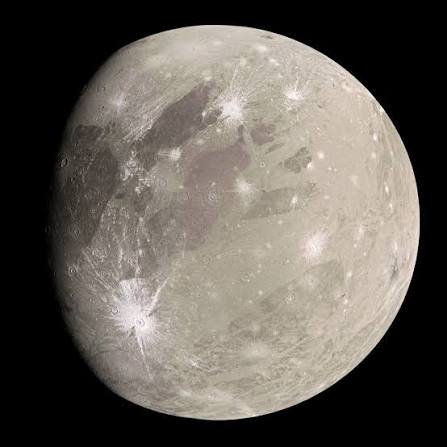
Ganymede Latest News
Magnetic and auroral evidence points to a vast ocean beneath Ganymede, but surface salts do not yet prove a direct connection through its roughly 150-kilometre ice shell.
About Ganymede
- It is the largest of Jupiter’s satellites and of all the satellites in the solar system.
- It is the only moon known to possess its own magnetic field.
- Discovered by Galileo Galilei in 1610, Ganymede’s name is derived from a figure in Roman mythology associated with the god Jupiter.
- It has a diameter of about 5,270 km, which makes it larger than the planet Mercury.
- It is situated about one million kilometers from Jupiter, exhibiting synchronous rotation, which means it always shows the same face to the planet.
- Ganymede’s relatively low density of 1.93 grams per cubic cm indicates that its composition is roughly half rock and half water ice by mass.
- Ganymede has a core of metallic iron, which is followed by a layer of rock that is topped off by a crust of mostly ice that is very thick.
- There are also a number of bumps on Ganymede’s surface, which may be rock formations.
- It is believed that Ganymede has a saltwater ocean below its surface.
- A thin atmosphere surrounds Ganymede, containing hydrogen and possibly other compounds like carbon dioxide.
- Ongoing exploration, including missions like the recently launched Jupiter Icy Moons Explorer (JUICE), aims to deepen our understanding of Ganymede’s geology, potential oceanic layers, and its role in the broader context of the solar system’s formation and evolution.
News: SD


 Last updated on Oct, 2026
→ UPSC 2027 Notification will be released on 13 January 2027 at upsconline.nic.in.
→ Check Nobel Prize 2026 Winners List here.
→ Download PIB PRiSM Monthly Magazine 2026 here.
→ Check UPSC Monthly Current Affairs Magazine The Recitals here.
→ Check out the latest UPSC Syllabus here.
→ Download UPSC Model Answers for Mains 2026
→ UPSC Mains Question Paper 2026 is out now for Essay & GS Paper 1, 2, 3 & 4.
→ UPSC Calendar 2027 has been released.
→ Enroll in Vajiram & Ravi’s UPSC Mains Test Series 2027 for structured answer writing practice, expert evaluation, and exam-oriented feedback.
→ Join Vajiram & Ravi’s UPSC Mentorship Program 2027 for personalized guidance, strategy planning, and one-to-one support from experienced mentors.
→ Go through the UPSC Mains Previous Year Papers to enhance your preparation.
→ UPSC has released UPSC Toppers List 2025 with the Civil Services final result on its official website.
→ Also check Best UPSC Coaching in India
Ganymede FAQs
Q1. What is Ganymede?+
Q2. What is unique about Ganymede among the moons of the Solar System?+
Q3. Who discovered Ganymede?+
Q4. What is the internal structure of Ganymede?+
Tags: ganymede prelims pointers upsc current affairs upsc prelims current affairs








