Garhwa Fort Latest News
The Central Bureau of Investigation (CBI) recently arrested the last remaining absconding accused in the 2002 Garhwa Fort idol theft, dacoity and murder case.
About Garhwa Fort
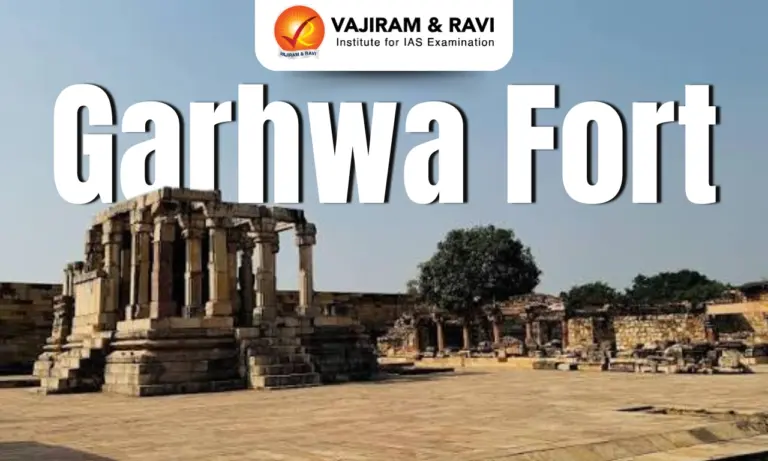
- Garhwa Fort is a Hindu temple complex located in Garhwa Village in the Prayagraj District of Uttar Pradesh.
- The fort was built in the year 1750, but the temples within the fort complex could be more than 1000 years old before the fort was constructed.
- The fort complex is protected as monuments of national importance by the central Archaeological Survey of India.


Garhwa Fort History
- The temple is believed to be built by the Guptas.
- Seven inscriptions from the reigns of Chandra Gupta, Kumara Gupta, and Skanda Gupta have been found at this site.
- Garhwa was called Bhattagram/Bhattapraya during the Gupta period.
- The fortifications around the temple were built in 1750 CE by the Baghel King Vikramaditya.
Garhwa Fort Architecture
- The fort complex spreads over a two-kilometer area.
- There are bastions on the four corners of the fort complex with easy access provided by a flight of steps.
- The most important structure in the fort complex is the Gupta-era temple. It is situated in southwestern part of the fort.
- The temple measures about 55 feet in length and 30 feet in width with an east entrance.
- The temple was built in the panchakona design. The temple consists of a sanctum and a pillared mandapa.
- The sanctum is square on plan. The Shiva Linga enshrined in the temple was stolen by the British, but the Sakthi Pita can be seen among the recovered artefacts within the complex.
- There are two stepwells in the complex. It is said that the stepwells never go dry.
- The temple has many relics dating from the Gupta period till the British era.
- The most notable relic in the complex is a sculpture representing the ten incarnations (dasavathara) of Lord Vishnu, belonging to the 11th or 12th century.
- Most of the sculptures have been shifted to the State Museum of Lucknow for safety reasons.
- The sculptures of the Gupta period were carved from pink sandstone, while the sculptures of the medieval era were carved from grey sandstone.
News: DP

 Last updated on Oct, 2026
→ UPSC 2027 Notification will be released on 13 January 2027 at upsconline.nic.in.
→ Check Nobel Prize 2026 Winners List here.
→ Download PIB PRiSM Monthly Magazine 2026 here.
→ Check UPSC Monthly Current Affairs Magazine The Recitals here.
→ Check out the latest UPSC Syllabus here.
→ Download UPSC Model Answers for Mains 2026
→ UPSC Mains Question Paper 2026 is out now for Essay & GS Paper 1, 2, 3 & 4.
→ UPSC Calendar 2027 has been released.
→ Enroll in Vajiram & Ravi’s UPSC Mains Test Series 2027 for structured answer writing practice, expert evaluation, and exam-oriented feedback.
→ Join Vajiram & Ravi’s UPSC Mentorship Program 2027 for personalized guidance, strategy planning, and one-to-one support from experienced mentors.
→ Go through the UPSC Mains Previous Year Papers to enhance your preparation.
→ UPSC has released UPSC Toppers List 2025 with the Civil Services final result on its official website.
→ Also check Best UPSC Coaching in India
Garhwa Fort FAQs
Q1. Where is Garhwa Fort located?+
Q2. What is Garhwa Fort primarily known for?+
Q3. Which dynasty is believed to have built the temple at Garhwa?+
Q4. Which is the most important structure within Garhwa Fort?+
Tags: garhwa fort prelims pointers upsc current affairs upsc prelims current affairs