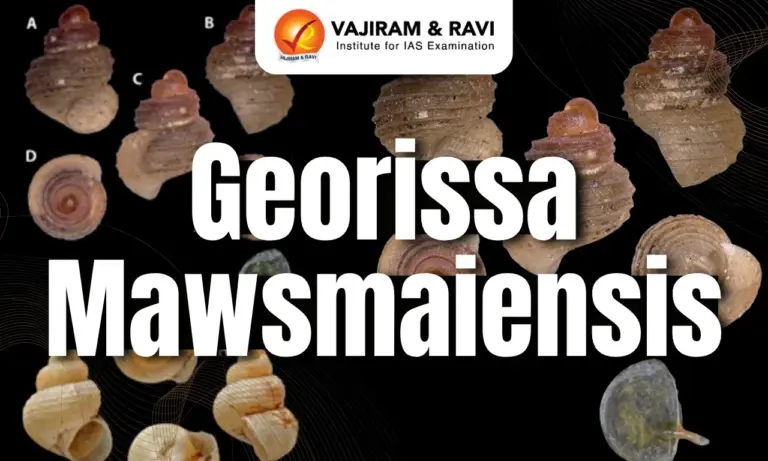
Georissa Mawsmaiensis is a newly identified micro snail species discovered in Mawsmai Cave in Meghalaya after a gap of about 170 years since the last Georissa record in India in 1851. This finding highlights the rich but underexplored biodiversity of limestone cave ecosystems. The species belongs to a genus widely distributed across Africa, Asia and the Pacific region, typically confined to karst landscapes and limestone based habitats.
Georissa Mawsmaiensis
Georissa Mawsmaiensis is a tiny cave dwelling snail with unique shell features discovered recently in Meghalaya’s limestone cave ecosystem.
- Discovery: It was discovered by researchers from ATREE, Bengaluru, marking the first Georissa discovery in India since 1851.
- Size: This species measures less than 2 millimetres in length.
- Morphological Features: It has four prominent spiral striations on shell whorls making it different from the Georissa sarrita which shows seven striations in apertural view.
- Habitat: It inhabits moist limestone surfaces in caves, thriving in calcium rich environments.
- Distribution: It belongs to the genus that is found across tropical forests and karst regions globally.
- Threats: Increasing tourism, artificial lighting and cemented cave pathways threaten its fragile microhabitat and other cave dependent fauna.
Mawsmai Cave
Mawsmai Cave is a limestone cave in Meghalaya known for biodiversity, fossils and unique geological formations formed by limestone dissolution processes. The term “Mawsmai” means “Oath Stone,” and locals call the cave “Krem.”
- Location: Located about 4 km from Cherrapunjee in East Khasi Hills.
- Physical Features: Situated at 1,195 metres altitude, the cave is influenced by streams of the Kynshi river and contains visible fossil formations on its walls.
- Biodiversity Importance: Around five cave snail species including Georissa Mawsmaiensis have been reported here. The region hosts nearly 1,700 identified caves while many are still unexplored scientifically.


 Last updated on Oct, 2026
→ UPSC 2027 Notification will be released on 13 January 2027 at upsconline.nic.in.
→ Check Nobel Prize 2026 Winners List here.
→ Download PIB PRiSM Monthly Magazine 2026 here.
→ Check UPSC Monthly Current Affairs Magazine The Recitals here.
→ Check out the latest UPSC Syllabus here.
→ Download UPSC Model Answers for Mains 2026
→ UPSC Mains Question Paper 2026 is out now for Essay & GS Paper 1, 2, 3 & 4.
→ UPSC Calendar 2027 has been released.
→ Enroll in Vajiram & Ravi’s UPSC Mains Test Series 2027 for structured answer writing practice, expert evaluation, and exam-oriented feedback.
→ Join Vajiram & Ravi’s UPSC Mentorship Program 2027 for personalized guidance, strategy planning, and one-to-one support from experienced mentors.
→ Go through the UPSC Mains Previous Year Papers to enhance your preparation.
→ UPSC has released UPSC Toppers List 2025 with the Civil Services final result on its official website.
→ Also check Best UPSC Coaching in India
Georissa Mawsmaiensis FAQs
Q1. What is Georissa Mawsmaiensis?+
Q2. Where was Georissa Mawsmaiensis discovered?+
Q3. What makes Georissa Mawsmaiensis unique?+
Q4. What are the threats to the Georissa Mawsmaiensis species?+
Q5. What type of habitat does Georissa Mawsmaiensis prefer?+
Tags: georissa mawsmaiensis invertebrate zoology