Geostationary Transfer Orbit (GTO) Latest News
ISRO’s Breakthrough in Semi-Cryogenic Engine Development for LVM3
Why in the News?
- ISRO has achieved a breakthrough in developing a semi-cryogenic engine (liquid oxygen/kerosene engine) with a high thrust of 2,000 kN (kilonewtons).
- The first successful hot test of the Engine Power Head Test Article (PHTA) was conducted at the ISRO Propulsion Complex, Mahendragiri, Tamil Nadu.
- This engine will be used in the semi-cryogenic booster stage of the Launch Vehicle Mark-3 (LVM3), enhancing India’s space launch capabilities.


About Geosynchronous Transfer Orbit (GTO)
What is a Transfer Orbit?
- A Transfer Orbit is used to move a satellite from one circular orbit to another in a fuel-efficient manner.
- The Hohmann Transfer Orbit is a commonly used maneuver for such transfers.
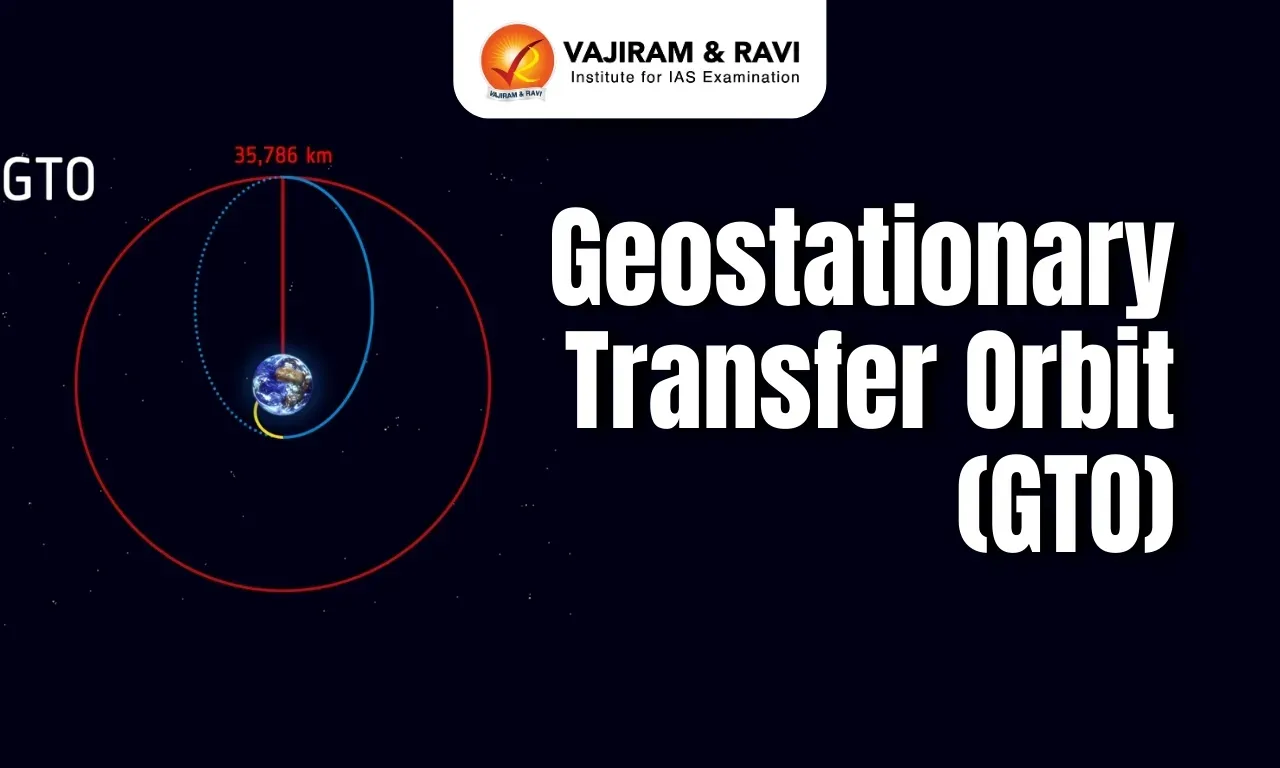
Geostationary Transfer Orbit (GTO)
- GTO is a highly elliptical orbit with:
- Perigee (closest point to Earth): 180-200 km above Earth’s surface.
- Apogee (farthest point from Earth): ~35,900 km (near geostationary orbit).
- Why is GTO Used?
- Satellites are first placed in GTO before they use their own propulsion system to move to a final geostationary orbit (GEO).
- This reduces the energy required from the launch vehicle, making it more fuel-efficient.
What is a Semi-Cryogenic Engine?
A semi-cryogenic engine is a type of liquid rocket engine that uses:
- Liquid Oxygen (LOX) as an oxidiser (cryogenic component).
- Refined kerosene (RP-1) as fuel (stored at ambient temperature).
Significance of ISRO’s Semi-Cryogenic Engine Development
- Engine power head test success: The hot test of the Power Head Test Article (PHTA) was conducted for 2.5 seconds to validate the ignition and boost strap mode operation.
- All engine parameters performed as expected.
- Developed by: Liquid Propulsion Systems Centre (LPSC) under ISRO.
- Upcoming plans: Further series of tests on PHTA before realizing the fully integrated engine.
- Replacement for Current LVM3 Core Stage:
- The SC120 stage (powered by SE2000 engine) will replace the existing L110 stage in LVM3.
- Payload capacity in Geosynchronous Transfer Orbit (GTO) to increase from 4 tonnes to 5 tonnes.
Cryogenic vs Semi-Cryogenic Engines
|
Feature |
Cryogenic Engine (LOX + LH2) |
Semi-Cryogenic Engine (LOX + Kerosene) |
|
Oxidizer used |
Liquid Oxygen (LOX) |
Liquid Oxygen (LOX) |
|
Fuel used |
Liquid Hydrogen (LH2) |
Refined Kerosene (RP-1) |
|
Storage |
Requires ultra-cold storage (-253°C) |
Can be stored at normal temperature |
|
Efficiency |
Lower density impulse |
Higher density impulse (more efficient thrust) |
|
Cost |
Expensive |
More cost-effective |
|
Handling |
Difficult to store and handle |
Easier to store and handle |
|
Used in |
Cryogenic Upper Stages of rockets |
Booster stages of heavy-lift launch vehicles |
Geostationary Transfer Orbit (GTO) FAQs
Q1: What is a Geosynchronous Transfer Orbit (GTO)?
Ans: GTO is an elliptical orbit used to transfer satellites from low Earth orbit (LEO) to a geostationary orbit (GEO) using a propulsion system.
Q2: What is the difference between GTO and GEO?
Ans: GTO is a temporary elliptical orbit, whereas GEO is a circular orbit where satellites remain fixed relative to Earth’s surface.
Q3: Why do rockets first place satellites in GTO instead of directly in GEO?
Ans: Direct placement in GEO requires more fuel; GTO allows satellites to use onboard propulsion to reach GEO efficiently.
Q4: What is the typical altitude range of GTO?
Ans: The perigee (closest point to Earth) is around 180-250 km, while the apogee (farthest point) is nearly 35,786 km.
Source: TH

 Last updated on Oct, 2026
→ UPSC 2027 Notification will be released on 13 January 2027 at upsconline.nic.in.
→ Asian Games 2026 are being held in Aichi-Nagoya, Japan, from 19 September to 4 October.
→ Check out the latest UPSC Syllabus here.
→ Download UPSC Model Answers for Mains 2026
→ UPSC Mains Question Paper 2026 is out now for Essay & GS Paper 1, 2, 3 & 4.
→ UPSC Calendar 2027 has been released.
→ Enroll in Vajiram & Ravi’s UPSC Mains Test Series 2027 for structured answer writing practice, expert evaluation, and exam-oriented feedback.
→ Join Vajiram & Ravi’s UPSC Mentorship Program 2027 for personalized guidance, strategy planning, and one-to-one support from experienced mentors.
→ Go through the UPSC Mains Previous Year Papers to enhance your preparation.
→ UPSC has released UPSC Toppers List 2025 with the Civil Services final result on its official website.
→ Download PIB PRiSM Monthly Magazine 2026 here.
→ Also check Best UPSC Coaching in India