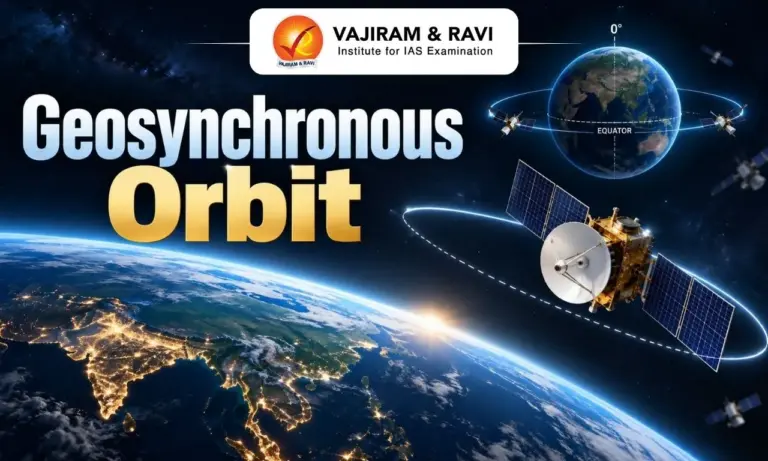
Geosynchronous Orbit is an Earth centered orbit in which a satellite completes one revolution in the same period as Earth’s rotation. Its orbital period is 23 hours, 56 minutes and 4 seconds, equal to one sidereal day. The orbit has a semi major axis of about height of 42,164 km from the centre of Earth.
Depending on its inclination and eccentricity, a satellite may appear to move across the sky while returning to the same position daily. Geosynchronous Orbit is important for communication, remote sensing and other satellite services.
What is a Geosynchronous Orbit?
Geosynchronous Orbit is a prograde, high Earth orbit that matches Earth’s rotational period. It is also known as the Clarke Orbit, after Arthur C. Clarke, who popularised its use for global communication. A circular geosynchronous orbit has an altitude of about 35,786 km above Earth’s surface.
Geosynchronous Orbit Features
The general features and important examples of the Geosynchronous Orbit are given below.
- Orbital Period: A satellite in Geosynchronous Orbit completes one revolution in 23 hours, 56 minutes and 4 seconds, matching one sidereal day.
- Geostationary Orbit: A geostationary orbit is a special type of geosynchronous orbit with zero eccentricity and zero inclination, keeping the satellite fixed above the equator.
- Tundra Orbit: A Tundra orbit is an eccentric geosynchronous orbit with an inclination of 63.4°, allowing prolonged coverage over high latitude regions.
- Satellite Movement: A geosynchronous satellite can appear to move north-south or east-west. Its ground track can form a figure eight pattern because of inclination and eccentricity.
- History: Herman Potočnik described the concept in 1929. Arthur C. Clarke popularised it in 1945 through his paper on extraterrestrial communication relays.
- First Functional Geosynchronous Satellite: Syncom 2, successfully placed in geosynchronous orbit in 1963, demonstrated practical satellite communication and relayed television transmissions.
- Applications: These orbits support communications, weather monitoring, remote sensing and broadcasting. Geostationary satellites allow fixed ground antennas to maintain continuous communication with the same satellite.


 Last updated on Oct, 2026
→ UPSC 2027 Notification will be released on 13 January 2027 at upsconline.nic.in.
→ Check Nobel Prize 2026 Winners List here.
→ Download PIB PRiSM Monthly Magazine 2026 here.
→ Check UPSC Monthly Current Affairs Magazine The Recitals here.
→ Check out the latest UPSC Syllabus here.
→ Download UPSC Model Answers for Mains 2026
→ UPSC Mains Question Paper 2026 is out now for Essay & GS Paper 1, 2, 3 & 4.
→ UPSC Calendar 2027 has been released.
→ Enroll in Vajiram & Ravi’s UPSC Mains Test Series 2027 for structured answer writing practice, expert evaluation, and exam-oriented feedback.
→ Join Vajiram & Ravi’s UPSC Mentorship Program 2027 for personalized guidance, strategy planning, and one-to-one support from experienced mentors.
→ Go through the UPSC Mains Previous Year Papers to enhance your preparation.
→ UPSC has released UPSC Toppers List 2025 with the Civil Services final result on its official website.
→ Also check Best UPSC Coaching in India
Geosynchronous Orbit FAQs
Q1. What is a Geosynchronous Orbit?+
Q2. What is the Height of a Geosynchronous Orbit?+
Q3. What is the difference between Geosynchronous and Geostationary Orbit?+
Q4. Why is Geosynchronous Orbit important?+
Q5. Why is Geosynchronous Orbit called the Clarke Orbit?+
Q6. What are the uses of Geosynchronous Orbit?+
Tags: geosynchronous geosynchronous orbit