Great Cormorant Latest News
A Hyderabad-born Canadian birder spotted a rare leucistic Great Cormorant at Ameenpur Lake near BHEL recently.
About Great Cormorant
- It is a large waterbird and a member of the cormorant family of seabirds.
- Scientific Name: Phalacrocorax carbo


Great Cormorant Habitat and Distribution
- They are probably the most widespread member of the cormorant family with a range that includes North America, Europe, Africa, China, India, Southeast Asia, New Zealand, Papua New Guinea and Australia.
- Well adapted to aquatic environments, they live in the shallow waters along marine shorelines but may inhabit lakes and rivers.
Great Cormorant Features
- It is the largest member of the cormorant family, reaching 35-40 inches in length with a wingspan of over five feet.
- Males are typically larger and heavier than females.
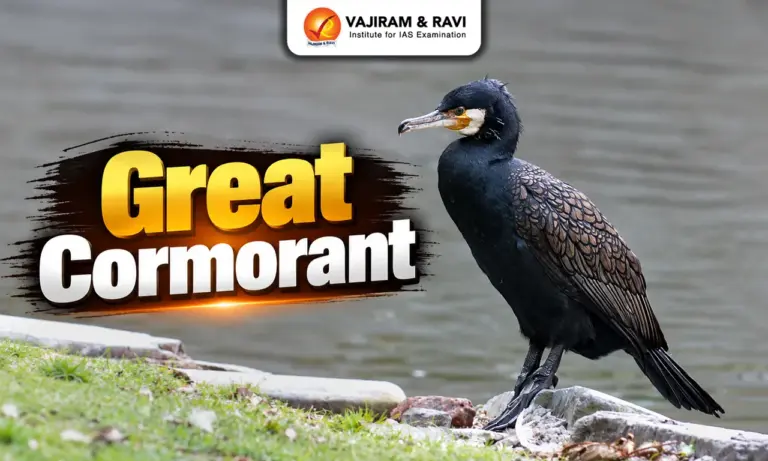
- They have dark, glossy plumage, very long necks, long, hooked bills and webbed feet.
- They have a longish tail and a yellow throat patch. Adults have white thigh patches in the breeding season.
- Their powerful bills are greyish with white patches around its base.
- They employ their powerful webbed feet for efficient swimming and diving to catch a variety of prey, including fish, crabs, and, in some areas, frogs or ducklings.
- Notably, the Great Cormorant has a unique fishing partnership with Asian fishermen, who train them to catch fish while preventing them from swallowing their catch using rings around their necks.
- Like other cormorants, their plumage has limited waterproofing. The birds spread their wings to dry when they leave the water after diving.
- These birds typically nest in small colonies, sometimes expanding to over 2,000 pairs.
Great Cormorant Conservation Status
It is classified as ‘Least Concern‘ under the IUCN Red List.
News: TT

 Last updated on Oct, 2026
→ UPSC 2027 Notification will be released on 13 January 2027 at upsconline.nic.in.
→ Check Nobel Prize 2026 Winners List here.
→ Download PIB PRiSM Monthly Magazine 2026 here.
→ Check UPSC Monthly Current Affairs Magazine The Recitals here.
→ Check out the latest UPSC Syllabus here.
→ Download UPSC Model Answers for Mains 2026
→ UPSC Mains Question Paper 2026 is out now for Essay & GS Paper 1, 2, 3 & 4.
→ UPSC Calendar 2027 has been released.
→ Enroll in Vajiram & Ravi’s UPSC Mains Test Series 2027 for structured answer writing practice, expert evaluation, and exam-oriented feedback.
→ Join Vajiram & Ravi’s UPSC Mentorship Program 2027 for personalized guidance, strategy planning, and one-to-one support from experienced mentors.
→ Go through the UPSC Mains Previous Year Papers to enhance your preparation.
→ UPSC has released UPSC Toppers List 2025 with the Civil Services final result on its official website.
→ Also check Best UPSC Coaching in India
Great Cormorant FAQs
Q1. What is the Great Cormorant?+
Q2. Where is the Great Cormorant distributed?+
Q3. What type of plumage does the Great Cormorant have?+
Q4. What are the major physical features of the Great Cormorant?+
Q5. What is the conservation status of the Great Cormorant according to the IUCN Red List?+
Tags: great cormorant prelims pointers upsc current affairs upsc prelims current affairs