


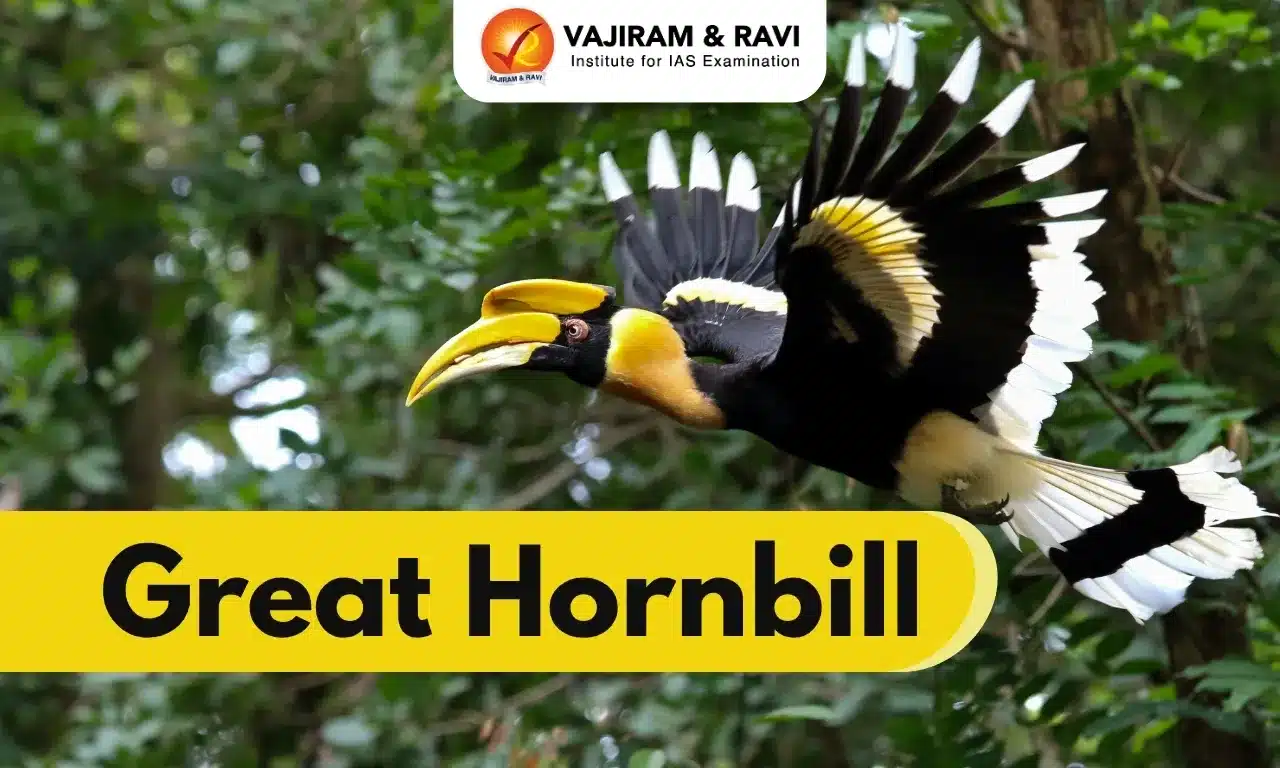
Great Hornbill Latest News
In a rare and remarkable sighting, the Malamuzhakki Vezhambal (Great Hornbill), Kerala’s State bird, was spotted in the coastal belt of Kakkampara, near Ezhimala in Kannur, an area far from its usual forested habitats.
About Great Hornbill
- The great hornbill, also known as the concave-casqued hornbill, great Indian hornbill, or great pied hornbill, is a large bird and one of the larger members of the hornbill family.
- Scientific Name: Buceros bicornis
- Distribution:
- It is found in the Indian subcontinent and Southeast Asia.
- In the subcontinent they are found in a few forest areas in the Western Ghats and in the forests along the Himalayas.
- Habitat: Great hornbills reside in wet evergreen and deciduous old-growth forests at elevations of 600 to 2000 meters (1968.5 to 6561 feet). For nesting, they prefer trees that tower above the canopy level.
- Features:
- They are fairly large, ranging from 95 to 120 cm in length and featuring a wingspan of 151 to 178 cm. On average, they weigh 3 kg.
- They are vividly colored and easily recognizable. The body, head, and wings are primarily black; the abdomen and neck are white. The tail is white and is crossed by a subterminal black band.
- A preen gland near the tail secretes tinted oil, which is spread across the feathers by the bird during grooming. This may give the bill, neck, casque, and tail and wing feathers coloration varying from yellow to red.
- The most recognizable feature of hornbills is the casque, which is a hollow structure located on top of the bill. It may be used by males to fight with other males and attract females.
- Like many other hornbills, these birds have prominent eyelashes.
- Males and females are similar except that the irises of males are red while those of females are white, and males have slightly larger bills and casques.
- It is predominantly frugivorous, but is an opportunist and will prey on small mammals, reptiles, and birds.
- Conservation Status:
- IUCN Red List: Vulnerable
Source: TH


 Last updated on Oct, 2026
→ UPSC 2027 Notification will be released on 13 January 2027 at upsconline.nic.in.
→ Check Nobel Prize 2026 Winners List here.
→ Download PIB PRiSM Monthly Magazine 2026 here.
→ Check UPSC Monthly Current Affairs Magazine The Recitals here.
→ Check out the latest UPSC Syllabus here.
→ Download UPSC Model Answers for Mains 2026
→ UPSC Mains Question Paper 2026 is out now for Essay & GS Paper 1, 2, 3 & 4.
→ UPSC Calendar 2027 has been released.
→ Enroll in Vajiram & Ravi’s UPSC Mains Test Series 2027 for structured answer writing practice, expert evaluation, and exam-oriented feedback.
→ Join Vajiram & Ravi’s UPSC Mentorship Program 2027 for personalized guidance, strategy planning, and one-to-one support from experienced mentors.
→ Go through the UPSC Mains Previous Year Papers to enhance your preparation.
→ UPSC has released UPSC Toppers List 2025 with the Civil Services final result on its official website.
→ Also check Best UPSC Coaching in India
Great Hornbill FAQs
Q1. Where is the Great Hornbill found in India?+
Q2. What is the IUCN Red List status of the Great Hornbill?+
Q3. What is the scientific name of the Great Hornbill?+
Q4. What type of forests does the Great Hornbill prefer for nesting?+
Tags: great hornbill








