What’s in Today’s Article?
- GST e-Invoicing Latest News
- GST E-Invoicing: Overview & Process
- Advantages of GST E-Invoicing
- New GST E-Invoicing Rules from April 1, 2025
- GST e-Invoicing FAQs
GST e-Invoicing Latest News
- The GST Council of India introduced e-invoicing (electronic invoicing) in a phased manner to standardize business-to-business (B2B) invoice reporting to the GST portal.
- There were no predefined formats. Hence, a uniform structure was developed in consultation with trade bodies and the Institute of Chartered Accountants of India.
- Over time, several modifications have been made to the e-invoicing regulations to enhance compliance and efficiency.


GST E-Invoicing: Overview & Process
- GST e-invoicing is a system where B2B and export invoices are reported to the Union Government’s e-invoice portal for validation.
- Each invoice receives a unique Invoice Reference Number (IRN).
- However, invoices are not generated by the government but are created by taxpayers in their own systems and then reported.
- The system enables seamless electronic data exchange through API integration.
Approval & Rollout
- Approved in the 37th GST Council meeting on September 20, 2019.
- Rolled out in a phased manner starting October 2020 for businesses with an Annual Aggregate Turnover (AATO) above ₹500 crore.
- Extended in January 2021 to businesses with AATO between ₹100 crore and ₹500 crore.
Documents Required for IRN Generation
- GST Invoices
- Credit Notes
- Debit Notes (for B2B supplies and exports)
Exempted Businesses
- Special Economic Zone (SEZ) units
- Insurance and banking sectors, including NBFCs
- Multiplex cinema admissions
- Goods transport agencies (road transport)
- Passenger transport services
E-Invoicing Process
- Taxpayers generate invoices using their own accounting/billing/ERP systems.
- The invoices are reported to the Invoice Registration Portal (IRP).
- The IRP validates the invoice and assigns a Unique Invoice Reference Number (IRN) along with a QR code.
- A GST invoice is legally valid only if it contains a valid IRN.
Advantages of GST E-Invoicing
- Automation & Efficiency
- Invoice details are auto-populated into GST return forms and e-way bills, reducing time and manual effort.
- Minimizes disputes and processing costs by ensuring digital storage of all forms.
- Improves payment cycles, enhancing overall business efficiency.
- Standardization & Interoperability
- Uses a digitally verifiable e-invoice format based on international standards (UBL/PEPPOL).
- Ensures machine readability and uniform interpretation across different platforms.
- Allows taxpayers to seamlessly switch between different portals.
- Fraud Prevention & Compliance
- Reduces fraudulent transactions by providing real-time access to data for tax authorities.
- Helps in curbing tax evasion and malpractice, leading to greater transparency.
New GST E-Invoicing Rules from April 1, 2025
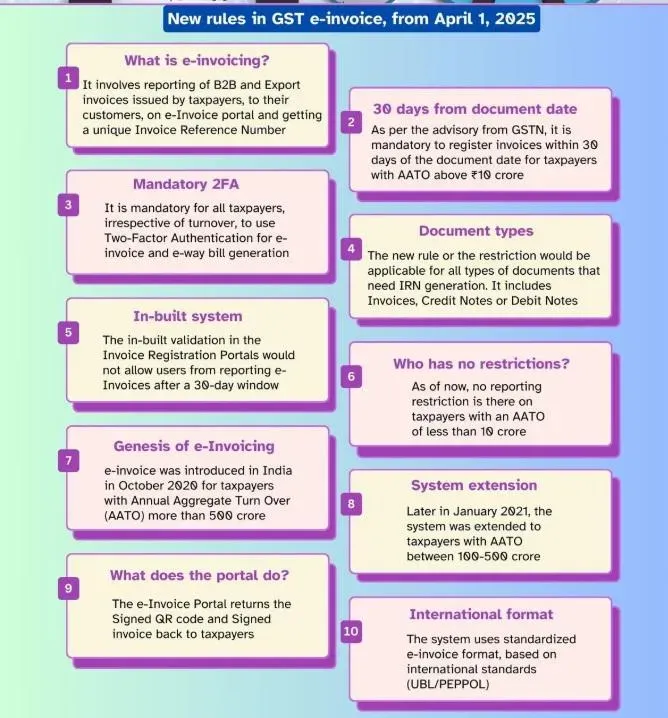
- Mandatory 30-Day Deadline for E-Invoice Reporting
- Businesses with an Annual Aggregate Turnover (AATO) of ₹10 crore and above must report e-invoices to the Invoice Registration Portal (IRP) within 30 days of issuance.
- Earlier, this rule applied only to businesses with AATO above ₹100 crore.
- With the lower turnover threshold, many more businesses must now comply with this rule.
- Stricter Compliance & Penalties
- Currently, businesses delay invoice uploads, causing discrepancies in Input Tax Credit (ITC) claims.
- From April 1, IRPs will block invoice uploads beyond 30 days, rejecting late submissions.
- Non-compliance may lead to penalties and financial consequences.
- Compulsory Two-Factor Authentication (2FA)
- From April 1, all taxpayers, regardless of turnover, must use Two-Factor Authentication (2FA) for e-invoice and e-way bill generation.
GST e-Invoicing FAQs
Q1. What is GST e-invoicing?
Ans. GST e-invoicing is an electronic system for reporting B2B and export invoices to the government’s Invoice Registration Portal (IRP).
Q2. How does GST e-invoicing work?
Ans. Businesses generate invoices, upload them to IRP, get a unique Invoice Reference Number (IRN), and use it for compliance.
Q3. What are the benefits of GST e-invoicing?
Ans. It automates compliance, prevents tax fraud, reduces errors, and integrates invoices with GST returns and e-way bills.
Q4. What changes in GST e-invoicing from April 1, 2025?
Ans. Businesses with ₹10 crore+ turnover must report invoices within 30 days, and Two-Factor Authentication (2FA) is mandatory.
Q5. Who is exempt from GST e-invoicing?
Ans. SEZ units, banks, NBFCs, passenger transport services, and goods transport agencies are exempt.

 Last updated on Oct, 2026
→ UPSC 2027 Notification will be released on 13 January 2027 at upsconline.nic.in.
→ Check Nobel Prize 2026 Winners List here.
→ Download PIB PRiSM Monthly Magazine 2026 here.
→ Check UPSC Monthly Current Affairs Magazine The Recitals here.
→ Check out the latest UPSC Syllabus here.
→ Download UPSC Model Answers for Mains 2026
→ UPSC Mains Question Paper 2026 is out now for Essay & GS Paper 1, 2, 3 & 4.
→ UPSC Calendar 2027 has been released.
→ Enroll in Vajiram & Ravi’s UPSC Mains Test Series 2027 for structured answer writing practice, expert evaluation, and exam-oriented feedback.
→ Join Vajiram & Ravi’s UPSC Mentorship Program 2027 for personalized guidance, strategy planning, and one-to-one support from experienced mentors.
→ Go through the UPSC Mains Previous Year Papers to enhance your preparation.
→ UPSC has released UPSC Toppers List 2025 with the Civil Services final result on its official website.
→ Also check Best UPSC Coaching in India