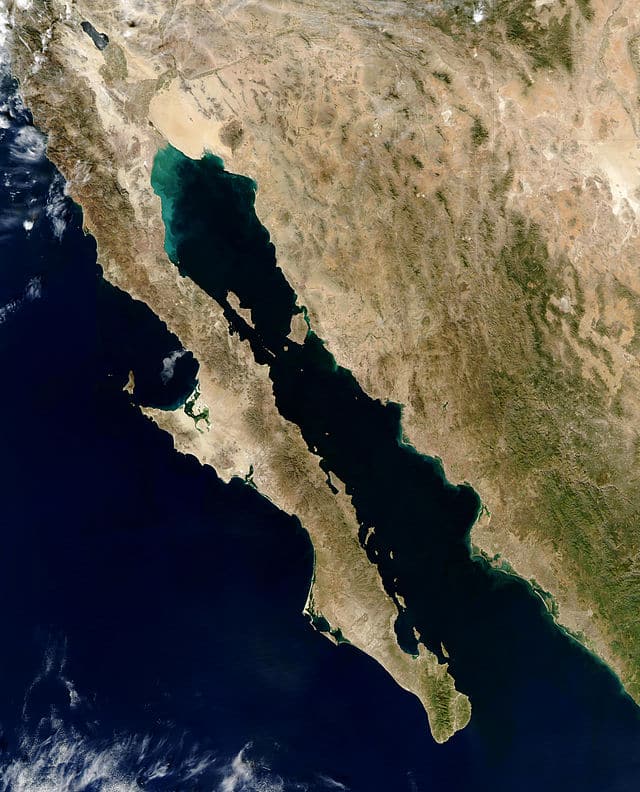
About Gulf of California:
- The Gulf of California, also called the Sea of Cortez is a large inlet of the eastern Pacific Ocean along the northwestern coast of Mexico.
- It separates the mountainous Lower California Peninsula/Baja California Peninsula in the west from the states of Sonora and Sinaloa on the mainland of Mexico in the east.
- Geography:
- It covers an area of 160,000 sq. km and has a long coastline of approximately 4,000km.
- It is about 1,126km long and has a maximum width ranging between 48 to 241km.
- The Gulf is divided into two portions and is separated by a narrowing that is marked by the islands of Tiburón and Angel de la Guarda.
- The northern portion is relatively shallow, with a mean depth of 180m, while the southern portion contains many depressions and the deepest of these depressions reaches a maximum depth of over 3,000m.
- The head of the gulf is dominated by the large Colorado River Delta through which the Colorado River drains into the Gulf.
- The long coastline of the gulf is extremely irregular and forms numerous small bays.
- Geology: The Gulf of California was created around 5.3 million years ago due to the movement of tectonic plates that separated the Baja California Peninsula from the North American Plate.
- Islands:
- There are about 37 major islands in the Gulf of California that is mostly located on its western side.
- It is believed that these islands were created due to volcanic eruptions and several of these islands are home to volcanoes.
- Some of the major islands include the Isla Ángel de la Guarda, Isla Tiburón, Islas Marías, Isla Partida, Islas San Francisco, Isla Coronados, etc.
- Climate: Due to the presence of an uninterrupted chain of mountains on the Baja California Peninsula, the Gulf of California experiences a ‘continental’ climate rather than an ‘oceanic’ climate.
Q1) What is a Gulf?
The Gulf is a portion of the sea that is almost surrounded by land except one narrow opening. Gulfs are formed when a giant rock collapses or when a piece of land sinks. This causes a big indentation in the area, and the water eventually fills it up. Gulfs are also formed through a natural process of erosion.
Source: Earthquake of magnitude 6.4 jolts Gulf of California, no damage reported


 Last updated on Oct, 2026
→ UPSC 2027 Notification will be released on 13 January 2027 at upsconline.nic.in.
→ Check Nobel Prize 2026 Winners List here.
→ Download PIB PRiSM Monthly Magazine 2026 here.
→ Check UPSC Monthly Current Affairs Magazine The Recitals here.
→ Check out the latest UPSC Syllabus here.
→ Download UPSC Model Answers for Mains 2026
→ UPSC Mains Question Paper 2026 is out now for Essay & GS Paper 1, 2, 3 & 4.
→ UPSC Calendar 2027 has been released.
→ Enroll in Vajiram & Ravi’s UPSC Mains Test Series 2027 for structured answer writing practice, expert evaluation, and exam-oriented feedback.
→ Join Vajiram & Ravi’s UPSC Mentorship Program 2027 for personalized guidance, strategy planning, and one-to-one support from experienced mentors.
→ Go through the UPSC Mains Previous Year Papers to enhance your preparation.
→ UPSC has released UPSC Toppers List 2025 with the Civil Services final result on its official website.
→ Also check Best UPSC Coaching in India