About Guyana:
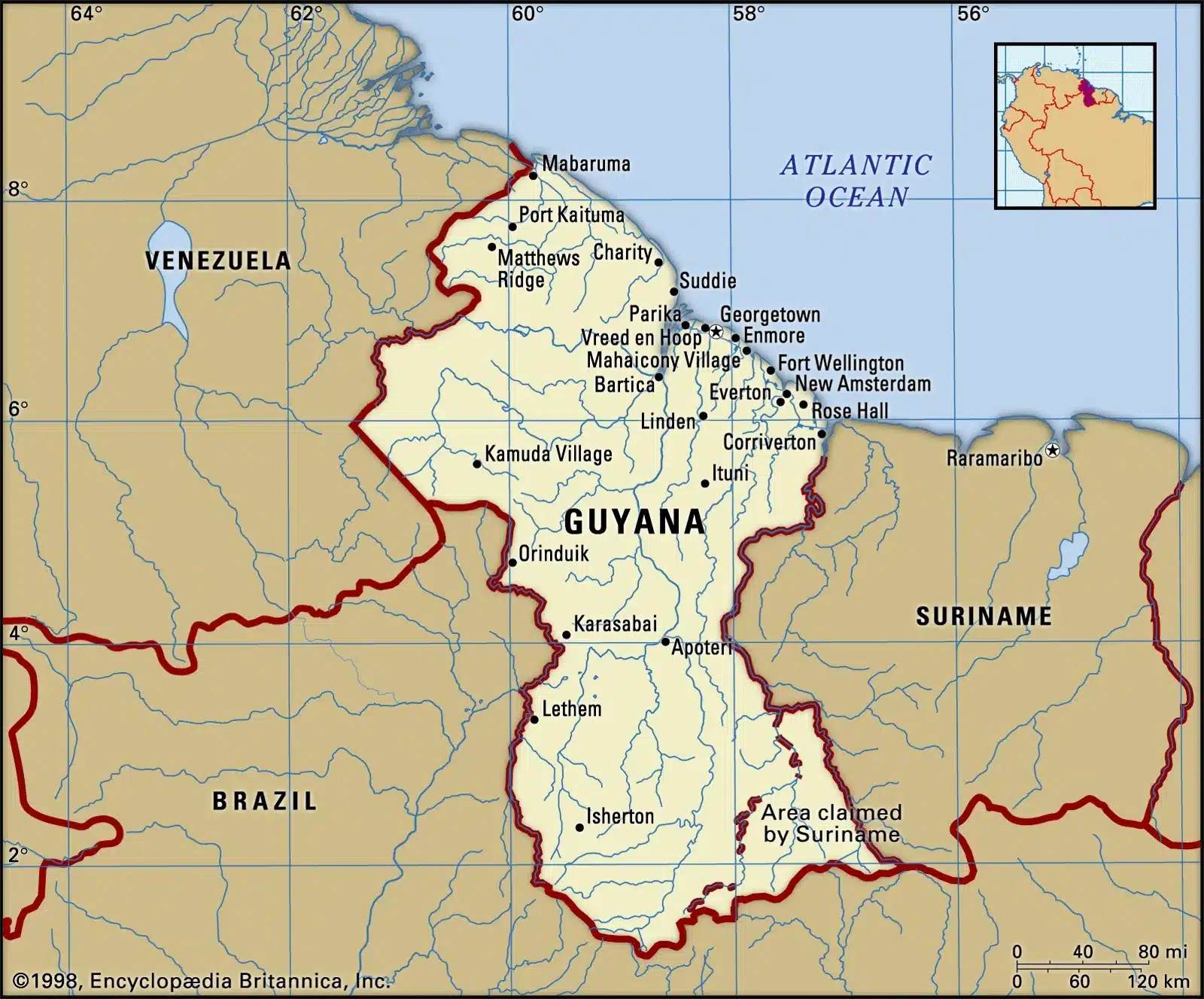
- It is a country located in the northeastern corner of South America.
- Borders:
- It is bordered by the Atlantic Ocean to the north, by Suriname (along the Courantyne River) to the east, by Brazil to the south and southwest, and by Venezuela to the west.
- It shares its maritime borders with Barbados and Trinidad and Tobago.
- Although geographically situated in South America, the country is culturally and historically connected to the Caribbean and is a founding member of the Caribbean Community (CARICOM).
- History:
- Indigenous peoples inhabited Guyana prior to European settlement, and their name for the land, guiana (“land of water”), gave the country its name.
- Originally a Dutch colony in the 17th century, by 1815 Guyana had become a British possession.
- Guyana achieved independence from the UK in 1966.
- Present-day Guyana reflects its British and Dutch colonial past and its reactions to that past.
- Guyana is involved in territorial disputes with both Suriname and Venezuela that are legacies of colonial rule.
- It is the only English-speaking country of South America.
- The capital and chief port of Guyana is Georgetown.
- Population:
- Guyana’s populace is mainly of colonial origin, although Indians are scattered throughout the forested interior.
- The more numerous coastal peoples are chiefly descendants of slaves from Africa and indentured workers from India, who were originally transported to work the coastal sugarcane plantations.
- It has been a member of the Commonwealth since 1970.
- Form of Government: Unitary multiparty republic with one legislative house (National Assembly).
- Currency: Guyanese dollar (G$)
- Rivers: The Essequibo River remains the largest in the nation. The Berbice, Courantyne, and Demerara are also important waterways for Guyana.
- The country is endowed with fertile agricultural lands, valuable mineral resources (including bauxite and gold), extensive tropical forests that cover 80 percent of the country, and recently discovered large offshore oil and gas (O&G) reserves.
Q1: What is the Caribbean Community (CARICOM)?
CARICOM, which stands for Caribbean Community, is the oldest surviving integration movement in the developing world. It is an organization of Caribbean countries and dependencies originally established as the Caribbean Community and Commons Market in 1973 by the Treaty of Chaguaramas. It has 15 members; Antigua and Barbuda, The Bahamas, Barbados, Belize, Dominica, Grenada, Guyana, Haiti, Jamaica, Montserrat, Saint Kitts and Nevis, Saint Lucia, Saint Vincent and the Grenadines, Suriname, and Trinidad and Tobago.
News: India’s prime minister meets with Caribbean leaders in Guyana with security in mind


 Last updated on Oct, 2026
→ UPSC 2027 Notification will be released on 13 January 2027 at upsconline.nic.in.
→ Check Nobel Prize 2026 Winners List here.
→ Download PIB PRiSM Monthly Magazine 2026 here.
→ Check UPSC Monthly Current Affairs Magazine The Recitals here.
→ Check out the latest UPSC Syllabus here.
→ Download UPSC Model Answers for Mains 2026
→ UPSC Mains Question Paper 2026 is out now for Essay & GS Paper 1, 2, 3 & 4.
→ UPSC Calendar 2027 has been released.
→ Enroll in Vajiram & Ravi’s UPSC Mains Test Series 2027 for structured answer writing practice, expert evaluation, and exam-oriented feedback.
→ Join Vajiram & Ravi’s UPSC Mentorship Program 2027 for personalized guidance, strategy planning, and one-to-one support from experienced mentors.
→ Go through the UPSC Mains Previous Year Papers to enhance your preparation.
→ UPSC has released UPSC Toppers List 2025 with the Civil Services final result on its official website.
→ Also check Best UPSC Coaching in India