


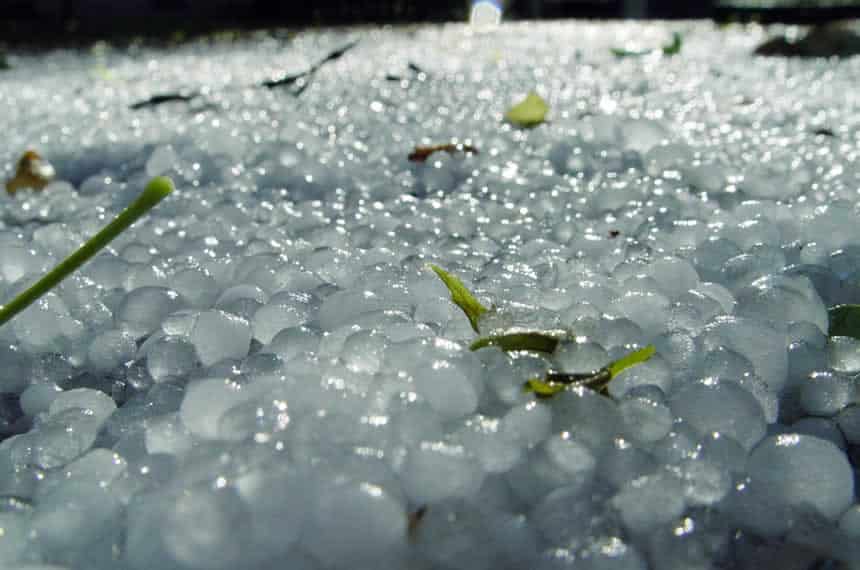
About Hailstorm:
- Hail is a type of solid rain made up of balls or lumps of ice.
- Storms that produce hail that reaches the ground are known as hailstorms.
- They typically last for no more than 15 minutes but can cause injuries to people and damage buildings, vehicles, and crops.
- They are most common in the midlatitudes.
- Hailstorms can sometimes be accompanied by other severe weather events, such as cyclones and tornadoes.
- Size: The size of hailstones can vary widely, from small pellets less than 1/4 inch in diameter to larger stones measuring several inches in size.
- Conditions for Hailstorms to occur:
- Highly developed Cumulonimbus clouds need to be present. These are the massive anvil or mushroom-shaped clouds that are seen during thunderstorms, which can reach heights of up to 65,000 feet.
- There must be strong currents of air ascending through these clouds. These currents are commonly known as updrafts.
- The clouds will need to contain high concentrations of supercooled liquid water.
- How are Hails formed?
- It begins as a water droplet that is swept up by an updraft inside of a thundercloud.
- Other supercooled water droplets which are already present inside the cloud will adhere to the water droplet’s surface, forming layers of ice around it.
- As the water droplet reaches higher elevations within the cloud, it comes into contact with more and more supercooled particles.
- The hail embryo will grow larger and larger as it reaches higher altitudes in the updraft.
- Finally, it will reach a size and weight where gravity will begin to act on it and pull it down.
- Large hailstones are often characterized by alternating layers of clear and opaque ice, caused by irregular rates of freezing.
Q1) What is a Tropical cyclone?
A tropical cyclone is a rapid rotating storm originating over tropical oceans from where it draws the energy to develop. It has a low pressure centre and clouds spiraling towards the eyewall surrounding the “eye”, the central part of the system where the weather is normally calm and free of clouds. Its diameter is typically around 200 to 500 km, but can reach 1000 km. A tropical cyclone brings very violent winds, torrential rain, high waves and, in some cases, very destructive storm surges and coastal flooding.
Source: Hailstorm in Kulgam, Shopian damages harvest-ready apple


 Last updated on Oct, 2026
→ UPSC 2027 Notification will be released on 13 January 2027 at upsconline.nic.in.
→ Check Nobel Prize 2026 Winners List here.
→ Download PIB PRiSM Monthly Magazine 2026 here.
→ Check UPSC Monthly Current Affairs Magazine The Recitals here.
→ Check out the latest UPSC Syllabus here.
→ Download UPSC Model Answers for Mains 2026
→ UPSC Mains Question Paper 2026 is out now for Essay & GS Paper 1, 2, 3 & 4.
→ UPSC Calendar 2027 has been released.
→ Enroll in Vajiram & Ravi’s UPSC Mains Test Series 2027 for structured answer writing practice, expert evaluation, and exam-oriented feedback.
→ Join Vajiram & Ravi’s UPSC Mentorship Program 2027 for personalized guidance, strategy planning, and one-to-one support from experienced mentors.
→ Go through the UPSC Mains Previous Year Papers to enhance your preparation.
→ UPSC has released UPSC Toppers List 2025 with the Civil Services final result on its official website.
→ Also check Best UPSC Coaching in India








