About Hayflick limit:
- It refers to the maximum number of times a cell can divide.
- It’s named after scientist Leonard Hayflick, who discovered this phenomenon.
- The limit plays a crucial role in aging and the development of age-related diseases.
- Hayflick found that cells go through three phases.
- The first is rapid, healthy cell division.
- In the second phase, mitosis slows. In the third stage, senescence, cells stop dividing entirely.
- They remain alive for a time after they stop dividing, but sometime after cellular division ends, cells do a particularly disturbing thing: Essentially, they commit suicide.
- Once a cell reaches the end of its life span, it undergoes a programmed cellular death called apoptosis.
- Hayflick’s discovery got further weight after researchers in the 1970s discovered telomeres.
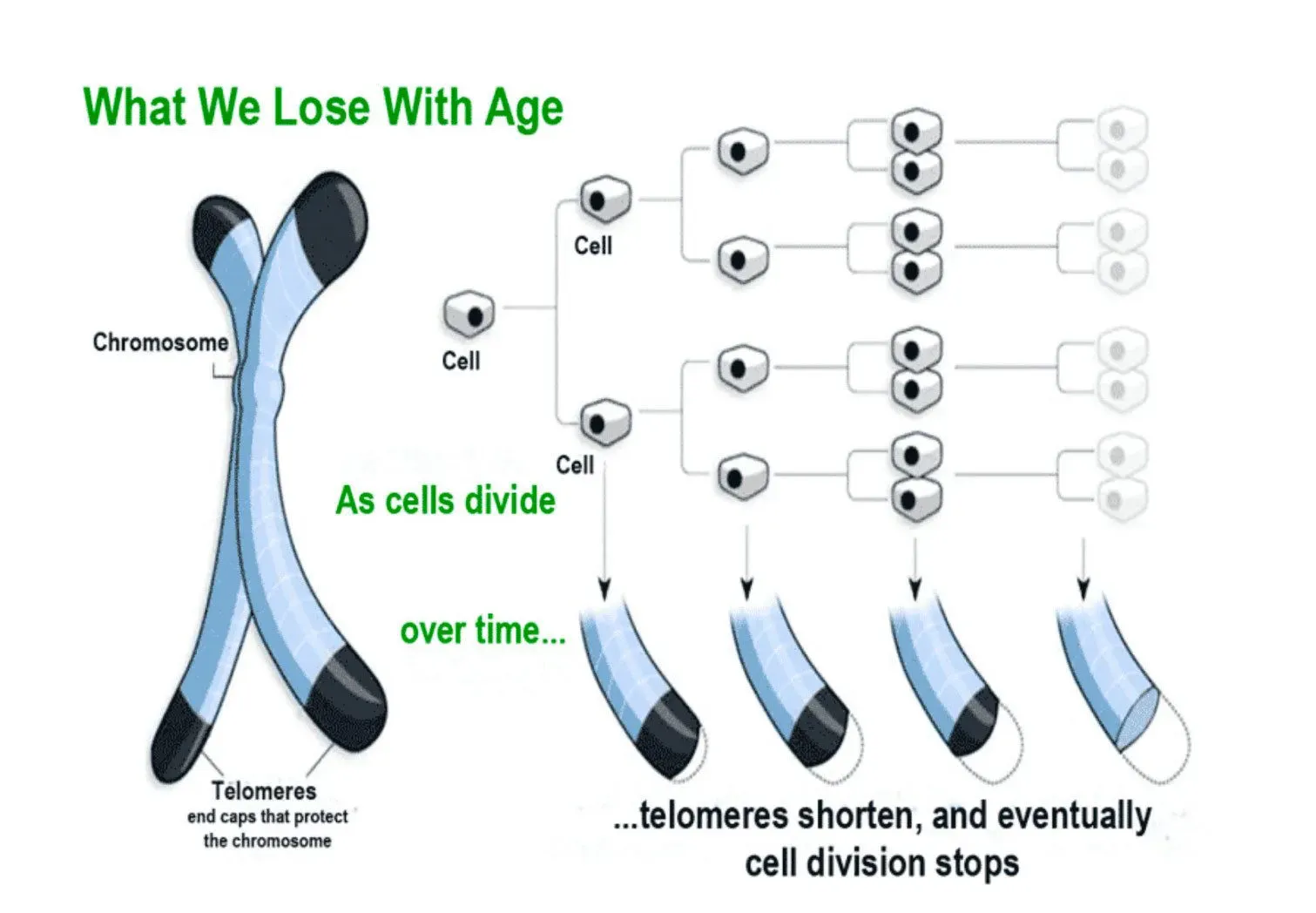
- Telomeres are repetitive DNA sequences at the very end of these strands, meant to protect the chromosome.
- Crucially, with each cell division, these telomeres get slightly shorter. Eventually, the telomere loss reaches a critical point at which cell division ends.
- That said, while shortening telomeres is related to aging, the exact relationship between telomere length and lifespan remains unclear.
Q1: What is Mitosis?
It is the process by which a cell replicates its chromosomes and then segregates them, producing two identical nuclei in preparation for cell division. Mitosis is generally followed by equal division of the cell’s content into two daughter cells that have identical genomes.
Source: Hayflick limit: Why immortality remains out of humans’ reach


 Last updated on Oct, 2026
→ UPSC 2027 Notification will be released on 13 January 2027 at upsconline.nic.in.
→ Asian Games 2026 are being held in Aichi-Nagoya, Japan, from 19 September to 4 October.
→ Check Nobel Prize 2026 Winners List here.
→ Download PIB PRiSM Monthly Magazine 2026 here.
→ Check UPSC Monthly Current Affairs Magazine The Recitals here.
→ Check out the latest UPSC Syllabus here.
→ Download UPSC Model Answers for Mains 2026
→ UPSC Mains Question Paper 2026 is out now for Essay & GS Paper 1, 2, 3 & 4.
→ UPSC Calendar 2027 has been released.
→ Enroll in Vajiram & Ravi’s UPSC Mains Test Series 2027 for structured answer writing practice, expert evaluation, and exam-oriented feedback.
→ Join Vajiram & Ravi’s UPSC Mentorship Program 2027 for personalized guidance, strategy planning, and one-to-one support from experienced mentors.
→ Go through the UPSC Mains Previous Year Papers to enhance your preparation.
→ UPSC has released UPSC Toppers List 2025 with the Civil Services final result on its official website.
→ Also check Best UPSC Coaching in India